
期刊文章
过刊浏览
- Volumes 108-119 (2025)
-
Volumes 96-107 (2025)
-
Volume 107
Pages 1-376 (December 2025)
-
Volume 106
Pages 1-336 (November 2025)
-
Volume 105
Pages 1-356 (October 2025)
-
Volume 104
Pages 1-332 (September 2025)
-
Volume 103
Pages 1-314 (August 2025)
-
Volume 102
Pages 1-276 (July 2025)
-
Volume 101
Pages 1-166 (June 2025)
-
Volume 100
Pages 1-256 (May 2025)
-
Volume 99
Pages 1-242 (April 2025)
-
Volume 98
Pages 1-288 (March 2025)
-
Volume 97
Pages 1-256 (February 2025)
-
Volume 96
Pages 1-340 (January 2025)
-
Volume 107
-
Volumes 84-95 (2024)
-
Volume 95
Pages 1-392 (December 2024)
-
Volume 94
Pages 1-400 (November 2024)
-
Volume 93
Pages 1-376 (October 2024)
-
Volume 92
Pages 1-316 (September 2024)
-
Volume 91
Pages 1-378 (August 2024)
-
Volume 90
Pages 1-580 (July 2024)
-
Volume 89
Pages 1-278 (June 2024)
-
Volume 88
Pages 1-350 (May 2024)
-
Volume 87
Pages 1-338 (April 2024)
-
Volume 86
Pages 1-312 (March 2024)
-
Volume 85
Pages 1-334 (February 2024)
-
Volume 84
Pages 1-308 (January 2024)
-
Volume 95
-
Volumes 72-83 (2023)
-
Volume 83
Pages 1-258 (December 2023)
-
Volume 82
Pages 1-204 (November 2023)
-
Volume 81
Pages 1-188 (October 2023)
-
Volume 80
Pages 1-202 (September 2023)
-
Volume 79
Pages 1-172 (August 2023)
-
Volume 78
Pages 1-146 (July 2023)
-
Volume 77
Pages 1-152 (June 2023)
-
Volume 76
Pages 1-176 (May 2023)
-
Volume 75
Pages 1-228 (April 2023)
-
Volume 74
Pages 1-200 (March 2023)
-
Volume 73
Pages 1-138 (February 2023)
-
Volume 72
Pages 1-144 (January 2023)
-
Volume 83
-
Volumes 60-71 (2022)
-
Volume 71
Pages 1-108 (December 2022)
-
Volume 70
Pages 1-106 (November 2022)
-
Volume 69
Pages 1-122 (October 2022)
-
Volume 68
Pages 1-124 (September 2022)
-
Volume 67
Pages 1-102 (August 2022)
-
Volume 66
Pages 1-112 (July 2022)
-
Volume 65
Pages 1-138 (June 2022)
-
Volume 64
Pages 1-186 (May 2022)
-
Volume 63
Pages 1-124 (April 2022)
-
Volume 62
Pages 1-104 (March 2022)
-
Volume 61
Pages 1-120 (February 2022)
-
Volume 60
Pages 1-124 (January 2022)
-
Volume 71
- Volumes 54-59 (2021)
- Volumes 48-53 (2020)
- Volumes 42-47 (2019)
- Volumes 36-41 (2018)
- Volumes 30-35 (2017)
- Volumes 24-29 (2016)
- Volumes 18-23 (2015)
- Volumes 12-17 (2014)
- Volume 11 (2013)
- Volume 10 (2012)
- Volume 9 (2011)
- Volume 8 (2010)
- Volume 7 (2009)
- Volume 6 (2008)
- Volume 5 (2007)
- Volume 4 (2006)
- Volume 3 (2005)
- Volume 2 (2004)
- Volume 1 (2003)
Volume 113
Mu, X., Zhu, J., An, X., Zhou, Z., & Zhang, H. (2026). Numerical investigation on the influence of packing structure of rigid cylindrical particles on frictional characteristics. Particuology, 113, 52-62. https://doi.org/https://doi.org/10.1016/j.partic.2026.03.022
Numerical investigation on the influence of packing structure of rigid cylindrical particles on frictional characteristics
Xiwen Mu a b, Jingjing Zhu a b, Xizhong An b, Zongyan Zhou c, Hao Zhang a b *
a Engineering Research Center of Frontier Technologies for Low-carbon Steelmaking (Ministry of Education), Northeastern University, Shenyang, 110819, China
b School of Metallurgy, Northeastern University, Shenyang, 110819, China
c Jiangxi Provincial Key Laboratory of Particle Technology, Jiangxi University of Science and Technology, Nanchang, 330013, China
10.1016/j.partic.2026.03.022
Volume 113,
June 2026,
Pages 52-62
Received 10 October 2025, Revised 27 February 2026, Accepted 10 March 2026, Available online 26 March 2026, Version of Record 31 March 2026.
E-mail:
zhangh@mail.neu.edu.cn
Highlights
• Effects of particle packing structure on friction characteristics investigated.
• Particles scale information adopted to explain the mechanisms.
• Correlations established to predict friction of cylindrical particles.
Abstract
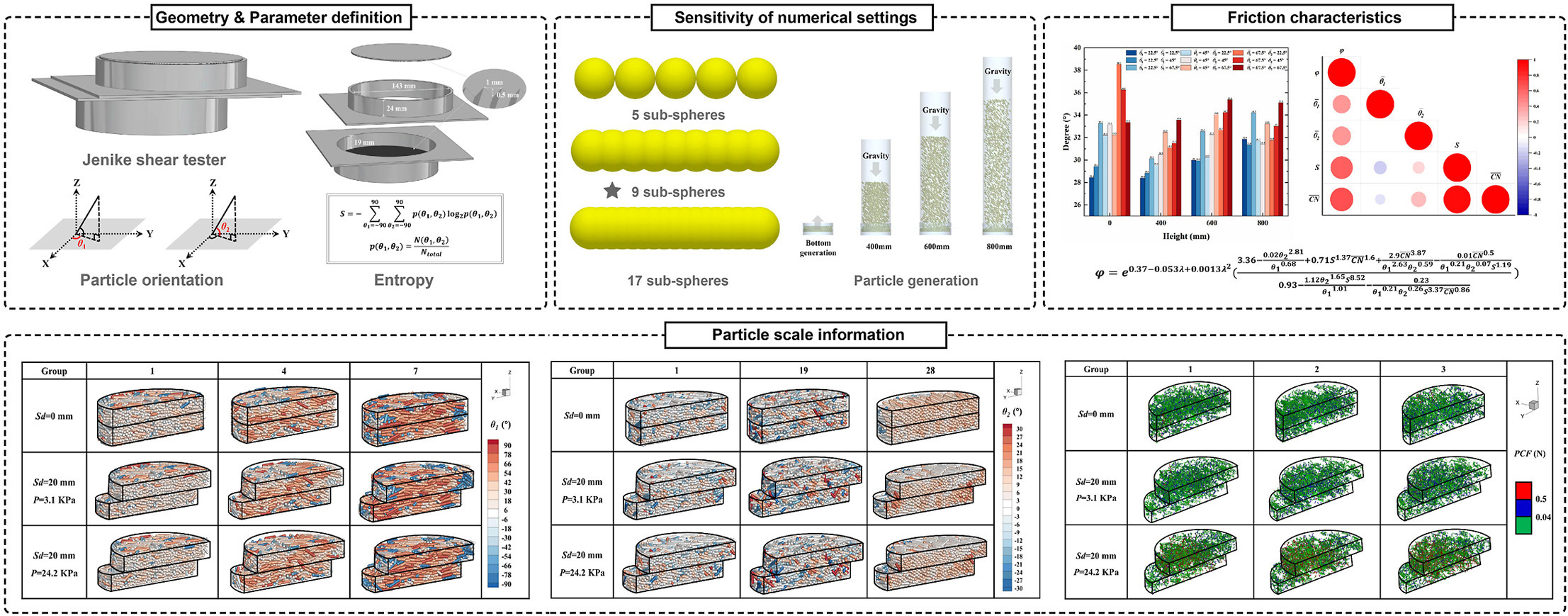
This study uses the Discrete Element Method (DEM) to simulate the Jenike shear test of different packing structures formed by rigid cylindrical particles with an aspect ratio of 5. The effects of the mean in-plane orientation of the particle axis relative to the direction normal to shearing, the mean out-of-plane inclination angle relative to the shear plane, the normalized Shannon entropy that characterizes structural disorder, and the average coordination number on frictional behavior are investigated. The results indicate that a larger out-of-plane inclination angle promotes jamming, thereby restricting particles motion. A larger in-plane orientation angle facilitates the development of out-of-plane inclination during shearing. Both the peak shear strength and internal friction angle increase with these two angles. Greater structural disorder and a higher average coordination number also enhance the shear stress of the particle system by forming more stable and dense packing structures. For systems whose normalized Shannon entropy is not lower than 0.656, a predictive correlation for the internal friction angle is established with considering the influence of the packing structure.
Graphical abstract
Keywords
DEM; Packing structure; Cylindrical particle; Friction characteristic
文章导读