
期刊文章
过刊浏览
- Volumes 108-119 (2025)
-
Volumes 96-107 (2025)
-
Volume 107
Pages 1-376 (December 2025)
-
Volume 106
Pages 1-336 (November 2025)
-
Volume 105
Pages 1-356 (October 2025)
-
Volume 104
Pages 1-332 (September 2025)
-
Volume 103
Pages 1-314 (August 2025)
-
Volume 102
Pages 1-276 (July 2025)
-
Volume 101
Pages 1-166 (June 2025)
-
Volume 100
Pages 1-256 (May 2025)
-
Volume 99
Pages 1-242 (April 2025)
-
Volume 98
Pages 1-288 (March 2025)
-
Volume 97
Pages 1-256 (February 2025)
-
Volume 96
Pages 1-340 (January 2025)
-
Volume 107
-
Volumes 84-95 (2024)
-
Volume 95
Pages 1-392 (December 2024)
-
Volume 94
Pages 1-400 (November 2024)
-
Volume 93
Pages 1-376 (October 2024)
-
Volume 92
Pages 1-316 (September 2024)
-
Volume 91
Pages 1-378 (August 2024)
-
Volume 90
Pages 1-580 (July 2024)
-
Volume 89
Pages 1-278 (June 2024)
-
Volume 88
Pages 1-350 (May 2024)
-
Volume 87
Pages 1-338 (April 2024)
-
Volume 86
Pages 1-312 (March 2024)
-
Volume 85
Pages 1-334 (February 2024)
-
Volume 84
Pages 1-308 (January 2024)
-
Volume 95
-
Volumes 72-83 (2023)
-
Volume 83
Pages 1-258 (December 2023)
-
Volume 82
Pages 1-204 (November 2023)
-
Volume 81
Pages 1-188 (October 2023)
-
Volume 80
Pages 1-202 (September 2023)
-
Volume 79
Pages 1-172 (August 2023)
-
Volume 78
Pages 1-146 (July 2023)
-
Volume 77
Pages 1-152 (June 2023)
-
Volume 76
Pages 1-176 (May 2023)
-
Volume 75
Pages 1-228 (April 2023)
-
Volume 74
Pages 1-200 (March 2023)
-
Volume 73
Pages 1-138 (February 2023)
-
Volume 72
Pages 1-144 (January 2023)
-
Volume 83
-
Volumes 60-71 (2022)
-
Volume 71
Pages 1-108 (December 2022)
-
Volume 70
Pages 1-106 (November 2022)
-
Volume 69
Pages 1-122 (October 2022)
-
Volume 68
Pages 1-124 (September 2022)
-
Volume 67
Pages 1-102 (August 2022)
-
Volume 66
Pages 1-112 (July 2022)
-
Volume 65
Pages 1-138 (June 2022)
-
Volume 64
Pages 1-186 (May 2022)
-
Volume 63
Pages 1-124 (April 2022)
-
Volume 62
Pages 1-104 (March 2022)
-
Volume 61
Pages 1-120 (February 2022)
-
Volume 60
Pages 1-124 (January 2022)
-
Volume 71
- Volumes 54-59 (2021)
- Volumes 48-53 (2020)
- Volumes 42-47 (2019)
- Volumes 36-41 (2018)
- Volumes 30-35 (2017)
- Volumes 24-29 (2016)
- Volumes 18-23 (2015)
- Volumes 12-17 (2014)
- Volume 11 (2013)
- Volume 10 (2012)
- Volume 9 (2011)
- Volume 8 (2010)
- Volume 7 (2009)
- Volume 6 (2008)
- Volume 5 (2007)
- Volume 4 (2006)
- Volume 3 (2005)
- Volume 2 (2004)
- Volume 1 (2003)
Volume 113
Zhou, F., Chen, X., Zhou, H., & Liu, P. (2026). Interface design and reinforcement mechanisms in carbon nanotube reinforced copper matrix composites for mechanical, electrical and thermal conductivity properties: A review. Particuology, 113, 63-87. https://doi.org/10.1016/j.partic.2026.03.016
Interface design and reinforcement mechanisms in carbon nanotube reinforced copper matrix composites for mechanical, electrical and thermal conductivity properties: A review
Fanfan Zhou, Xiaohong Chen *, Honglei Zhou, Ping Liu
School of Materials and Chemistry, University of Shanghai for Science and Technology, Shanghai, 200093, China
10.1016/j.partic.2026.03.016
Volume 113,
June 2026,
Pages 63-87
Received 28 January 2026, Revised 1 March 2026, Accepted 15 March 2026, Available online 25 March 2026, Version of Record 31 March 2026.
E-mail:
cxh10761112@163.com
Highlights
• Summarizes CNTs dispersion strategies and evaluates their effectiveness.
• Analyzes CNTs/Cu interface designs and explains their effects on bonding strength.
• Outlines multiscale reinforcement mechanisms and clarifies CNTs reinforcing roles.
• Highlights future directions and challenges for high performance Cu composites.
Abstract
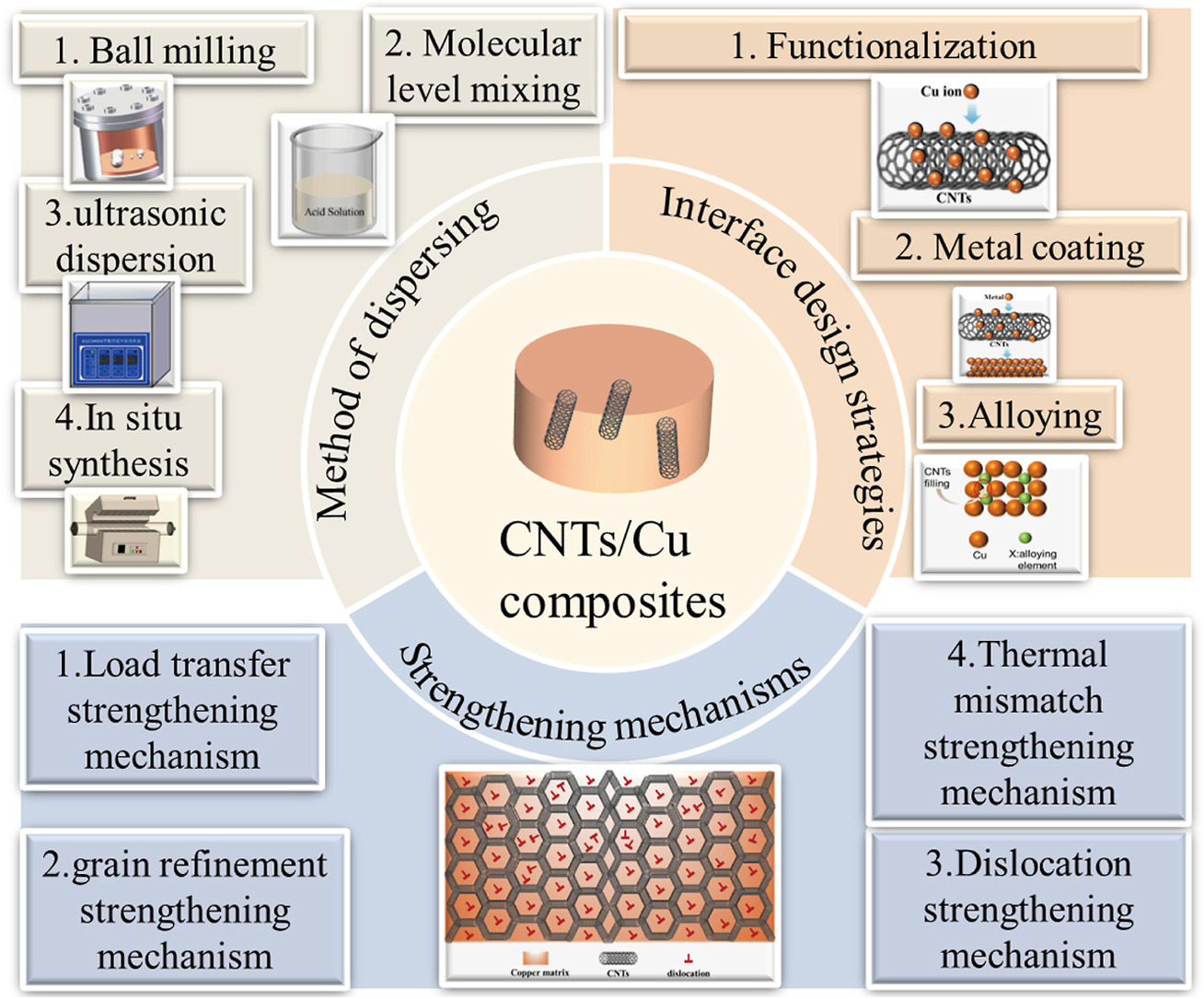
Recently, carbon nanotubes (CNTs)-reinforced copper (Cu) matrix (CNTs/Cu) composites have attracted significant research interest due to their excellent properties and potential applications. These studies focus on interfacial design and reinforcement mechanisms, as interface bonding is crucial for composite performance. However, CNTs tend to agglomerate and have poor wettability with Cu, leading to weak mechanical bonding at the interface. This weak bonding limits load transfer and electron conduction, reducing the performance of composites. To achieve high-performance CNTs/Cu composites, it is crucial to design the interface structure and consider its impact on composite properties. This paper reviews recent progress on CNTs dispersion methods and interface design in CNTs/Cu composites, with a focus on interface bonding mechanisms and their effect on performance. First, it introduces CNTs dispersion techniques and their impact on interface design. Then, it explores different interface modification strategies and their influence on interface strength and overall performance. Additionally, the paper reviews how interface design affects the mechanical, electrical and thermal properties of composites and four reinforcement mechanisms that enhance performance. Finally, the paper summarizes current technical challenges and future research directions, providing insights into interface design for CNTs/Cu composites and useful references for interface engineering of CNTs with other metals.
Graphical abstract
Keywords
CNTs/Cu composites; Dispersion methods; Interface design; Reinforcement mechanisms
文章导读