
期刊文章
过刊浏览
- Volumes 108-119 (2025)
-
Volumes 96-107 (2025)
-
Volume 107
Pages 1-376 (December 2025)
-
Volume 106
Pages 1-336 (November 2025)
-
Volume 105
Pages 1-356 (October 2025)
-
Volume 104
Pages 1-332 (September 2025)
-
Volume 103
Pages 1-314 (August 2025)
-
Volume 102
Pages 1-276 (July 2025)
-
Volume 101
Pages 1-166 (June 2025)
-
Volume 100
Pages 1-256 (May 2025)
-
Volume 99
Pages 1-242 (April 2025)
-
Volume 98
Pages 1-288 (March 2025)
-
Volume 97
Pages 1-256 (February 2025)
-
Volume 96
Pages 1-340 (January 2025)
-
Volume 107
-
Volumes 84-95 (2024)
-
Volume 95
Pages 1-392 (December 2024)
-
Volume 94
Pages 1-400 (November 2024)
-
Volume 93
Pages 1-376 (October 2024)
-
Volume 92
Pages 1-316 (September 2024)
-
Volume 91
Pages 1-378 (August 2024)
-
Volume 90
Pages 1-580 (July 2024)
-
Volume 89
Pages 1-278 (June 2024)
-
Volume 88
Pages 1-350 (May 2024)
-
Volume 87
Pages 1-338 (April 2024)
-
Volume 86
Pages 1-312 (March 2024)
-
Volume 85
Pages 1-334 (February 2024)
-
Volume 84
Pages 1-308 (January 2024)
-
Volume 95
-
Volumes 72-83 (2023)
-
Volume 83
Pages 1-258 (December 2023)
-
Volume 82
Pages 1-204 (November 2023)
-
Volume 81
Pages 1-188 (October 2023)
-
Volume 80
Pages 1-202 (September 2023)
-
Volume 79
Pages 1-172 (August 2023)
-
Volume 78
Pages 1-146 (July 2023)
-
Volume 77
Pages 1-152 (June 2023)
-
Volume 76
Pages 1-176 (May 2023)
-
Volume 75
Pages 1-228 (April 2023)
-
Volume 74
Pages 1-200 (March 2023)
-
Volume 73
Pages 1-138 (February 2023)
-
Volume 72
Pages 1-144 (January 2023)
-
Volume 83
-
Volumes 60-71 (2022)
-
Volume 71
Pages 1-108 (December 2022)
-
Volume 70
Pages 1-106 (November 2022)
-
Volume 69
Pages 1-122 (October 2022)
-
Volume 68
Pages 1-124 (September 2022)
-
Volume 67
Pages 1-102 (August 2022)
-
Volume 66
Pages 1-112 (July 2022)
-
Volume 65
Pages 1-138 (June 2022)
-
Volume 64
Pages 1-186 (May 2022)
-
Volume 63
Pages 1-124 (April 2022)
-
Volume 62
Pages 1-104 (March 2022)
-
Volume 61
Pages 1-120 (February 2022)
-
Volume 60
Pages 1-124 (January 2022)
-
Volume 71
- Volumes 54-59 (2021)
- Volumes 48-53 (2020)
- Volumes 42-47 (2019)
- Volumes 36-41 (2018)
- Volumes 30-35 (2017)
- Volumes 24-29 (2016)
- Volumes 18-23 (2015)
- Volumes 12-17 (2014)
- Volume 11 (2013)
- Volume 10 (2012)
- Volume 9 (2011)
- Volume 8 (2010)
- Volume 7 (2009)
- Volume 6 (2008)
- Volume 5 (2007)
- Volume 4 (2006)
- Volume 3 (2005)
- Volume 2 (2004)
- Volume 1 (2003)
Volume 113
Wang, C., Liu, Y., Zhang, J., & Li, S. (2026). Comparative study of bubble segmentation methods for image analysis in hydrogen-based fluidized beds. Particuology, 113, 88-101. https://doi.org/10.1016/j.partic.2026.03.014
Comparative study of bubble segmentation methods for image analysis in hydrogen-based fluidized beds
Chuanhao Wang, Yuchen Liu, Jiehan Zhang, Shiyuan Li *
School of Energy and Environmental Engineering, University of Science and Technology Beijing, Beijing, 100083, China
10.1016/j.partic.2026.03.014
Volume 113,
June 2026,
Pages 88-101
Received 13 July 2025, Revised 27 February 2026, Accepted 4 March 2026, Available online 25 March 2026, Version of Record 1 April 2026.
E-mail:
lishiyuan@ustb.edu.cn
Highlights
• DeepLabV3+ framework is developed for simultaneous gas–solid phase segmentation in iron ore powder fluidization.
• Segmentation accuracy and efficiency of DeepLabV3+ with different backbone networks are systematically evaluated.
• The method is compared with threshold-based approaches and the SAM3 foundation model.
• Fluidization behaviors of different particles under various conditions are analyzed using the proposed method.
Abstract
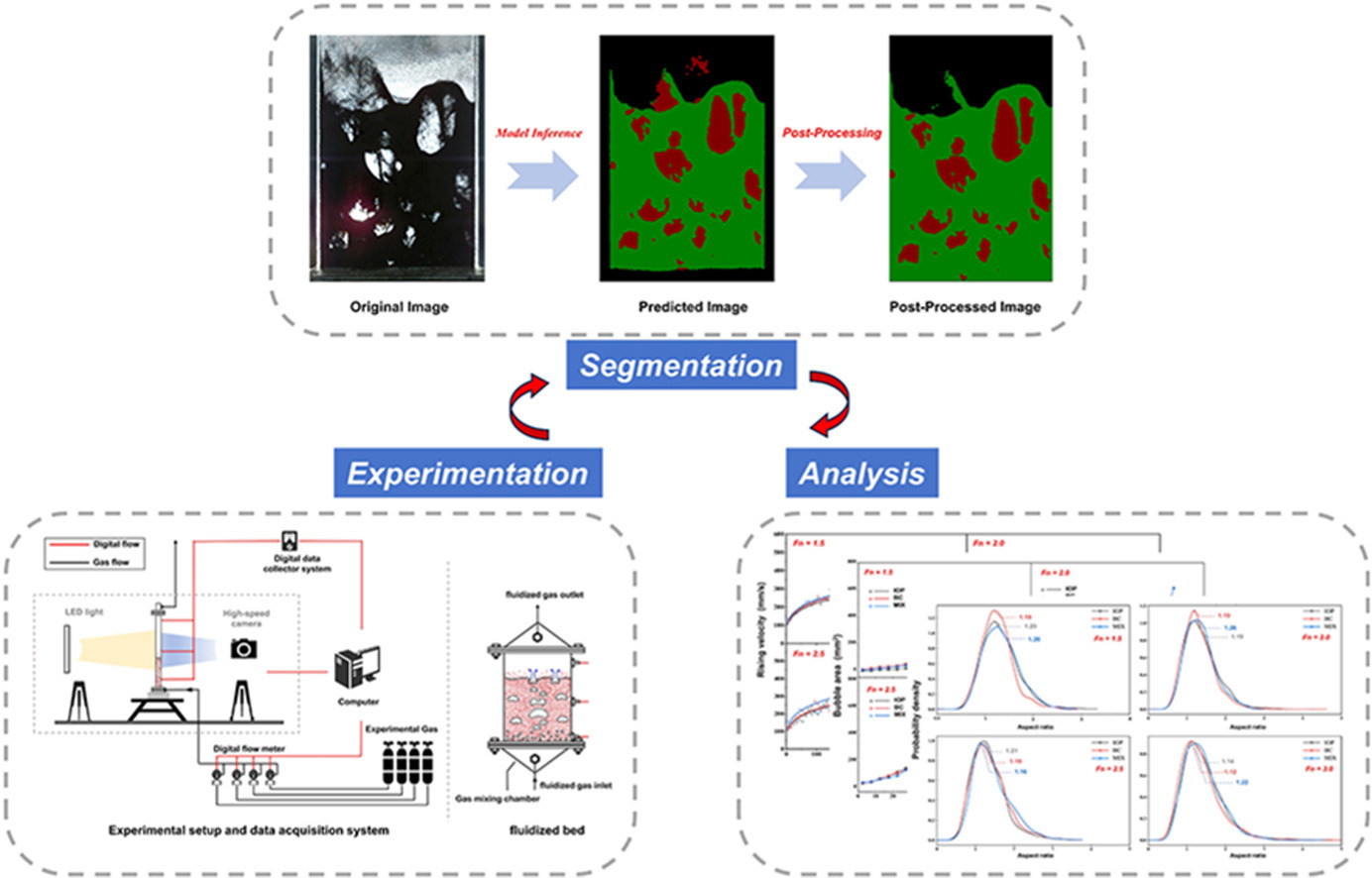
Clarifying the fluidization behavior of iron ore powders in fluidized beds is a fundamental issue for realizing hydrogen-based fluidized bed reduction. Digital image analysis (DIA), as a promising non-intrusive diagnostic technique, provides an effective approach for the quantitative characterization of fluidization behavior. In this study, a DeepLabV3+-based deep learning framework was employed to simultaneously segment the gas and solid phases during the fluidization process, and the effects of different backbone network configurations on training cost and segmentation performance were systematically evaluated. On this basis, the proposed method was further compared with conventional threshold-based segmentation methods and the general-purpose foundation model SAM3. The results indicate that using ResNet18 as the backbone achieves a favorable balance between segmentation accuracy and computational efficiency. The deep learning–based segmentation method shows strong adaptability to complex backgrounds and diverse fluidization states, and its segmentation accuracy and processing efficiency are significantly superior to those of traditional image segmentation methods and SAM3. Further experimental results based on this approach reveal that, at the same fluidization number, the iron ore powder system generates smaller bubbles with lower rising velocities, exhibiting a bubble population characterized by smaller sizes, higher number density, and lower rising velocities. With increasing hydrogen concentration in the fluidizing gas, the bubble size decreases further and the bed expansion ratio is reduced, while the variations in bubble shape and rising velocity remain insignificant.
Graphical abstract
Keywords
Gas-solid two-phase flow; Hydrogen metallurgy; Quasi-2D fluidized bed; Deep learning; Image segmentation; Digital image
文章导读