
期刊文章
过刊浏览
- Volumes 108-119 (2025)
-
Volumes 96-107 (2025)
-
Volume 107
Pages 1-376 (December 2025)
-
Volume 106
Pages 1-336 (November 2025)
-
Volume 105
Pages 1-356 (October 2025)
-
Volume 104
Pages 1-332 (September 2025)
-
Volume 103
Pages 1-314 (August 2025)
-
Volume 102
Pages 1-276 (July 2025)
-
Volume 101
Pages 1-166 (June 2025)
-
Volume 100
Pages 1-256 (May 2025)
-
Volume 99
Pages 1-242 (April 2025)
-
Volume 98
Pages 1-288 (March 2025)
-
Volume 97
Pages 1-256 (February 2025)
-
Volume 96
Pages 1-340 (January 2025)
-
Volume 107
-
Volumes 84-95 (2024)
-
Volume 95
Pages 1-392 (December 2024)
-
Volume 94
Pages 1-400 (November 2024)
-
Volume 93
Pages 1-376 (October 2024)
-
Volume 92
Pages 1-316 (September 2024)
-
Volume 91
Pages 1-378 (August 2024)
-
Volume 90
Pages 1-580 (July 2024)
-
Volume 89
Pages 1-278 (June 2024)
-
Volume 88
Pages 1-350 (May 2024)
-
Volume 87
Pages 1-338 (April 2024)
-
Volume 86
Pages 1-312 (March 2024)
-
Volume 85
Pages 1-334 (February 2024)
-
Volume 84
Pages 1-308 (January 2024)
-
Volume 95
-
Volumes 72-83 (2023)
-
Volume 83
Pages 1-258 (December 2023)
-
Volume 82
Pages 1-204 (November 2023)
-
Volume 81
Pages 1-188 (October 2023)
-
Volume 80
Pages 1-202 (September 2023)
-
Volume 79
Pages 1-172 (August 2023)
-
Volume 78
Pages 1-146 (July 2023)
-
Volume 77
Pages 1-152 (June 2023)
-
Volume 76
Pages 1-176 (May 2023)
-
Volume 75
Pages 1-228 (April 2023)
-
Volume 74
Pages 1-200 (March 2023)
-
Volume 73
Pages 1-138 (February 2023)
-
Volume 72
Pages 1-144 (January 2023)
-
Volume 83
-
Volumes 60-71 (2022)
-
Volume 71
Pages 1-108 (December 2022)
-
Volume 70
Pages 1-106 (November 2022)
-
Volume 69
Pages 1-122 (October 2022)
-
Volume 68
Pages 1-124 (September 2022)
-
Volume 67
Pages 1-102 (August 2022)
-
Volume 66
Pages 1-112 (July 2022)
-
Volume 65
Pages 1-138 (June 2022)
-
Volume 64
Pages 1-186 (May 2022)
-
Volume 63
Pages 1-124 (April 2022)
-
Volume 62
Pages 1-104 (March 2022)
-
Volume 61
Pages 1-120 (February 2022)
-
Volume 60
Pages 1-124 (January 2022)
-
Volume 71
- Volumes 54-59 (2021)
- Volumes 48-53 (2020)
- Volumes 42-47 (2019)
- Volumes 36-41 (2018)
- Volumes 30-35 (2017)
- Volumes 24-29 (2016)
- Volumes 18-23 (2015)
- Volumes 12-17 (2014)
- Volume 11 (2013)
- Volume 10 (2012)
- Volume 9 (2011)
- Volume 8 (2010)
- Volume 7 (2009)
- Volume 6 (2008)
- Volume 5 (2007)
- Volume 4 (2006)
- Volume 3 (2005)
- Volume 2 (2004)
- Volume 1 (2003)
Volume 113
Mardiana, S., Arcana, I. M., Ismunandar, & Kadja, G. T. M. (2026). Tailoring MFI@RFE hybrid zeolites for enhanced polyethylene cracking performance. Particuology, 113, 113-122. https://doi.org/10.1016/j.partic.2026.03.024
Tailoring MFI@RFE hybrid zeolites for enhanced polyethylene cracking performance
St Mardiana a b c, I Made Arcana a, Ismunandar a, Grandprix T.M. Kadja a d e *
a Division of Inorganic and Physical Chemistry, Faculty of Mathematics and Natural Sciences, Institut Teknologi Bandung, Jl. Ganesha no. 10, Bandung, 40132, Indonesia
b Doctoral Program of Chemistry, Faculty of Mathematics and Natural Sciences, Institut Teknologi Bandung, Jl. Ganesha no. 10, Bandung, 40132, Indonesia
c Department of Chemistry, Faculty of Mathematics and Natural Sciences, Universitas Sumatera Utara, Medan, 20155, Indonesia
d Center for Catalysis and Reaction Engineering, Institut Teknologi Bandung, Jl. Ganesha no. 10, Bandung, 40132, Indonesia
e Research Center for Nanosciences and Nanotechnology, Institut Teknologi Bandung, Jl. Ganesha No. 10, Bandung, 40132, Indonesia
10.1016/j.partic.2026.03.024
Volume 113,
June 2026,
Pages 113-122
Received 9 December 2025, Revised 3 March 2026, Accepted 13 March 2026, Available online 27 March 2026, Version of Record 2 April 2026.
E-mail:
grandprix.thomryes@itb.ac.id
Highlights
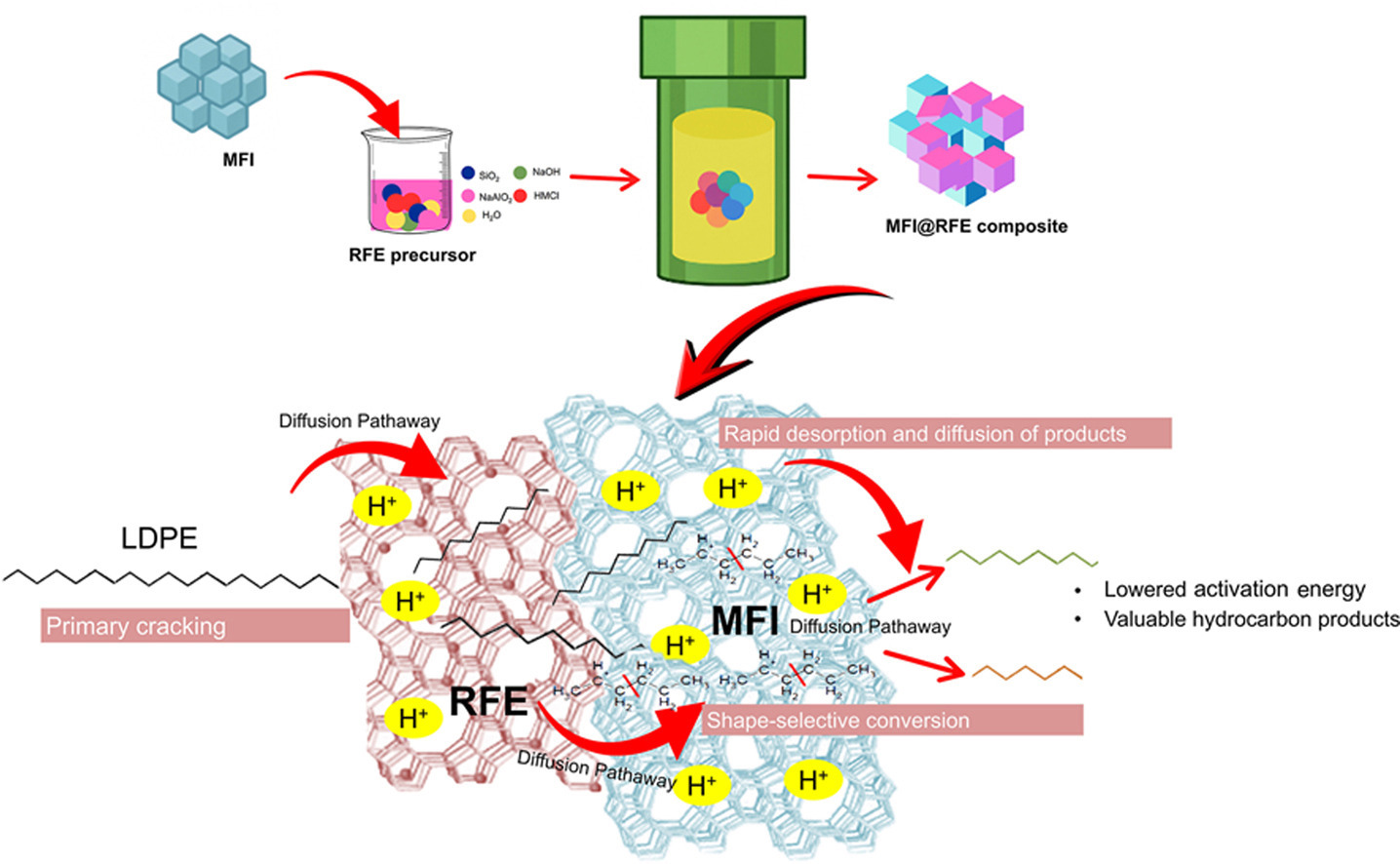
• A novel MFI@RFE composite zeolite was successfully synthesized through hydrothermal method.
• The Si/Al ratio significantly affects the formation of MFI@RFE composite.
• MFI@RFE composite exhibits excellent catalytic performance in polyethylene cracking.
• Synergistic MFI–RFE framework enhances cracking behavior and lowers activation energy.
Abstract
Zeolites have long emerged as promising catalysts for plastic cracking and overcoming key challenges in hydrocarbon conversion and waste recycling. However, among hundreds of zeolite types, each has its own unique structure, selectivity, and suffers from intrinsic limitations, including MFI-type zeolite (Mobil Five) and RFE-zeolite type. In this regard, MFI zeolites, which consist of a three-dimensional 10-membered ring pore system, have been proven to exhibit high aromatic selectivity, although their shape selectivity is relatively less strict due to intersecting channels. On the other hand, RFE zeolite, previously referred to as ∗MRE, has one-dimensional 10-membered rings that offer stricter shape selectivity, which is crucial for maximizing specific isomers, but suffers from diffusion limitation. This work aims to develop the novel MFI@RFE zeolite composite to integrate the complementary advantages of both frameworks and to evaluate its catalytic performance in the cracking of low-density polyethylene (LDPE). The results exhibit that MFI@RFE zeolite composite was successfully synthesized through the hydrothermal method with a Si/Al ratio of RFE as shell is 50, 75, and 100 (MFI@RFE50, MFI@RFE75, and MFI@RFE100). Among these, the MFI@RFE75 sample showed the optimum catalytic performance in LDPE cracking, reaching 50% conversion at 386 °C and observed activation energy of 103.88 kJ mol−1. Both values were significantly lower than those of the MFI and RFE catalysts. Overall, these results highlight the potential of rationally designed composite zeolites as an effective strategy to improve catalytic performance in polyethylene cracking through synergistic framework integration.
Graphical abstract
Keywords
Catalytic cracking; Composite zeolite; Low-density polyethylene; MFI zeolite; RFE zeolite
文章导读