
期刊文章
过刊浏览
- Volumes 108-119 (2025)
-
Volumes 96-107 (2025)
-
Volume 107
Pages 1-376 (December 2025)
-
Volume 106
Pages 1-336 (November 2025)
-
Volume 105
Pages 1-356 (October 2025)
-
Volume 104
Pages 1-332 (September 2025)
-
Volume 103
Pages 1-314 (August 2025)
-
Volume 102
Pages 1-276 (July 2025)
-
Volume 101
Pages 1-166 (June 2025)
-
Volume 100
Pages 1-256 (May 2025)
-
Volume 99
Pages 1-242 (April 2025)
-
Volume 98
Pages 1-288 (March 2025)
-
Volume 97
Pages 1-256 (February 2025)
-
Volume 96
Pages 1-340 (January 2025)
-
Volume 107
-
Volumes 84-95 (2024)
-
Volume 95
Pages 1-392 (December 2024)
-
Volume 94
Pages 1-400 (November 2024)
-
Volume 93
Pages 1-376 (October 2024)
-
Volume 92
Pages 1-316 (September 2024)
-
Volume 91
Pages 1-378 (August 2024)
-
Volume 90
Pages 1-580 (July 2024)
-
Volume 89
Pages 1-278 (June 2024)
-
Volume 88
Pages 1-350 (May 2024)
-
Volume 87
Pages 1-338 (April 2024)
-
Volume 86
Pages 1-312 (March 2024)
-
Volume 85
Pages 1-334 (February 2024)
-
Volume 84
Pages 1-308 (January 2024)
-
Volume 95
-
Volumes 72-83 (2023)
-
Volume 83
Pages 1-258 (December 2023)
-
Volume 82
Pages 1-204 (November 2023)
-
Volume 81
Pages 1-188 (October 2023)
-
Volume 80
Pages 1-202 (September 2023)
-
Volume 79
Pages 1-172 (August 2023)
-
Volume 78
Pages 1-146 (July 2023)
-
Volume 77
Pages 1-152 (June 2023)
-
Volume 76
Pages 1-176 (May 2023)
-
Volume 75
Pages 1-228 (April 2023)
-
Volume 74
Pages 1-200 (March 2023)
-
Volume 73
Pages 1-138 (February 2023)
-
Volume 72
Pages 1-144 (January 2023)
-
Volume 83
-
Volumes 60-71 (2022)
-
Volume 71
Pages 1-108 (December 2022)
-
Volume 70
Pages 1-106 (November 2022)
-
Volume 69
Pages 1-122 (October 2022)
-
Volume 68
Pages 1-124 (September 2022)
-
Volume 67
Pages 1-102 (August 2022)
-
Volume 66
Pages 1-112 (July 2022)
-
Volume 65
Pages 1-138 (June 2022)
-
Volume 64
Pages 1-186 (May 2022)
-
Volume 63
Pages 1-124 (April 2022)
-
Volume 62
Pages 1-104 (March 2022)
-
Volume 61
Pages 1-120 (February 2022)
-
Volume 60
Pages 1-124 (January 2022)
-
Volume 71
- Volumes 54-59 (2021)
- Volumes 48-53 (2020)
- Volumes 42-47 (2019)
- Volumes 36-41 (2018)
- Volumes 30-35 (2017)
- Volumes 24-29 (2016)
- Volumes 18-23 (2015)
- Volumes 12-17 (2014)
- Volume 11 (2013)
- Volume 10 (2012)
- Volume 9 (2011)
- Volume 8 (2010)
- Volume 7 (2009)
- Volume 6 (2008)
- Volume 5 (2007)
- Volume 4 (2006)
- Volume 3 (2005)
- Volume 2 (2004)
- Volume 1 (2003)
Volume 113
ang, L., Li, S., Meng, X., Zhang, H., & Guan, H. (2026). Calibration of the volume fraction model for particle drag, experimental validation, and numerical study of shock-driven nozzle gas-solid jet. Particuology, 113, 123-139. https://doi.org/10.1016/j.partic.2026.03.023
Calibration of the volume fraction model for particle drag, experimental validation, and numerical study of shock-driven nozzle gas-solid jet
Lite Zhang *, Shenghao Li, Xiangbo Meng, Heng Zhang, Hao Guan
School of Mechanical Engineering, Zhejiang Sci-Tech University, Hangzhou, 310018, China
10.1016/j.partic.2026.03.023
Volume 113,
June 2026,
Pages 123-139
Received 14 January 2026, Revised 26 February 2026, Accepted 12 March 2026, Available online 27 March 2026, Version of Record 2 April 2026.
E-mail:
langzichsh@zstu.edu.cn
Highlights
• New drag model includes compressibility, inertia, high volume fraction.
• The volume-fraction correction exponent is calibrated using shock-tube experiments.
• Interchangeable-nozzle shock-tube tests provide robust validation data.
• The modified drag model outperforms classical correlations in predictive accuracy.
• Mach number, particle size, and nozzle geometry strongly influence jet performance.
Abstract
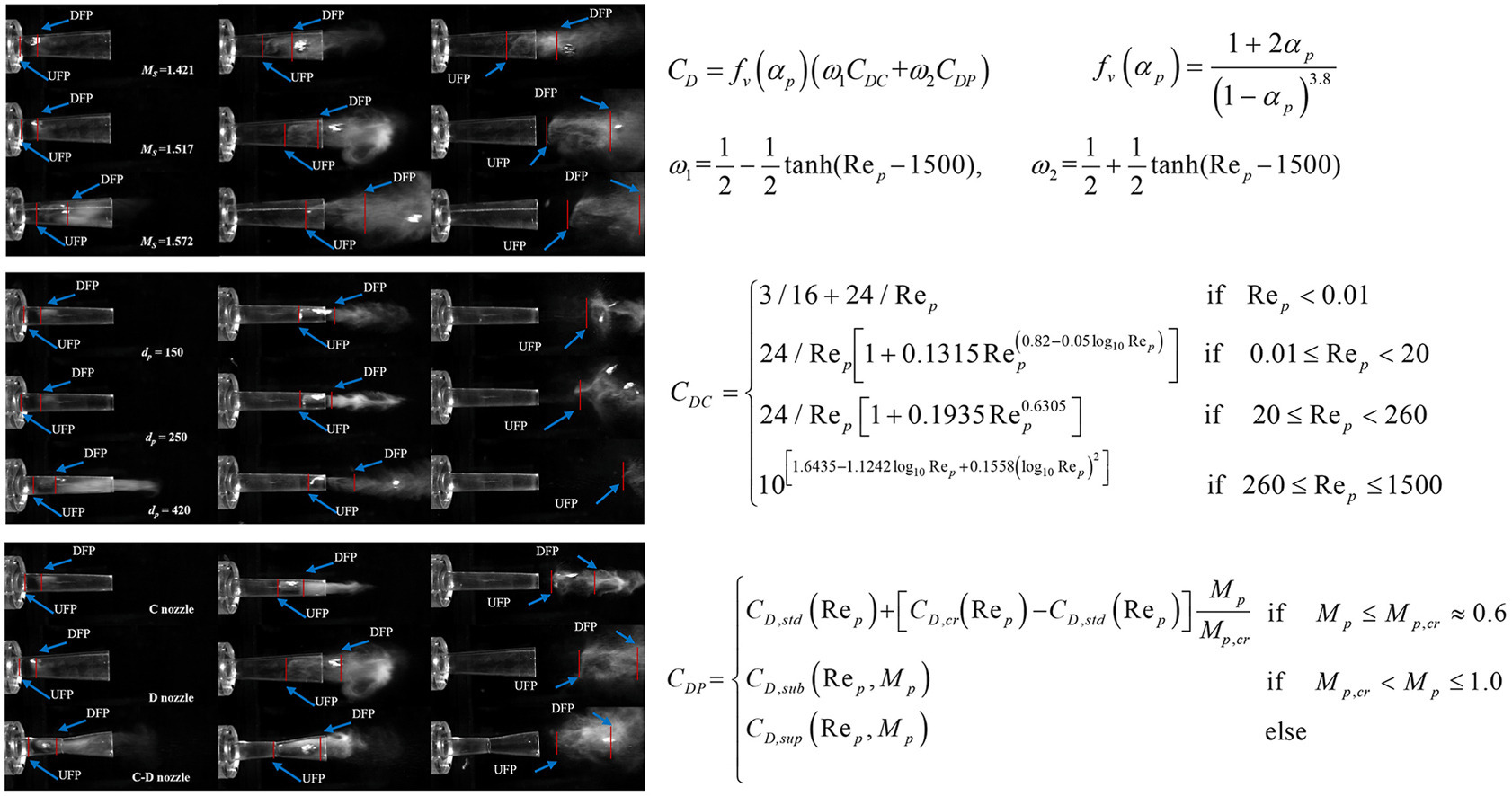
Based on experimental observations of shock-driven dense particle flows, this work extends and refines the volume-fraction correction framework originally proposed by Sangani. By incorporating realistic particle spatial distributions, the drag model is modified to more accurately describe gas–solid momentum exchange under dense flow conditions. Following model calibration, the volume-fraction correction exponent is identified as n∗ = 3.8, which yields improved predictive accuracy compared with commonly used drag models. To validate the model and investigate the influence of nozzle geometry on particle transport behavior, a shock-tube experimental system equipped with three representative nozzle configurations—converging, converging–diverging, and diverging nozzles—was constructed. Experimental and numerical results demonstrate that the modified drag model accurately captures the dynamics of shock-driven particle jets: converging nozzles enhance particle concentration, diverging nozzles promote particle acceleration and dispersion, while converging–diverging nozzles exhibit combined regulation characteristics at different stages. These findings provide physically consistent modeling support for understanding shock–particle interaction mechanisms and for optimizing shock-driven particle transport systems, such as dry powder fire extinguishers.
Graphical abstract
Keywords
Shock wave; Particle group; Modified resistance coefficient model; Gas-particle jet
文章导读