
期刊文章
过刊浏览
- Volumes 108-119 (2025)
-
Volumes 96-107 (2025)
-
Volume 107
Pages 1-376 (December 2025)
-
Volume 106
Pages 1-336 (November 2025)
-
Volume 105
Pages 1-356 (October 2025)
-
Volume 104
Pages 1-332 (September 2025)
-
Volume 103
Pages 1-314 (August 2025)
-
Volume 102
Pages 1-276 (July 2025)
-
Volume 101
Pages 1-166 (June 2025)
-
Volume 100
Pages 1-256 (May 2025)
-
Volume 99
Pages 1-242 (April 2025)
-
Volume 98
Pages 1-288 (March 2025)
-
Volume 97
Pages 1-256 (February 2025)
-
Volume 96
Pages 1-340 (January 2025)
-
Volume 107
-
Volumes 84-95 (2024)
-
Volume 95
Pages 1-392 (December 2024)
-
Volume 94
Pages 1-400 (November 2024)
-
Volume 93
Pages 1-376 (October 2024)
-
Volume 92
Pages 1-316 (September 2024)
-
Volume 91
Pages 1-378 (August 2024)
-
Volume 90
Pages 1-580 (July 2024)
-
Volume 89
Pages 1-278 (June 2024)
-
Volume 88
Pages 1-350 (May 2024)
-
Volume 87
Pages 1-338 (April 2024)
-
Volume 86
Pages 1-312 (March 2024)
-
Volume 85
Pages 1-334 (February 2024)
-
Volume 84
Pages 1-308 (January 2024)
-
Volume 95
-
Volumes 72-83 (2023)
-
Volume 83
Pages 1-258 (December 2023)
-
Volume 82
Pages 1-204 (November 2023)
-
Volume 81
Pages 1-188 (October 2023)
-
Volume 80
Pages 1-202 (September 2023)
-
Volume 79
Pages 1-172 (August 2023)
-
Volume 78
Pages 1-146 (July 2023)
-
Volume 77
Pages 1-152 (June 2023)
-
Volume 76
Pages 1-176 (May 2023)
-
Volume 75
Pages 1-228 (April 2023)
-
Volume 74
Pages 1-200 (March 2023)
-
Volume 73
Pages 1-138 (February 2023)
-
Volume 72
Pages 1-144 (January 2023)
-
Volume 83
-
Volumes 60-71 (2022)
-
Volume 71
Pages 1-108 (December 2022)
-
Volume 70
Pages 1-106 (November 2022)
-
Volume 69
Pages 1-122 (October 2022)
-
Volume 68
Pages 1-124 (September 2022)
-
Volume 67
Pages 1-102 (August 2022)
-
Volume 66
Pages 1-112 (July 2022)
-
Volume 65
Pages 1-138 (June 2022)
-
Volume 64
Pages 1-186 (May 2022)
-
Volume 63
Pages 1-124 (April 2022)
-
Volume 62
Pages 1-104 (March 2022)
-
Volume 61
Pages 1-120 (February 2022)
-
Volume 60
Pages 1-124 (January 2022)
-
Volume 71
- Volumes 54-59 (2021)
- Volumes 48-53 (2020)
- Volumes 42-47 (2019)
- Volumes 36-41 (2018)
- Volumes 30-35 (2017)
- Volumes 24-29 (2016)
- Volumes 18-23 (2015)
- Volumes 12-17 (2014)
- Volume 11 (2013)
- Volume 10 (2012)
- Volume 9 (2011)
- Volume 8 (2010)
- Volume 7 (2009)
- Volume 6 (2008)
- Volume 5 (2007)
- Volume 4 (2006)
- Volume 3 (2005)
- Volume 2 (2004)
- Volume 1 (2003)
Volume 113
Díaz-Heras, M., Majó, M., Calderón, A., Almendros-Ibáñez, J. A., & Barreneche, C. (2026). Rheological and morphological characterization of alternative solid particle materials for CSP applications. Particuology, 113, 140-150. https://doi.org/10.1016/j.partic.2026.03.013
Rheological and morphological characterization of alternative solid particle materials for CSP applications (Open Access)
Minerva Díaz-Heras a b *, Marc Majó c, Alejandro Calderón c, José A. Almendros-Ibáñez a b, Camila Barreneche c *
a Universidad de Castilla-La Mancha, Renewable Energy Research Institute, c/ de la Investigación s/n, 02071, Albacete, Spain
b Universidad de Castilla-La Mancha, E.T.S. de Ingeniería Industrial, Dpto. Mecánica Aplicada e Ingeniería de Proyectos, Campus Universitario s/n, 02071, Albacete, Spain
c Departament de Ciéncia de Materials i Química Física, Universitat de Barcelona, C/Martí i Franqués 1, 08028, Barcelona, Spain
10.1016/j.partic.2026.03.013
Volume 113,
June 2026,
Pages 140-150
Received 2 December 2025, Revised 4 February 2026, Accepted 4 March 2026, Available online 27 March 2026, Version of Record 2 April 2026.
E-mail:
Minerva.diaz@uclm.es; c.barreneche@ub.edu
Highlights
• Four residual materials were studied as alternative materials for CSP applications.
• Morphological and rheological properties were measured for four residual materials.
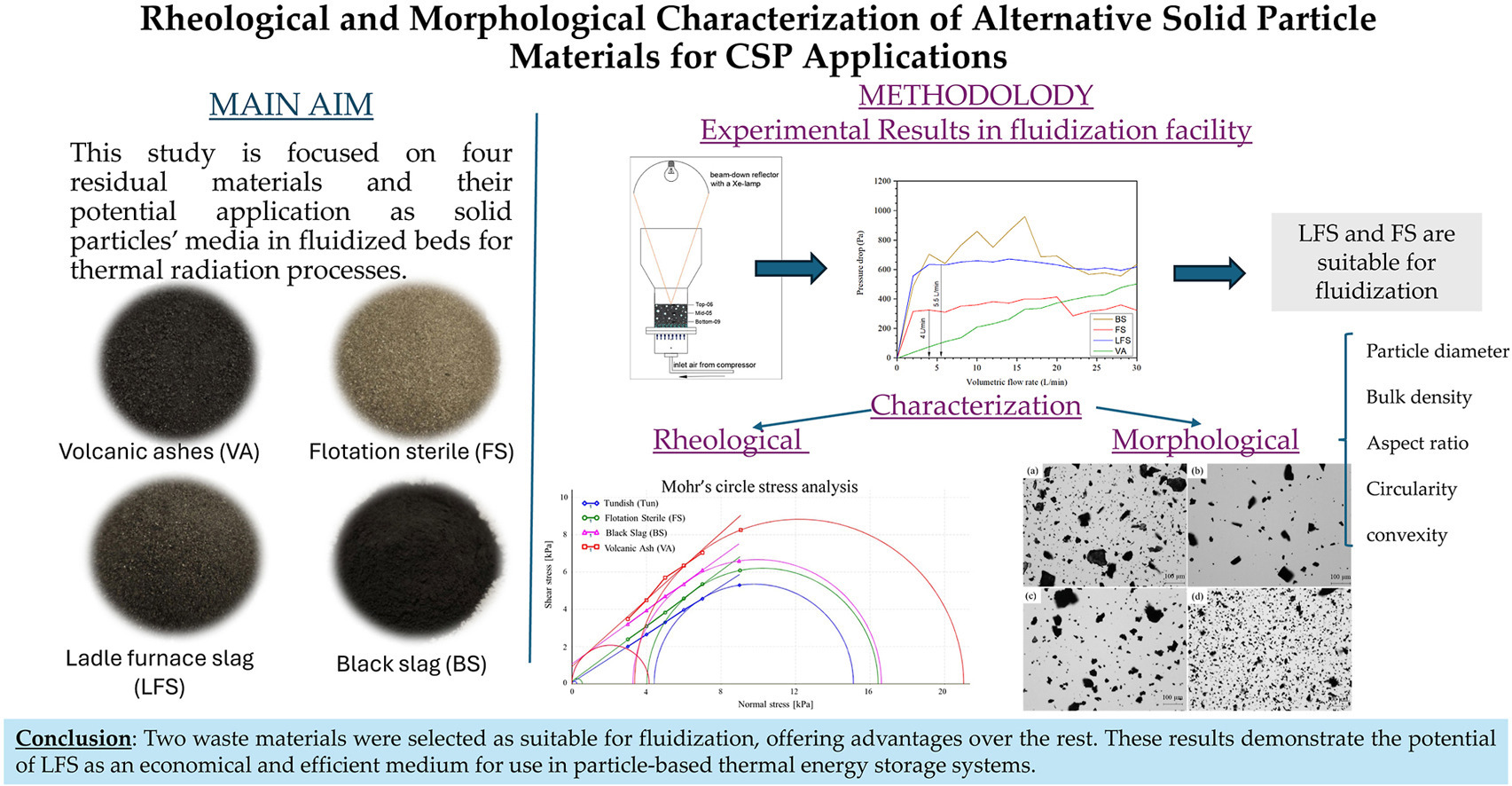
• Flotation Sterile and Ladle Furnace Slag exhibited stable behavior in fluidization.
• Ladle furnace slag is a cost-effective and flow efficient medium for TES systems.
• Ladle furnace slag has a yield stress ∽50% lower than that of flotation sterile.
Abstract
This study is focused on four residual materials, volcanic ashes (VA), flotation sterile (FS), ladle furnace slag (LFS) and black slags (BS) and their potential application as solid particles’ media in fluidized beds for thermal radiation processes. Although all materials fall within the Geldart B classification—indicating favorable fluidization behaviour—only two, FS and LFS, exhibited stable and complete fluidization. Detailed rheological and morphological analyses were conducted before and after exposure to radiation and fluidization, revealing no significant structural degradation. Minimum fluidization velocities were determined to assess flowability, leading to the exclusion of BS and VA materials despite their adequate physical and thermal properties. Between the two suitable candidates, LFS demonstrated a yield stress approximately 50% lower than that of FS, suggesting superior flowability and reduced mechanical resistance under non-confined conditions. However, LFS required a slightly higher minimum fluidization velocity (1.1 L/min more) due to its heterogeneous particle morphology. These findings highlight the potential of LFS as a cost-effective and flow-efficient medium for use in particle-based thermal energy storage systems.
Graphical abstract
Keywords
Alternative materials; TES; Solid particles; Rheology; CSP; High temperature
文章导读