
期刊文章
过刊浏览
- Volumes 108-119 (2025)
-
Volumes 96-107 (2025)
-
Volume 107
Pages 1-376 (December 2025)
-
Volume 106
Pages 1-336 (November 2025)
-
Volume 105
Pages 1-356 (October 2025)
-
Volume 104
Pages 1-332 (September 2025)
-
Volume 103
Pages 1-314 (August 2025)
-
Volume 102
Pages 1-276 (July 2025)
-
Volume 101
Pages 1-166 (June 2025)
-
Volume 100
Pages 1-256 (May 2025)
-
Volume 99
Pages 1-242 (April 2025)
-
Volume 98
Pages 1-288 (March 2025)
-
Volume 97
Pages 1-256 (February 2025)
-
Volume 96
Pages 1-340 (January 2025)
-
Volume 107
-
Volumes 84-95 (2024)
-
Volume 95
Pages 1-392 (December 2024)
-
Volume 94
Pages 1-400 (November 2024)
-
Volume 93
Pages 1-376 (October 2024)
-
Volume 92
Pages 1-316 (September 2024)
-
Volume 91
Pages 1-378 (August 2024)
-
Volume 90
Pages 1-580 (July 2024)
-
Volume 89
Pages 1-278 (June 2024)
-
Volume 88
Pages 1-350 (May 2024)
-
Volume 87
Pages 1-338 (April 2024)
-
Volume 86
Pages 1-312 (March 2024)
-
Volume 85
Pages 1-334 (February 2024)
-
Volume 84
Pages 1-308 (January 2024)
-
Volume 95
-
Volumes 72-83 (2023)
-
Volume 83
Pages 1-258 (December 2023)
-
Volume 82
Pages 1-204 (November 2023)
-
Volume 81
Pages 1-188 (October 2023)
-
Volume 80
Pages 1-202 (September 2023)
-
Volume 79
Pages 1-172 (August 2023)
-
Volume 78
Pages 1-146 (July 2023)
-
Volume 77
Pages 1-152 (June 2023)
-
Volume 76
Pages 1-176 (May 2023)
-
Volume 75
Pages 1-228 (April 2023)
-
Volume 74
Pages 1-200 (March 2023)
-
Volume 73
Pages 1-138 (February 2023)
-
Volume 72
Pages 1-144 (January 2023)
-
Volume 83
-
Volumes 60-71 (2022)
-
Volume 71
Pages 1-108 (December 2022)
-
Volume 70
Pages 1-106 (November 2022)
-
Volume 69
Pages 1-122 (October 2022)
-
Volume 68
Pages 1-124 (September 2022)
-
Volume 67
Pages 1-102 (August 2022)
-
Volume 66
Pages 1-112 (July 2022)
-
Volume 65
Pages 1-138 (June 2022)
-
Volume 64
Pages 1-186 (May 2022)
-
Volume 63
Pages 1-124 (April 2022)
-
Volume 62
Pages 1-104 (March 2022)
-
Volume 61
Pages 1-120 (February 2022)
-
Volume 60
Pages 1-124 (January 2022)
-
Volume 71
- Volumes 54-59 (2021)
- Volumes 48-53 (2020)
- Volumes 42-47 (2019)
- Volumes 36-41 (2018)
- Volumes 30-35 (2017)
- Volumes 24-29 (2016)
- Volumes 18-23 (2015)
- Volumes 12-17 (2014)
- Volume 11 (2013)
- Volume 10 (2012)
- Volume 9 (2011)
- Volume 8 (2010)
- Volume 7 (2009)
- Volume 6 (2008)
- Volume 5 (2007)
- Volume 4 (2006)
- Volume 3 (2005)
- Volume 2 (2004)
- Volume 1 (2003)
Volume 113
Zhao, B., Guo, Q., Zhao, W., Gong, Y., Ge, Z., Wang, Y., . . . Yu, G. (2026). Effects of particle morphology and rotational behavior on coal gasification reaction characteristics in an impinging entrained-flow gasifier. Particuology, 113, 164-179. https://doi.org/10.1016/j.partic.2026.03.010
Effects of particle morphology and rotational behavior on coal gasification reaction characteristics in an impinging entrained-flow gasifier
Bo Zhao a, Qinghua Guo a, Wenjing Zhao a, Yan Gong a *, Zhihao Ge a, Yifei Wang a, Jin Bai b, Guangsuo Yu a c *
a Institute of Clean Coal Technology, East China University of Science and Technology, Shanghai, 200237, China
b State Key Laboratory of Coal Conversion, Institute of Coal Chemistry, Chinese Academy of Sciences, Taiyuan, 030001, China
c State Key Laboratory of High-efficiency Utilization of Coal and Green Chemical Engineering, Ningxia University, Yinchuan, 750021, China
10.1016/j.partic.2026.03.010
Volume 113,
June 2026,
Pages 164-179
Received 17 November 2025, Revised 26 February 2026, Accepted 6 March 2026, Available online 21 March 2026, Version of Record 4 April 2026.
E-mail:
yangong@ecust.edu.cn; gsyu@ecust.edu.cn
Highlights
• An ellipsoidal coal particles motion model is established based on experiment.
• Particle rotation's impact on reaction intensity is greater than that of morphology.
• Ellipsoidal particle shows more high-temperature isothermal surface than sphere one.
• Carbon consumption grows as rotation axis is perpendicular with airflow direction.
Abstract
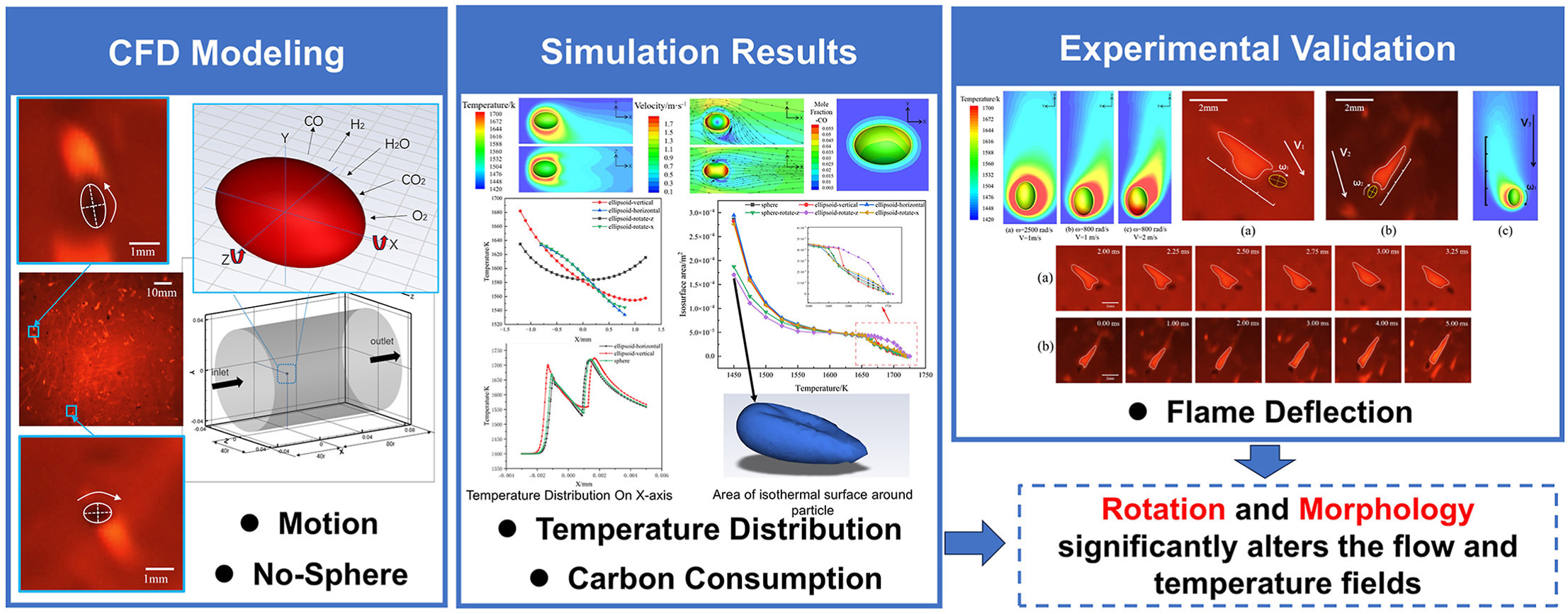
Investigating the dynamic behavior and reaction mechanism of coal particles in gasifiers is fundamental to advancing gasification technology. Due to the complexity of reaction conditions, a combined experimental and numerical approach is essential for comprehensive analysis. In this study, based on a bench-scale opposed multi-burner coal-water slurry gasifier, the morphology and movement of particles are statistically analyzed. Subsequently, numerical simulation was combined with the results of the hot model experiments, and a realistic physical model of single particles in the gasifier was established to simulate the gasification process and motion behavior of single particles. An ellipsoidal particle model with a simplified rotational motion was developed, to examine the effects of morphology and motion on reaction characteristics. While the volume-averaged temperature differed only slightly between ellipsoidal and spherical particle, the internal temperature distribution was strongly influenced by morphology. However, rotation had a greater impact than morphology. Different rotational behaviors led to varying trends in carbon consumption rates and temperature distributions. Experimentally validated results show that particle rotation induces flame deflection. Investigations on single particle rotation provide quantitative parameters for multi-particle systems, and offer references for particle residence time and its distribution in the gasifier. This study provides microscopic quantitative support for building high-precision detailed full-furnace models, lay a scientific foundation for the optimal design of industrial gasifiers, and ultimately improve the accuracy and engineering applicability of overall simulations.
Graphical abstract
Keywords
Numerical simulation; Entrained-flow gasification; Particle behavior; Particle reaction; Gas-solid surface reaction
文章导读