
期刊文章
过刊浏览
- Volumes 108-119 (2025)
-
Volumes 96-107 (2025)
-
Volume 107
Pages 1-376 (December 2025)
-
Volume 106
Pages 1-336 (November 2025)
-
Volume 105
Pages 1-356 (October 2025)
-
Volume 104
Pages 1-332 (September 2025)
-
Volume 103
Pages 1-314 (August 2025)
-
Volume 102
Pages 1-276 (July 2025)
-
Volume 101
Pages 1-166 (June 2025)
-
Volume 100
Pages 1-256 (May 2025)
-
Volume 99
Pages 1-242 (April 2025)
-
Volume 98
Pages 1-288 (March 2025)
-
Volume 97
Pages 1-256 (February 2025)
-
Volume 96
Pages 1-340 (January 2025)
-
Volume 107
-
Volumes 84-95 (2024)
-
Volume 95
Pages 1-392 (December 2024)
-
Volume 94
Pages 1-400 (November 2024)
-
Volume 93
Pages 1-376 (October 2024)
-
Volume 92
Pages 1-316 (September 2024)
-
Volume 91
Pages 1-378 (August 2024)
-
Volume 90
Pages 1-580 (July 2024)
-
Volume 89
Pages 1-278 (June 2024)
-
Volume 88
Pages 1-350 (May 2024)
-
Volume 87
Pages 1-338 (April 2024)
-
Volume 86
Pages 1-312 (March 2024)
-
Volume 85
Pages 1-334 (February 2024)
-
Volume 84
Pages 1-308 (January 2024)
-
Volume 95
-
Volumes 72-83 (2023)
-
Volume 83
Pages 1-258 (December 2023)
-
Volume 82
Pages 1-204 (November 2023)
-
Volume 81
Pages 1-188 (October 2023)
-
Volume 80
Pages 1-202 (September 2023)
-
Volume 79
Pages 1-172 (August 2023)
-
Volume 78
Pages 1-146 (July 2023)
-
Volume 77
Pages 1-152 (June 2023)
-
Volume 76
Pages 1-176 (May 2023)
-
Volume 75
Pages 1-228 (April 2023)
-
Volume 74
Pages 1-200 (March 2023)
-
Volume 73
Pages 1-138 (February 2023)
-
Volume 72
Pages 1-144 (January 2023)
-
Volume 83
-
Volumes 60-71 (2022)
-
Volume 71
Pages 1-108 (December 2022)
-
Volume 70
Pages 1-106 (November 2022)
-
Volume 69
Pages 1-122 (October 2022)
-
Volume 68
Pages 1-124 (September 2022)
-
Volume 67
Pages 1-102 (August 2022)
-
Volume 66
Pages 1-112 (July 2022)
-
Volume 65
Pages 1-138 (June 2022)
-
Volume 64
Pages 1-186 (May 2022)
-
Volume 63
Pages 1-124 (April 2022)
-
Volume 62
Pages 1-104 (March 2022)
-
Volume 61
Pages 1-120 (February 2022)
-
Volume 60
Pages 1-124 (January 2022)
-
Volume 71
- Volumes 54-59 (2021)
- Volumes 48-53 (2020)
- Volumes 42-47 (2019)
- Volumes 36-41 (2018)
- Volumes 30-35 (2017)
- Volumes 24-29 (2016)
- Volumes 18-23 (2015)
- Volumes 12-17 (2014)
- Volume 11 (2013)
- Volume 10 (2012)
- Volume 9 (2011)
- Volume 8 (2010)
- Volume 7 (2009)
- Volume 6 (2008)
- Volume 5 (2007)
- Volume 4 (2006)
- Volume 3 (2005)
- Volume 2 (2004)
- Volume 1 (2003)
Volume 113
Zhang, F., Li, M., Ma, X., Netsch, N., Tavakkol, S., Zirwes, T., . . . Stapf, D. (2026). Assessment of the interplay between convective heat transfer and reaction kinetics during plastic pyrolysis. Particuology, 113, 180-188. https://doi.org/10.1016/j.partic.2026.03.019
Assessment of the interplay between convective heat transfer and reaction kinetics during plastic pyrolysis (Open Access)
Feichi Zhang a *, Muhao Li a, Xiaoyue Ma a, Niklas Netsch a, Salar Tavakkol a *, Thorsten Zirwes b, Rui Zhang c, Dieter Stapf a
a Institute for Technical Chemistry, Karlsruhe Institute of Technology, Kaiserstr.12, 76131, Karlsruhe, Germany
b Institute for Reactive Flows, University of Stuttgart, Pfaffenwaldring 31, 70569, Stuttgart, Germany
c Nanjing University of Science and Technology, Xiaolingwei Street, 210094, Nanjing, China
10.1016/j.partic.2026.03.019
Volume 113,
June 2026,
Pages 180-188
Received 30 November 2025, Revised 17 February 2026, Accepted 8 March 2026, Available online 27 March 2026, Version of Record 4 April 2026.
E-mail:
Feichi.Zhang@kit.edu; salar.tavakkol@kit.edu
Highlights
• Revealed the interplay between convective heating and reaction kinetics in plastic pyrolysis.
• Used the Pyrolysis number to delineate regimes governed by heating rate versus reaction rate.
• Built a predictive model for pyrolysis time to guide reactor design optimization.
• Pinpointed optimal heating conditions at a Pyrolysis number near unity.
• Quantified the influence of intra-particle conduction versus convection on the overall pyrolysis conversion.
Abstract
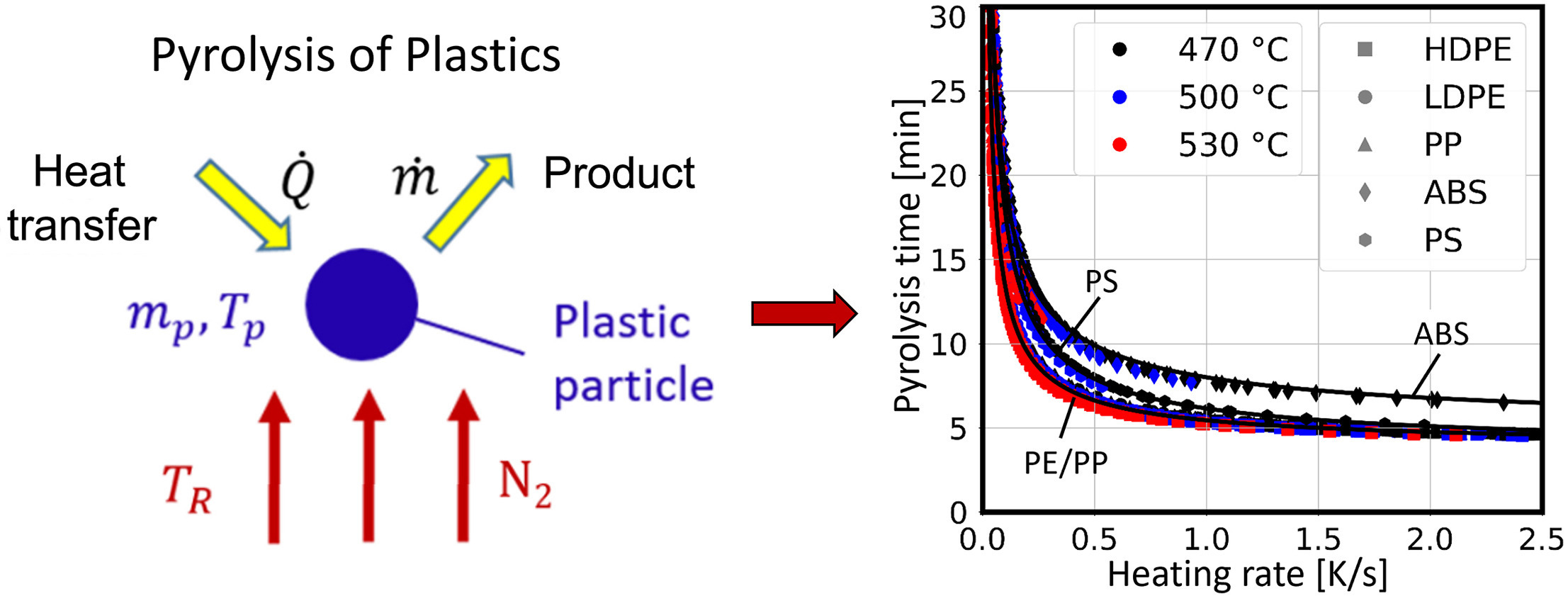
This work numerically investigates the pyrolysis of five common thermoplastics using a homogeneous, single-particle model (0D) to elucidate the interplay between convective heat transfer and reaction kinetics. The results reveal a fundamental competition between external heat supply and the endothermic cooling effect of the reaction, manifesting as a temperature plateau where heat input is balanced by the reaction enthalpy. We demonstrate that enhanced heat transfer—achieved via smaller particle sizes or higher Nusselt numbers—shifts the process toward higher reaction rates and temperatures. To quantify this behavior, we utilize the Pyrolysis number (Py), defined as the ratio of the characteristic chemical reaction time to the convective heat transfer time. A universal inverse correlation is identified between the dimensionless pyrolysis time and Py, valid across all investigated polymers and operating conditions. This correlation delineates two distinct operational regimes: reaction-limited control (Py > 1) and convective-heating limited control (Py < 1). These findings provide a predictive framework for optimizing heating rates and estimating residence times for complete conversion. Finally, comparison with particle-resolved (1D) simulations shows that neglecting intra-particle heat conduction causes faster heating and pyrolysis conversion, thereby underestimating the overall pyrolysis duration.
Graphical abstract
Keywords
Plastic pyrolysis; Chemical recycling; Pyrolysis reaction; Heat transfer; Pyrolysis number
文章导读