
期刊文章
过刊浏览
- Volumes 108-119 (2025)
-
Volumes 96-107 (2025)
-
Volume 107
Pages 1-376 (December 2025)
-
Volume 106
Pages 1-336 (November 2025)
-
Volume 105
Pages 1-356 (October 2025)
-
Volume 104
Pages 1-332 (September 2025)
-
Volume 103
Pages 1-314 (August 2025)
-
Volume 102
Pages 1-276 (July 2025)
-
Volume 101
Pages 1-166 (June 2025)
-
Volume 100
Pages 1-256 (May 2025)
-
Volume 99
Pages 1-242 (April 2025)
-
Volume 98
Pages 1-288 (March 2025)
-
Volume 97
Pages 1-256 (February 2025)
-
Volume 96
Pages 1-340 (January 2025)
-
Volume 107
-
Volumes 84-95 (2024)
-
Volume 95
Pages 1-392 (December 2024)
-
Volume 94
Pages 1-400 (November 2024)
-
Volume 93
Pages 1-376 (October 2024)
-
Volume 92
Pages 1-316 (September 2024)
-
Volume 91
Pages 1-378 (August 2024)
-
Volume 90
Pages 1-580 (July 2024)
-
Volume 89
Pages 1-278 (June 2024)
-
Volume 88
Pages 1-350 (May 2024)
-
Volume 87
Pages 1-338 (April 2024)
-
Volume 86
Pages 1-312 (March 2024)
-
Volume 85
Pages 1-334 (February 2024)
-
Volume 84
Pages 1-308 (January 2024)
-
Volume 95
-
Volumes 72-83 (2023)
-
Volume 83
Pages 1-258 (December 2023)
-
Volume 82
Pages 1-204 (November 2023)
-
Volume 81
Pages 1-188 (October 2023)
-
Volume 80
Pages 1-202 (September 2023)
-
Volume 79
Pages 1-172 (August 2023)
-
Volume 78
Pages 1-146 (July 2023)
-
Volume 77
Pages 1-152 (June 2023)
-
Volume 76
Pages 1-176 (May 2023)
-
Volume 75
Pages 1-228 (April 2023)
-
Volume 74
Pages 1-200 (March 2023)
-
Volume 73
Pages 1-138 (February 2023)
-
Volume 72
Pages 1-144 (January 2023)
-
Volume 83
-
Volumes 60-71 (2022)
-
Volume 71
Pages 1-108 (December 2022)
-
Volume 70
Pages 1-106 (November 2022)
-
Volume 69
Pages 1-122 (October 2022)
-
Volume 68
Pages 1-124 (September 2022)
-
Volume 67
Pages 1-102 (August 2022)
-
Volume 66
Pages 1-112 (July 2022)
-
Volume 65
Pages 1-138 (June 2022)
-
Volume 64
Pages 1-186 (May 2022)
-
Volume 63
Pages 1-124 (April 2022)
-
Volume 62
Pages 1-104 (March 2022)
-
Volume 61
Pages 1-120 (February 2022)
-
Volume 60
Pages 1-124 (January 2022)
-
Volume 71
- Volumes 54-59 (2021)
- Volumes 48-53 (2020)
- Volumes 42-47 (2019)
- Volumes 36-41 (2018)
- Volumes 30-35 (2017)
- Volumes 24-29 (2016)
- Volumes 18-23 (2015)
- Volumes 12-17 (2014)
- Volume 11 (2013)
- Volume 10 (2012)
- Volume 9 (2011)
- Volume 8 (2010)
- Volume 7 (2009)
- Volume 6 (2008)
- Volume 5 (2007)
- Volume 4 (2006)
- Volume 3 (2005)
- Volume 2 (2004)
- Volume 1 (2003)
Volume 113
Tan, C., E, D., Zhang, Y., Chen, Y., Su, Z., Cui, J., . . . Kuang, S. (2026). Numerical and experimental study on effect of ratio of overflow pipe outer diameter to cylindrical section diameter on hydrocyclone performance. Particuology, 113, 189-198. https://doi.org/10.1016/j.partic.2026.03.021
Numerical and experimental study on effect of ratio of overflow pipe outer diameter to cylindrical section diameter on hydrocyclone performance
Cong Tan a b, Dianyu E a b *, Yuhao Zhang a b *, Yachao Chen a b, Zhongfang Su a b, Jiaxin Cui a b, Ruiping Zou d e, Shibo Kuang c
a Jiangxi Provincial Key Laboratory of Particle Technology, Jiangxi University of Science and Technology, Nanchang, 330013, China
b Research Centre for Intelligent Mineral Processing & Metallurgy, International Institute for Innovation, Jiangxi University of Science and Technology, Nanchang, 330013, China
c ARC Research Hub for Smart Process Design and Control, Department of Chemical and Biological Engineering, Monash University, VIC, 3800, Australia
d School of Materials Science and Engineering, University of New South Wales, Sydney, NSW, 2052, Australia
e JITRI Institute for Process Modelling and Optimization, Suzhou, 215123, China
10.1016/j.partic.2026.03.021
Volume 113,
June 2026,
Pages 189-198
Received 23 October 2025, Revised 7 February 2026, Accepted 12 March 2026, Available online 27 March 2026, Version of Record 3 April 2026.
E-mail:
dianyu.e@jxust.edu.cn; zhangyuhao@88.com
Highlights
• Effect of overflow pipe-to-cylinder ratio on hydrocyclone performance is explored.
• Internal geometric proportions are crucial for flow field stability, not scale.
• For FX25, an RODCD of 0.72 improves separation efficiency and reduces pressure drop.
• Excessive RODCD in FX25 destabilizes the flow and leads to performance failure.
• Optimal RODCD ranges vary by hydrocyclone size: 0.48–0.64 for FX75, ∼0.72 for FX25.
Abstract
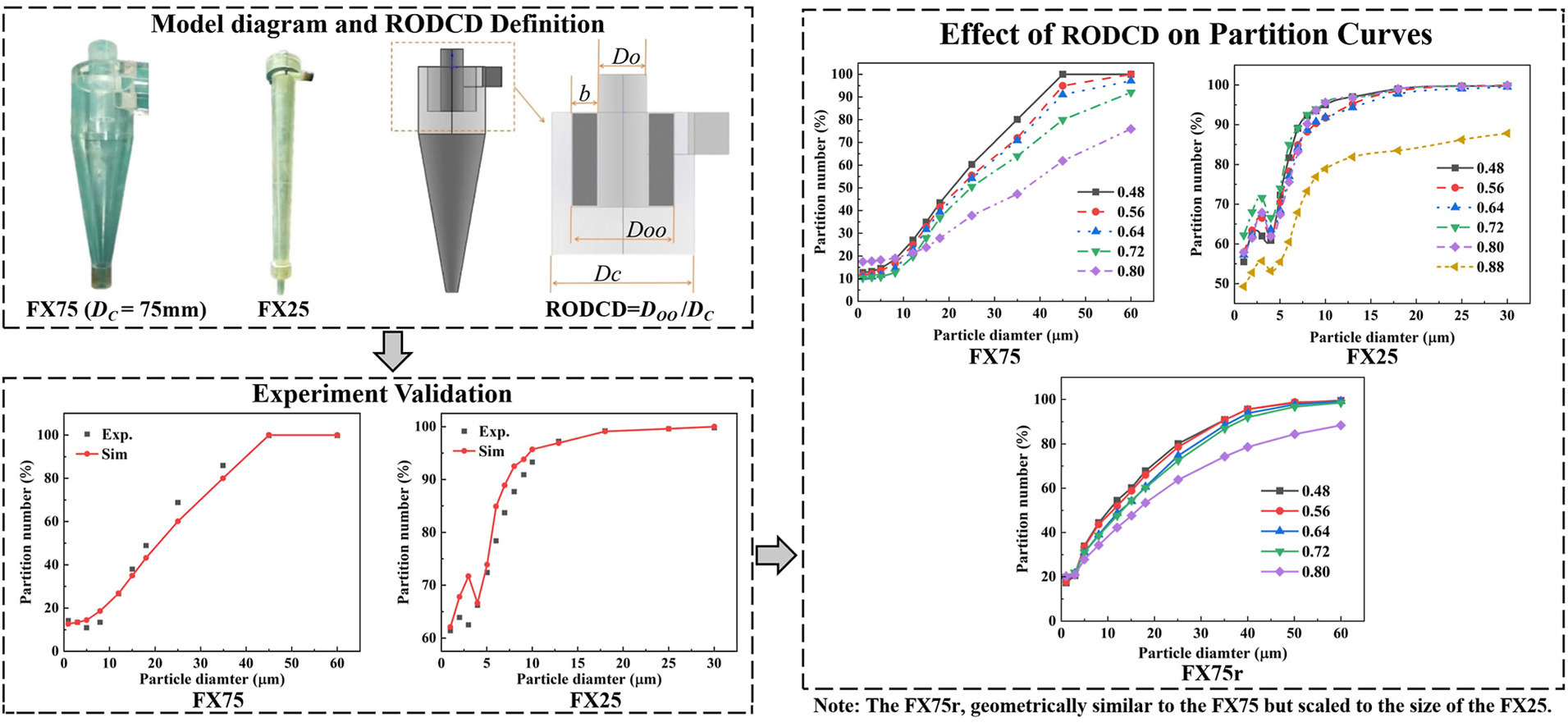
Hydrocyclones are widely used in industrial separation processes due to their compact design and high processing capacity. The structure of the overflow pipe plays a crucial role in determining separation performance. Although numerous studies have explored the effects of overflow pipe wall thickness on hydrocyclone performance, results remain inconsistent. This study combines numerical simulations and physical experiments to investigate the impact of the ratio of the overflow pipe’s outer diameter to the cylinder section diameter (RODCD) on the performance and flow characteristics of hydrocyclones (FX75, FX25, and FX75r). The FX75 is a commonly used medium-scale model, while the FX25 is designed for finer particle separation. The FX75r, geometrically similar to the FX75 but scaled to the size of the FX25, is introduced to examine the effects of RODCD across different geometric designs. The results indicate that for the FX75, optimal separation occurs within an RODCD range of 0.48–0.64, while for the FX25, an RODCD of 0.72 improves performance by reducing pressure drop and enhancing separation efficiency. Increasing the RODCD to 0.72 stabilizes the air core, reduces turbulence, and optimizes the vortex structure, leading to improved separation efficiency and reduced energy consumption. However, at excessive RODCD values (e.g., 0.88), flow field destabilization occurs, impairing effective separation. Geometric similarity validation confirms that hydrodynamic stability at higher RODCD values is more strongly influenced by internal geometric proportions than by cylinder diameter. These findings offer valuable insights into optimizing hydrocyclone design and RODCD to enhance separation efficiency in industrial applications.
Graphical abstract
Keywords
Hydrocyclone; CFD; Overflow pipe-to-cylinder ratio; Flow field characteristics; Separation performance
文章导读