
期刊文章
过刊浏览
- Volumes 108-119 (2025)
-
Volumes 96-107 (2025)
-
Volume 107
Pages 1-376 (December 2025)
-
Volume 106
Pages 1-336 (November 2025)
-
Volume 105
Pages 1-356 (October 2025)
-
Volume 104
Pages 1-332 (September 2025)
-
Volume 103
Pages 1-314 (August 2025)
-
Volume 102
Pages 1-276 (July 2025)
-
Volume 101
Pages 1-166 (June 2025)
-
Volume 100
Pages 1-256 (May 2025)
-
Volume 99
Pages 1-242 (April 2025)
-
Volume 98
Pages 1-288 (March 2025)
-
Volume 97
Pages 1-256 (February 2025)
-
Volume 96
Pages 1-340 (January 2025)
-
Volume 107
-
Volumes 84-95 (2024)
-
Volume 95
Pages 1-392 (December 2024)
-
Volume 94
Pages 1-400 (November 2024)
-
Volume 93
Pages 1-376 (October 2024)
-
Volume 92
Pages 1-316 (September 2024)
-
Volume 91
Pages 1-378 (August 2024)
-
Volume 90
Pages 1-580 (July 2024)
-
Volume 89
Pages 1-278 (June 2024)
-
Volume 88
Pages 1-350 (May 2024)
-
Volume 87
Pages 1-338 (April 2024)
-
Volume 86
Pages 1-312 (March 2024)
-
Volume 85
Pages 1-334 (February 2024)
-
Volume 84
Pages 1-308 (January 2024)
-
Volume 95
-
Volumes 72-83 (2023)
-
Volume 83
Pages 1-258 (December 2023)
-
Volume 82
Pages 1-204 (November 2023)
-
Volume 81
Pages 1-188 (October 2023)
-
Volume 80
Pages 1-202 (September 2023)
-
Volume 79
Pages 1-172 (August 2023)
-
Volume 78
Pages 1-146 (July 2023)
-
Volume 77
Pages 1-152 (June 2023)
-
Volume 76
Pages 1-176 (May 2023)
-
Volume 75
Pages 1-228 (April 2023)
-
Volume 74
Pages 1-200 (March 2023)
-
Volume 73
Pages 1-138 (February 2023)
-
Volume 72
Pages 1-144 (January 2023)
-
Volume 83
-
Volumes 60-71 (2022)
-
Volume 71
Pages 1-108 (December 2022)
-
Volume 70
Pages 1-106 (November 2022)
-
Volume 69
Pages 1-122 (October 2022)
-
Volume 68
Pages 1-124 (September 2022)
-
Volume 67
Pages 1-102 (August 2022)
-
Volume 66
Pages 1-112 (July 2022)
-
Volume 65
Pages 1-138 (June 2022)
-
Volume 64
Pages 1-186 (May 2022)
-
Volume 63
Pages 1-124 (April 2022)
-
Volume 62
Pages 1-104 (March 2022)
-
Volume 61
Pages 1-120 (February 2022)
-
Volume 60
Pages 1-124 (January 2022)
-
Volume 71
- Volumes 54-59 (2021)
- Volumes 48-53 (2020)
- Volumes 42-47 (2019)
- Volumes 36-41 (2018)
- Volumes 30-35 (2017)
- Volumes 24-29 (2016)
- Volumes 18-23 (2015)
- Volumes 12-17 (2014)
- Volume 11 (2013)
- Volume 10 (2012)
- Volume 9 (2011)
- Volume 8 (2010)
- Volume 7 (2009)
- Volume 6 (2008)
- Volume 5 (2007)
- Volume 4 (2006)
- Volume 3 (2005)
- Volume 2 (2004)
- Volume 1 (2003)
Volume 113
Shen, Y., Qiu, L., & Yuan, T. (2026). A 3D lattice Boltzmann method with μ(I)-rheology for simulating large-scale granular flows. Particuology, 113, 199-209. https://doi.org/10.1016/j.partic.2026.03.027
A 3D lattice Boltzmann method with μ(I)-rheology for simulating large-scale granular flows
Yiyang Shen, Liuchao Qiu *, Tangjing Yuan
College of Water Resources & Civil Engineering, China Agricultural University, Beijing, 100083, China
10.1016/j.partic.2026.03.027
Volume 113,
June 2026,
Pages 199-209
Received 13 January 2026, Revised 6 March 2026, Accepted 19 March 2026, Available online 1 April 2026, Version of Record 6 April 2026.
E-mail:
qiuliuchao@cau.edu.cn
Highlights
• A GPU-accelerated 3D lattice Boltzmann method for large-scale landslide simulation is proposed.
• Multistate constitutive behavior of landslide materials is captured by μ(I)-rheology model.
• A granular collapse experiment with a step beneath the column was performed.
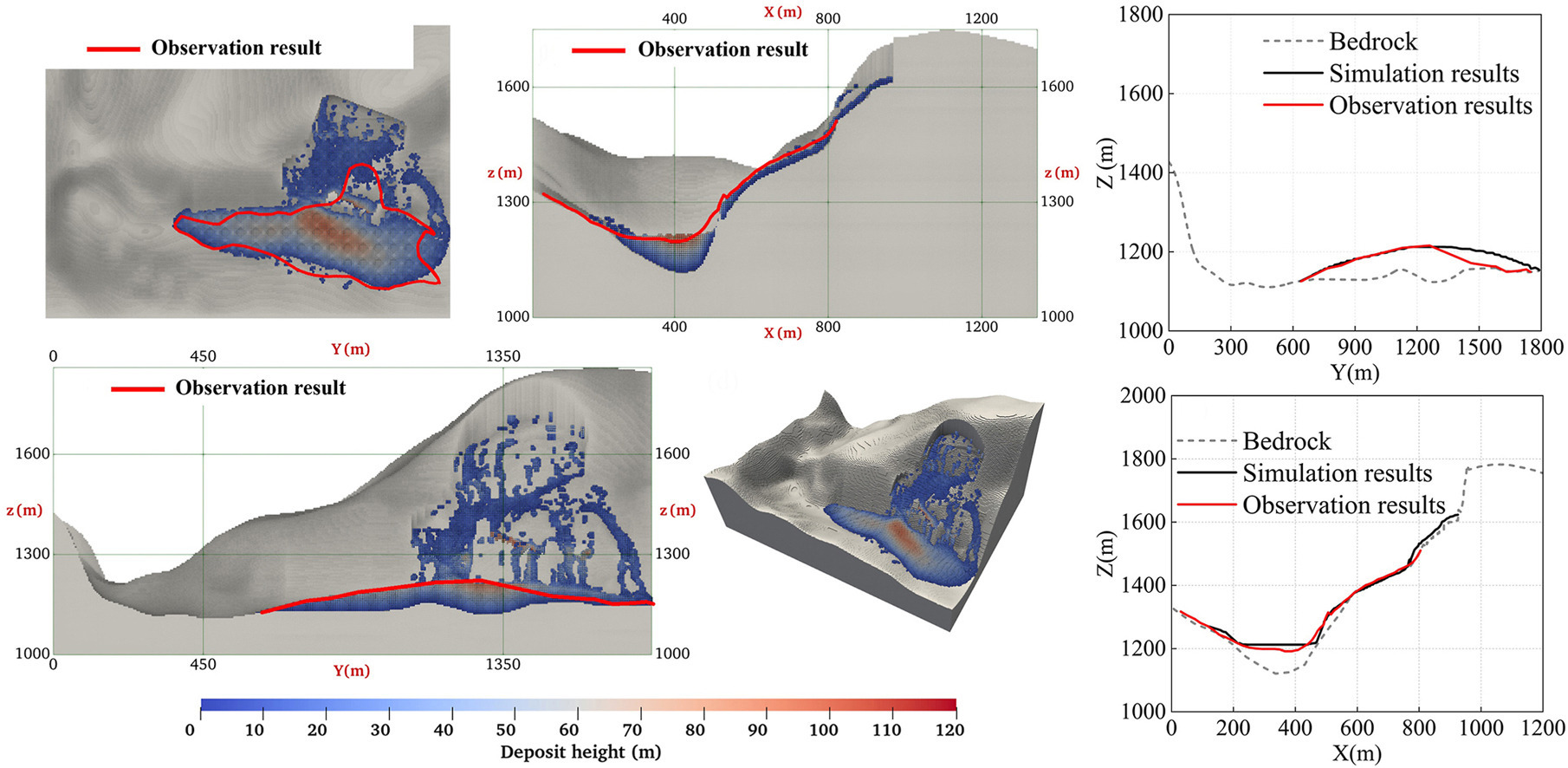
• The proposed method was used in reconstruction of the 2014 Hongshiyan landslide evolution.
Abstract
The simulation of granular flows is highly challenging due to the involvement of large deformations and complex flow dynamics. In this paper, we developed a 3D numerical method to simulate the evolution processes of granular flows. The proposed approach employs the lattice Boltzmann method (LBM) as the solver, incorporates the μ(I)-rheology model for characterizing the constitutive response of granular flows, and uses a single-phase volume of fluid (VOF) scheme for tracking its free-surface. To enhance computational efficiency for large-scale simulations, an OpenCL-based GPU parallelization technique is used to accelerate computations. After validation via a granular collapse experiment, the model is applied to simulate the large-scale granular flow of the 2014 Hongshiyan landslide. Numerical results agree well with field observations, accurately reproducing the runout distance and deposit extent, which demonstrates the model's capability for simulating large-scale granular flows in complex 3D terrain.
Graphical abstract
Keywords
Granular flows; Lattice Boltzmann method; μ(I)-rheology model; Free-surface flow; Numerical modeling
文章导读