
期刊文章
过刊浏览
- Volumes 108-119 (2025)
-
Volumes 96-107 (2025)
-
Volume 107
Pages 1-376 (December 2025)
-
Volume 106
Pages 1-336 (November 2025)
-
Volume 105
Pages 1-356 (October 2025)
-
Volume 104
Pages 1-332 (September 2025)
-
Volume 103
Pages 1-314 (August 2025)
-
Volume 102
Pages 1-276 (July 2025)
-
Volume 101
Pages 1-166 (June 2025)
-
Volume 100
Pages 1-256 (May 2025)
-
Volume 99
Pages 1-242 (April 2025)
-
Volume 98
Pages 1-288 (March 2025)
-
Volume 97
Pages 1-256 (February 2025)
-
Volume 96
Pages 1-340 (January 2025)
-
Volume 107
-
Volumes 84-95 (2024)
-
Volume 95
Pages 1-392 (December 2024)
-
Volume 94
Pages 1-400 (November 2024)
-
Volume 93
Pages 1-376 (October 2024)
-
Volume 92
Pages 1-316 (September 2024)
-
Volume 91
Pages 1-378 (August 2024)
-
Volume 90
Pages 1-580 (July 2024)
-
Volume 89
Pages 1-278 (June 2024)
-
Volume 88
Pages 1-350 (May 2024)
-
Volume 87
Pages 1-338 (April 2024)
-
Volume 86
Pages 1-312 (March 2024)
-
Volume 85
Pages 1-334 (February 2024)
-
Volume 84
Pages 1-308 (January 2024)
-
Volume 95
-
Volumes 72-83 (2023)
-
Volume 83
Pages 1-258 (December 2023)
-
Volume 82
Pages 1-204 (November 2023)
-
Volume 81
Pages 1-188 (October 2023)
-
Volume 80
Pages 1-202 (September 2023)
-
Volume 79
Pages 1-172 (August 2023)
-
Volume 78
Pages 1-146 (July 2023)
-
Volume 77
Pages 1-152 (June 2023)
-
Volume 76
Pages 1-176 (May 2023)
-
Volume 75
Pages 1-228 (April 2023)
-
Volume 74
Pages 1-200 (March 2023)
-
Volume 73
Pages 1-138 (February 2023)
-
Volume 72
Pages 1-144 (January 2023)
-
Volume 83
-
Volumes 60-71 (2022)
-
Volume 71
Pages 1-108 (December 2022)
-
Volume 70
Pages 1-106 (November 2022)
-
Volume 69
Pages 1-122 (October 2022)
-
Volume 68
Pages 1-124 (September 2022)
-
Volume 67
Pages 1-102 (August 2022)
-
Volume 66
Pages 1-112 (July 2022)
-
Volume 65
Pages 1-138 (June 2022)
-
Volume 64
Pages 1-186 (May 2022)
-
Volume 63
Pages 1-124 (April 2022)
-
Volume 62
Pages 1-104 (March 2022)
-
Volume 61
Pages 1-120 (February 2022)
-
Volume 60
Pages 1-124 (January 2022)
-
Volume 71
- Volumes 54-59 (2021)
- Volumes 48-53 (2020)
- Volumes 42-47 (2019)
- Volumes 36-41 (2018)
- Volumes 30-35 (2017)
- Volumes 24-29 (2016)
- Volumes 18-23 (2015)
- Volumes 12-17 (2014)
- Volume 11 (2013)
- Volume 10 (2012)
- Volume 9 (2011)
- Volume 8 (2010)
- Volume 7 (2009)
- Volume 6 (2008)
- Volume 5 (2007)
- Volume 4 (2006)
- Volume 3 (2005)
- Volume 2 (2004)
- Volume 1 (2003)
Volume 113
Chari, A., Jørgensen, K. B., & Chavan, S. M. (2026). Steric and solvent effects on epoxide reactivity in post-synthetic modification of UiO-66-NH2. Particuology, 113, 210-217. https://doi.org/10.1016/j.partic.2026.03.026
Steric and solvent effects on epoxide reactivity in post-synthetic modification of UiO-66-NH2 (Open Access)
Ananya Chari, Kåre B. Jørgensen *, Sachin Maruti Chavan *
Department of Chemistry, Bioscience and Environmental Engineering, Faculty of Science and Technology, University of Stavanger, 4036, Stavanger, Norway
10.1016/j.partic.2026.03.026
Volume 113,
June 2026,
Pages 210-217
Received 8 January 2026, Revised 19 February 2026, Accepted 14 March 2026, Available online 29 March 2026, Version of Record 8 April 2026.
E-mail:
kare.b.jorgensen@uis.no; sachin.m.chavan@uis.no
Highlights
• Post-synthetic modification of amine groups in the zirconium-based UiO-66-NH2 framework.
• Epoxide size and steric bulk influence reactivity, solvent effects, and assess the resulting impact on pore accessibility.
• Concentration-dependent control of the ratio between amine functionalization and epoxide hydrolysis.
Abstract
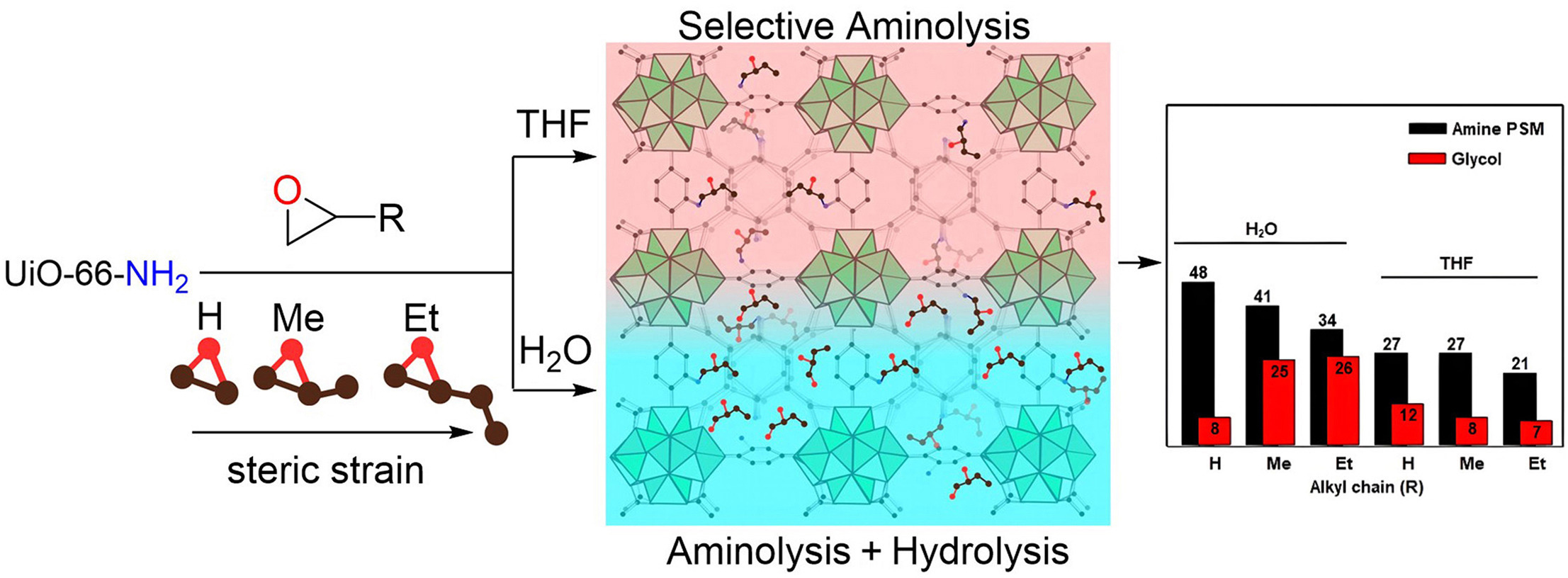
Post-synthetic modification (PSM) of amine-functionalized MOFs offers a powerful strategy for diversifying pore chemistry without altering the underlying framework structure. Here, we systematically investigate the influence of epoxide size, solvent environment, and reagent concentration on the reactivity and structural effects of epoxide-based PSM in UiO-66-NH2. Using a series of electrophiles, 1,2-ethylene oxide (EE), 1,2-propylene oxide (EP), and 1,2-epoxybutane (EB) with increasing steric hindrance, we compare reactions performed in aprotic (THF) and protic (H2O) systems using combined PXRD, N2 sorption, NMR, and HPLC-MS-DAD analyses. Reactions in THF proceed via selective aminolysis, forming β-hydroxylalkylamino with limited reduction in porosity. In contrast, a protic system leads to epoxide hydrolysis as a side reaction, which accumulates in the pores and reduces the accessible surface area. Concentration-dependent studies with EB further reveal how steric crowding and hydrolytic pathways amplify pore obstruction. Across all conditions, the UiO-66 framework remains structurally robust, but the extent of pore accessibility and product heterogeneity correlates strongly with epoxide size and solvent environment. These structural properties and reactivity trends define how pore chemistry and accessibility can be tuned through selective epoxide design.
Graphical abstract
Keywords
Metal-organic frameworks; Epoxide; Modification; Amine; Functionalization; Zirconium
文章导读