
期刊文章
过刊浏览
- Volumes 108-119 (2025)
-
Volumes 96-107 (2025)
-
Volume 107
Pages 1-376 (December 2025)
-
Volume 106
Pages 1-336 (November 2025)
-
Volume 105
Pages 1-356 (October 2025)
-
Volume 104
Pages 1-332 (September 2025)
-
Volume 103
Pages 1-314 (August 2025)
-
Volume 102
Pages 1-276 (July 2025)
-
Volume 101
Pages 1-166 (June 2025)
-
Volume 100
Pages 1-256 (May 2025)
-
Volume 99
Pages 1-242 (April 2025)
-
Volume 98
Pages 1-288 (March 2025)
-
Volume 97
Pages 1-256 (February 2025)
-
Volume 96
Pages 1-340 (January 2025)
-
Volume 107
-
Volumes 84-95 (2024)
-
Volume 95
Pages 1-392 (December 2024)
-
Volume 94
Pages 1-400 (November 2024)
-
Volume 93
Pages 1-376 (October 2024)
-
Volume 92
Pages 1-316 (September 2024)
-
Volume 91
Pages 1-378 (August 2024)
-
Volume 90
Pages 1-580 (July 2024)
-
Volume 89
Pages 1-278 (June 2024)
-
Volume 88
Pages 1-350 (May 2024)
-
Volume 87
Pages 1-338 (April 2024)
-
Volume 86
Pages 1-312 (March 2024)
-
Volume 85
Pages 1-334 (February 2024)
-
Volume 84
Pages 1-308 (January 2024)
-
Volume 95
-
Volumes 72-83 (2023)
-
Volume 83
Pages 1-258 (December 2023)
-
Volume 82
Pages 1-204 (November 2023)
-
Volume 81
Pages 1-188 (October 2023)
-
Volume 80
Pages 1-202 (September 2023)
-
Volume 79
Pages 1-172 (August 2023)
-
Volume 78
Pages 1-146 (July 2023)
-
Volume 77
Pages 1-152 (June 2023)
-
Volume 76
Pages 1-176 (May 2023)
-
Volume 75
Pages 1-228 (April 2023)
-
Volume 74
Pages 1-200 (March 2023)
-
Volume 73
Pages 1-138 (February 2023)
-
Volume 72
Pages 1-144 (January 2023)
-
Volume 83
-
Volumes 60-71 (2022)
-
Volume 71
Pages 1-108 (December 2022)
-
Volume 70
Pages 1-106 (November 2022)
-
Volume 69
Pages 1-122 (October 2022)
-
Volume 68
Pages 1-124 (September 2022)
-
Volume 67
Pages 1-102 (August 2022)
-
Volume 66
Pages 1-112 (July 2022)
-
Volume 65
Pages 1-138 (June 2022)
-
Volume 64
Pages 1-186 (May 2022)
-
Volume 63
Pages 1-124 (April 2022)
-
Volume 62
Pages 1-104 (March 2022)
-
Volume 61
Pages 1-120 (February 2022)
-
Volume 60
Pages 1-124 (January 2022)
-
Volume 71
- Volumes 54-59 (2021)
- Volumes 48-53 (2020)
- Volumes 42-47 (2019)
- Volumes 36-41 (2018)
- Volumes 30-35 (2017)
- Volumes 24-29 (2016)
- Volumes 18-23 (2015)
- Volumes 12-17 (2014)
- Volume 11 (2013)
- Volume 10 (2012)
- Volume 9 (2011)
- Volume 8 (2010)
- Volume 7 (2009)
- Volume 6 (2008)
- Volume 5 (2007)
- Volume 4 (2006)
- Volume 3 (2005)
- Volume 2 (2004)
- Volume 1 (2003)
Volume 113
Huang, H., Cai, T., Zhang, D., & Zhou, W. (2026). 3D particle localization using self-supervised learning method for Lagrangian particle tracking. Particuology, 113, 218-235. https://doi.org/10.1016/j.partic.2026.03.018
3D particle localization using self-supervised learning method for Lagrangian particle tracking
Haoqin Huang a b, Tianyi Cai a b, Dapeng Zhang a b, Wu Zhou a b *
a School of Energy and Power Engineering, University of Shanghai for Science and Technology, Shanghai, 200093, China
b Shanghai Key Laboratory of Multiphase Flow and Heat Transfer for Power Engineering, Shanghai, 200093, China
10.1016/j.partic.2026.03.018
Volume 113,
June 2026,
Pages 218-235
Received 25 December 2025, Revised 26 February 2026, Accepted 6 March 2026, Available online 26 March 2026, Version of Record 8 April 2026.
E-mail:
zhouwu@usst.edu.cn
Highlights
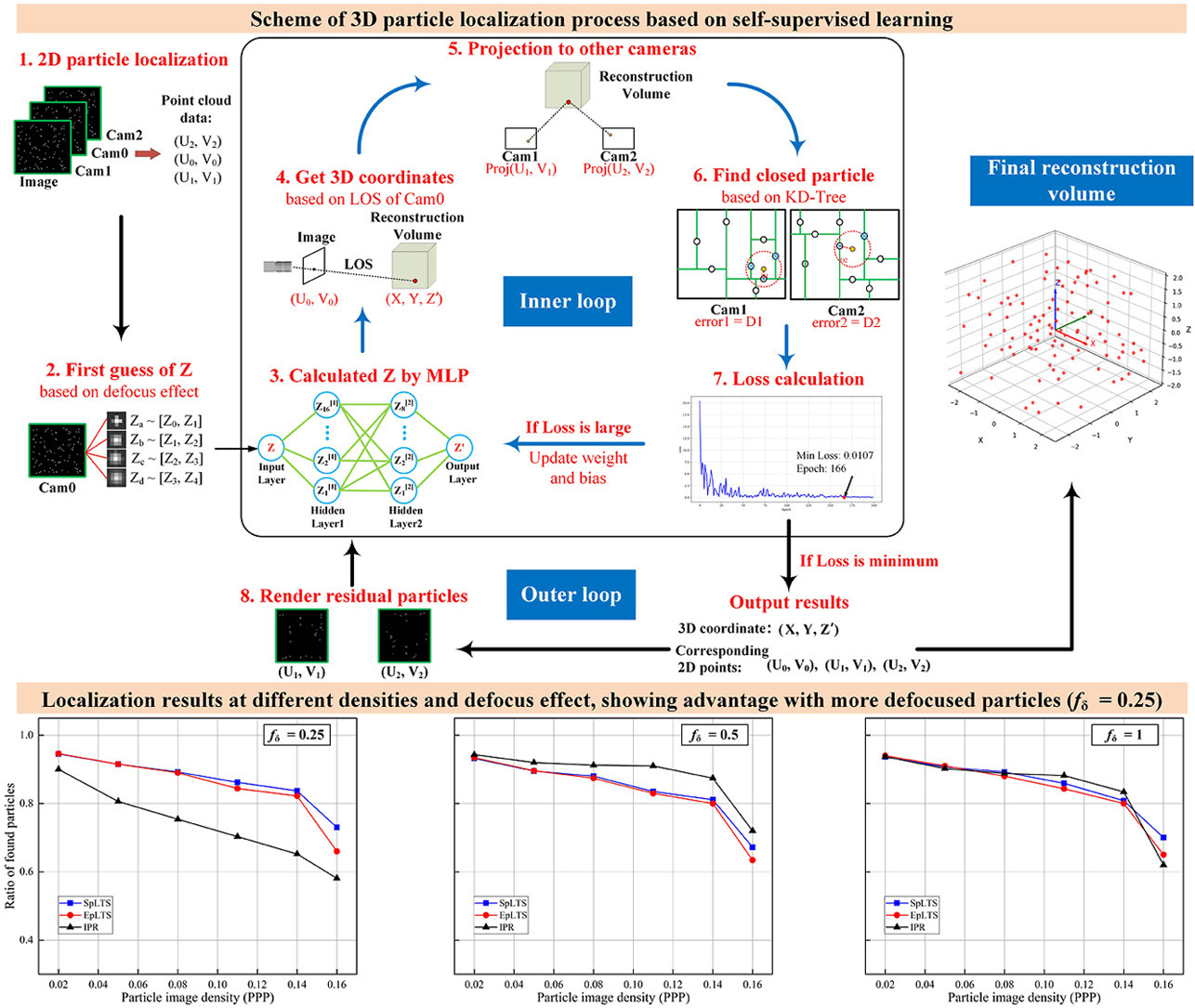
• A self-supervised learning method for 3D particle localization using MLP and iterative computational scheme.
• Relationship between particle defocus features and depth information was incorporated as a physical constraint.
• The proposed approach outperforms state-of-the-art IPR method in presence of a large number of defocus effect.
Abstract
To achieve high spatial resolution in 3D Lagrangian Particle Tracking (LPT), a self-supervised learning-based 3D particle localization method is proposed, which employs a Multilayer Perceptron (MLP) framework within an iterative optimization scheme. This neural network takes the estimated depth coordinate of each particle as input and is trained in a self-supervised manner by projecting particles onto multiple camera views, using the distance to the nearest matched projection point as the loss function. Depending on the input strategy, two implementations are introduced: the Sequential and Ensemble Particle Localization Technique (SpLTS and EpLTS, respectively), both based on self-supervised learning. Evaluated on synthetic particle fields, the method demonstrates significant improvements over the state-of-the-art Iterative Particle Reconstruction (IPR) method under defocus condition, since the proposed method can leverage particle defocus feature as a physical constraint to refine depth estimates. Particularly when the depth of field is less than half the reconstruction volume (fδ < 0.5), both SpLTS and EpLTS achieve approximately 10–15% higher localization accuracy than IPR, while maintaining robust performance up to high seeding densities of 0.14 ppp. Furthermore, under backlight illumination, neither the defocus effect within the intersection zone nor the particles outside it substantially affects SpLTS, which demonstrates superior performance compared to EpLTS. However, EpLTS exhibits higher computational efficiency than SpLTS, although both remain slower than IPR, indicating substantial potential for further optimization.
Graphical abstract
Keywords
Lagrangian particle tracking; 3D localization; Self-supervised learning; Multilayer perceptron
文章导读