
期刊文章
过刊浏览
- Volumes 108-119 (2025)
-
Volumes 96-107 (2025)
-
Volume 107
Pages 1-376 (December 2025)
-
Volume 106
Pages 1-336 (November 2025)
-
Volume 105
Pages 1-356 (October 2025)
-
Volume 104
Pages 1-332 (September 2025)
-
Volume 103
Pages 1-314 (August 2025)
-
Volume 102
Pages 1-276 (July 2025)
-
Volume 101
Pages 1-166 (June 2025)
-
Volume 100
Pages 1-256 (May 2025)
-
Volume 99
Pages 1-242 (April 2025)
-
Volume 98
Pages 1-288 (March 2025)
-
Volume 97
Pages 1-256 (February 2025)
-
Volume 96
Pages 1-340 (January 2025)
-
Volume 107
-
Volumes 84-95 (2024)
-
Volume 95
Pages 1-392 (December 2024)
-
Volume 94
Pages 1-400 (November 2024)
-
Volume 93
Pages 1-376 (October 2024)
-
Volume 92
Pages 1-316 (September 2024)
-
Volume 91
Pages 1-378 (August 2024)
-
Volume 90
Pages 1-580 (July 2024)
-
Volume 89
Pages 1-278 (June 2024)
-
Volume 88
Pages 1-350 (May 2024)
-
Volume 87
Pages 1-338 (April 2024)
-
Volume 86
Pages 1-312 (March 2024)
-
Volume 85
Pages 1-334 (February 2024)
-
Volume 84
Pages 1-308 (January 2024)
-
Volume 95
-
Volumes 72-83 (2023)
-
Volume 83
Pages 1-258 (December 2023)
-
Volume 82
Pages 1-204 (November 2023)
-
Volume 81
Pages 1-188 (October 2023)
-
Volume 80
Pages 1-202 (September 2023)
-
Volume 79
Pages 1-172 (August 2023)
-
Volume 78
Pages 1-146 (July 2023)
-
Volume 77
Pages 1-152 (June 2023)
-
Volume 76
Pages 1-176 (May 2023)
-
Volume 75
Pages 1-228 (April 2023)
-
Volume 74
Pages 1-200 (March 2023)
-
Volume 73
Pages 1-138 (February 2023)
-
Volume 72
Pages 1-144 (January 2023)
-
Volume 83
-
Volumes 60-71 (2022)
-
Volume 71
Pages 1-108 (December 2022)
-
Volume 70
Pages 1-106 (November 2022)
-
Volume 69
Pages 1-122 (October 2022)
-
Volume 68
Pages 1-124 (September 2022)
-
Volume 67
Pages 1-102 (August 2022)
-
Volume 66
Pages 1-112 (July 2022)
-
Volume 65
Pages 1-138 (June 2022)
-
Volume 64
Pages 1-186 (May 2022)
-
Volume 63
Pages 1-124 (April 2022)
-
Volume 62
Pages 1-104 (March 2022)
-
Volume 61
Pages 1-120 (February 2022)
-
Volume 60
Pages 1-124 (January 2022)
-
Volume 71
- Volumes 54-59 (2021)
- Volumes 48-53 (2020)
- Volumes 42-47 (2019)
- Volumes 36-41 (2018)
- Volumes 30-35 (2017)
- Volumes 24-29 (2016)
- Volumes 18-23 (2015)
- Volumes 12-17 (2014)
- Volume 11 (2013)
- Volume 10 (2012)
- Volume 9 (2011)
- Volume 8 (2010)
- Volume 7 (2009)
- Volume 6 (2008)
- Volume 5 (2007)
- Volume 4 (2006)
- Volume 3 (2005)
- Volume 2 (2004)
- Volume 1 (2003)
Volume 113
Brömmer, M., Mahiques, E. I., & Scherer, V. (2026). Locally resolved DEM/CFD simulations of a generic oxy-fuel kiln for lime production. Particuology, 113, 236-248. https://doi.org/10.1016/j.partic.2026.03.028
Locally resolved DEM/CFD simulations of a generic oxy-fuel kiln for lime production (Open Access)
Maximilian Brömmer *, Enric Illana Mahiques, Viktor Scherer
Ruhr University Bochum, Institute of Energy Plant Technology, Universitätsstraße 150, 44780, Bochum, Germany
10.1016/j.partic.2026.03.028
Volume 113,
June 2026,
Pages 236-248
Received 2 February 2026, Revised 10 March 2026, Accepted 17 March 2026, Available online 1 April 2026, Version of Record 8 April 2026.
E-mail:
broemmer@leat.rub.de
Highlights
• 3D DEM/CFD simulation of a single shaft kiln in oxy-fuel operation.
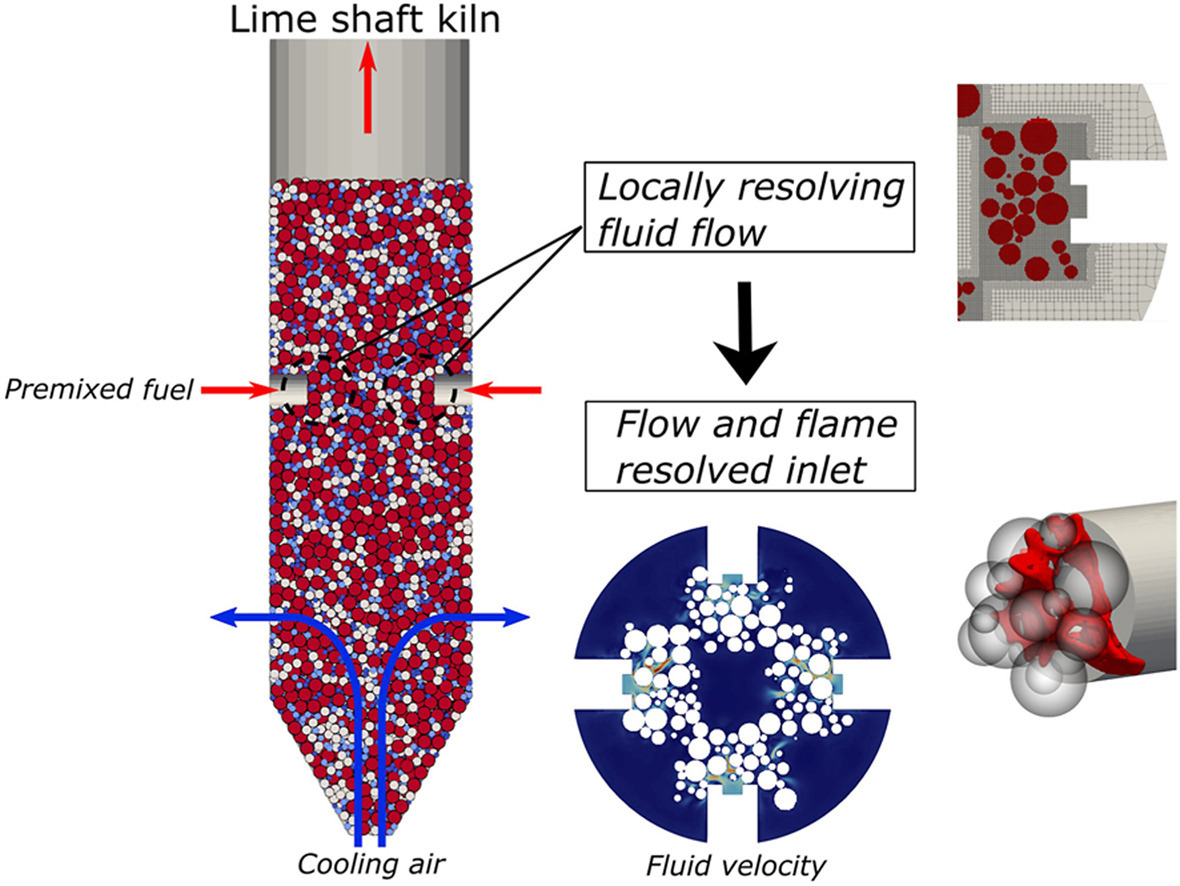
• Particle- and flame-resolved gas flow in a shaft kiln.
• Hybrid resolved-unresolved particle representation in gas flow.
Abstract
Limestones release CO2 during their decomposition in shaft kilns, which is typically initiated by the combustion of natural gas. Oxy-fuel technology is one option to mitigate CO2 emissions by enabling carbon capture methodologies but induces more challenging process conditions.
3D DEM/CFD simulations can compute the complex interaction of particles and gas flow but usually rely on spatial averaging of the gas-phase, which cannot capture all flow details. For a more detailed description of the processes, resolving the interstitial gas flow and the flame front inside the particle assembly is necessary. This study examines a down-scaled single-shaft lime kiln, utilizing an approach to locally resolve the gas flow in the most important region at the burner lances. The kiln has a height of 2.5 m, a diameter of 0.64 m, and contains 22,400 limestone particles of four different diameters. Two different simulation approaches are compared, the conventional unresolved method and the locally resolved approach. Results show minor differences in the average particle conversion degree. Higher differences are found in the local distribution of conversion degree and maximum particle temperatures. Unresolved simulations predict higher temperatures, leading to a deterioration of quicklime reactivity and potentially harming product quality, as details of the flow features are not captured. Consequently, the results indicate that unresolved simulations are a good approximation for the mean calcination degree of the particles but for more sensitive details, such as product quality, a higher-resolution simulation is necessary.
Graphical abstract
Keywords
DEM/CFD; Packed bed; Calcination; Oxy-fuel; Limestone
文章导读