
期刊文章
过刊浏览
- Volumes 108-119 (2025)
-
Volumes 96-107 (2025)
-
Volume 107
Pages 1-376 (December 2025)
-
Volume 106
Pages 1-336 (November 2025)
-
Volume 105
Pages 1-356 (October 2025)
-
Volume 104
Pages 1-332 (September 2025)
-
Volume 103
Pages 1-314 (August 2025)
-
Volume 102
Pages 1-276 (July 2025)
-
Volume 101
Pages 1-166 (June 2025)
-
Volume 100
Pages 1-256 (May 2025)
-
Volume 99
Pages 1-242 (April 2025)
-
Volume 98
Pages 1-288 (March 2025)
-
Volume 97
Pages 1-256 (February 2025)
-
Volume 96
Pages 1-340 (January 2025)
-
Volume 107
-
Volumes 84-95 (2024)
-
Volume 95
Pages 1-392 (December 2024)
-
Volume 94
Pages 1-400 (November 2024)
-
Volume 93
Pages 1-376 (October 2024)
-
Volume 92
Pages 1-316 (September 2024)
-
Volume 91
Pages 1-378 (August 2024)
-
Volume 90
Pages 1-580 (July 2024)
-
Volume 89
Pages 1-278 (June 2024)
-
Volume 88
Pages 1-350 (May 2024)
-
Volume 87
Pages 1-338 (April 2024)
-
Volume 86
Pages 1-312 (March 2024)
-
Volume 85
Pages 1-334 (February 2024)
-
Volume 84
Pages 1-308 (January 2024)
-
Volume 95
-
Volumes 72-83 (2023)
-
Volume 83
Pages 1-258 (December 2023)
-
Volume 82
Pages 1-204 (November 2023)
-
Volume 81
Pages 1-188 (October 2023)
-
Volume 80
Pages 1-202 (September 2023)
-
Volume 79
Pages 1-172 (August 2023)
-
Volume 78
Pages 1-146 (July 2023)
-
Volume 77
Pages 1-152 (June 2023)
-
Volume 76
Pages 1-176 (May 2023)
-
Volume 75
Pages 1-228 (April 2023)
-
Volume 74
Pages 1-200 (March 2023)
-
Volume 73
Pages 1-138 (February 2023)
-
Volume 72
Pages 1-144 (January 2023)
-
Volume 83
-
Volumes 60-71 (2022)
-
Volume 71
Pages 1-108 (December 2022)
-
Volume 70
Pages 1-106 (November 2022)
-
Volume 69
Pages 1-122 (October 2022)
-
Volume 68
Pages 1-124 (September 2022)
-
Volume 67
Pages 1-102 (August 2022)
-
Volume 66
Pages 1-112 (July 2022)
-
Volume 65
Pages 1-138 (June 2022)
-
Volume 64
Pages 1-186 (May 2022)
-
Volume 63
Pages 1-124 (April 2022)
-
Volume 62
Pages 1-104 (March 2022)
-
Volume 61
Pages 1-120 (February 2022)
-
Volume 60
Pages 1-124 (January 2022)
-
Volume 71
- Volumes 54-59 (2021)
- Volumes 48-53 (2020)
- Volumes 42-47 (2019)
- Volumes 36-41 (2018)
- Volumes 30-35 (2017)
- Volumes 24-29 (2016)
- Volumes 18-23 (2015)
- Volumes 12-17 (2014)
- Volume 11 (2013)
- Volume 10 (2012)
- Volume 9 (2011)
- Volume 8 (2010)
- Volume 7 (2009)
- Volume 6 (2008)
- Volume 5 (2007)
- Volume 4 (2006)
- Volume 3 (2005)
- Volume 2 (2004)
- Volume 1 (2003)
Volume 113
Sabah, E., Koltka, S., & Ercan, M. (2026). Ultrafine grinding of waste marble: A synergistic optimization of mechanical stressing and pulp rheology. Particuology, 113, 249-263. https://doi.org/10.1016/j.partic.2026.03.030
Ultrafine grinding of waste marble: A synergistic optimization of mechanical stressing and pulp rheology
Eyup Sabah a *, Selçuk Koltka b, Mustafa Ercan c
a Afyon Kocatepe University, Department of Mining Engineering, 03204, Afyonkarahisar, Türkiye
b Kimtas-Carmeuse, Bergama-İzmir, Türkiye
c Ermaş Madencilik A.Ş., Ula-Muğla, Türkiye
10.1016/j.partic.2026.03.030
Volume 113,
June 2026,
Pages 249-263
Received 20 December 2025, Revised 10 February 2026, Accepted 18 March 2026, Available online 2 April 2026, Version of Record 8 April 2026.
E-mail:
esabah@aku.edu.tr
Highlights
• Slurry rheology is the primary factor limiting stirred media milling performance.
• The polymeric dispersant synergistically unlocks a high-solids grinding regime.
• Holistic optimization yields ultra-fine marble powder with high energy efficiency.
Abstract
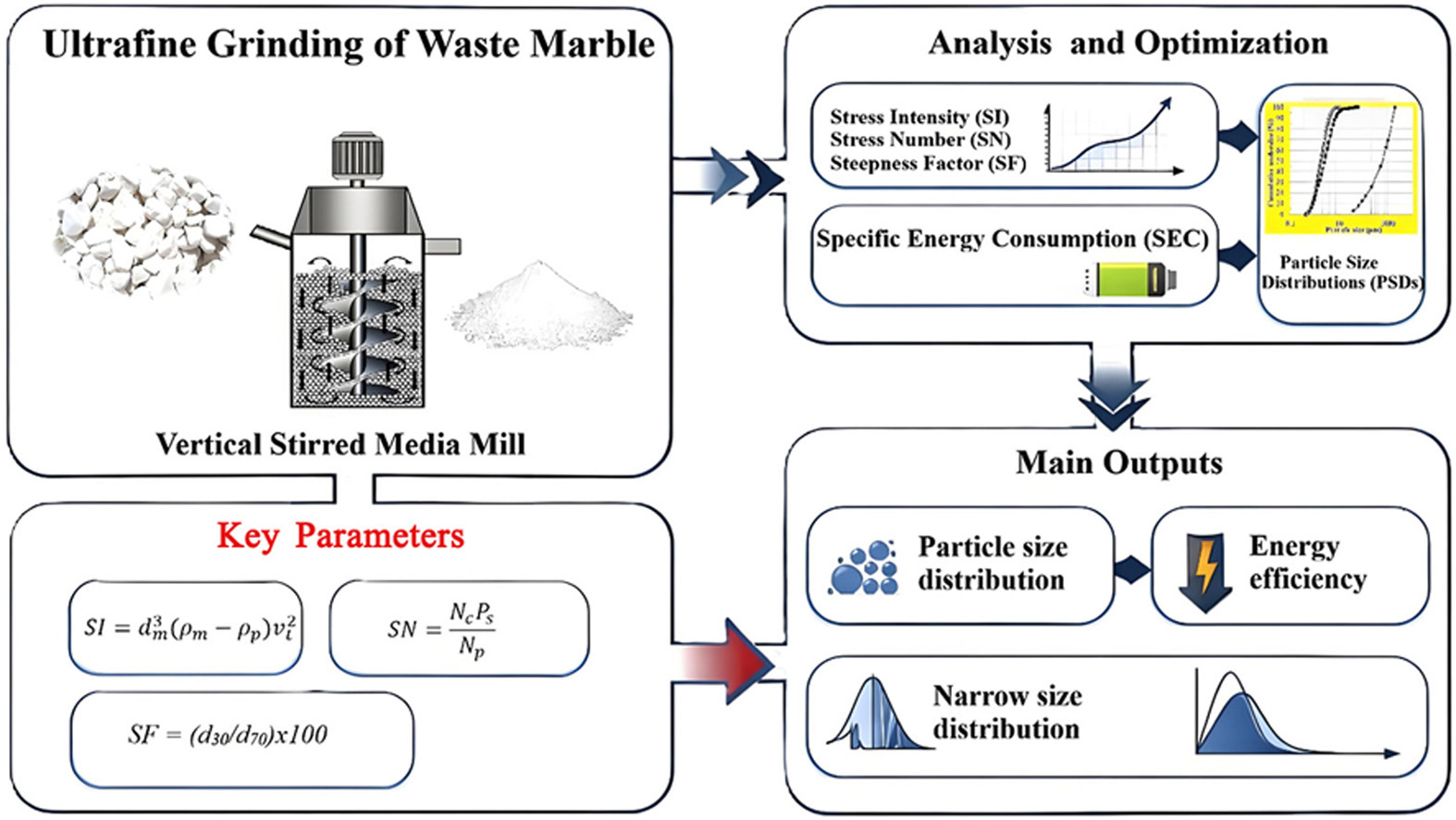
The valorization of waste marble into high-value ultra-fine calcium carbonate powders presents significant challenges related to energy consumption and process control. This study provides a comprehensive optimization of the wet grinding of waste marble in a vertical stirred media mill, integrating physical parameters with chemical rheology control. A systematic investigation of grinding time, stirrer speed, media filling ratio, solids content, and media size revealed that process performance is fundamentally constrained by pulp rheology. High viscosity at solids concentrations above 70 wt% limited grinding efficiency, establishing a performance ceiling for purely physical optimization. To overcome this, the efficacy of inorganic and polymeric dispersants was evaluated. The addition of 0.4 wt% of a polymeric dispersant proved to be a critical enabling technology, transforming the rheological state of the pulp. This chemical intervention synergistically unlocked the potential of a high-solids (70 wt%), high-collision-frequency (2 mm media) grinding regime that was previously inefficient. The globally optimized process yielded a final product with an ultra-fine median particle size (d50) of 1.63 μm, exceptional whiteness (99.05%), and a high specific surface area (11.06 m2/g), all achieved at a competitive specific energy consumption of 318 kWh/t. This work demonstrates that a holistic optimization approach, where pulp chemistry is treated as a primary design parameter alongside mill mechanics, is essential for the energy-efficient production of high-quality mineral powders from industrial waste.
Graphical abstract
Keywords
Waste marble; Vertical stirred media milling; Ultra-fine grinding; Rheology; Process optimization
文章导读