
期刊文章
过刊浏览
- Volumes 108-119 (2025)
-
Volumes 96-107 (2025)
-
Volume 107
Pages 1-376 (December 2025)
-
Volume 106
Pages 1-336 (November 2025)
-
Volume 105
Pages 1-356 (October 2025)
-
Volume 104
Pages 1-332 (September 2025)
-
Volume 103
Pages 1-314 (August 2025)
-
Volume 102
Pages 1-276 (July 2025)
-
Volume 101
Pages 1-166 (June 2025)
-
Volume 100
Pages 1-256 (May 2025)
-
Volume 99
Pages 1-242 (April 2025)
-
Volume 98
Pages 1-288 (March 2025)
-
Volume 97
Pages 1-256 (February 2025)
-
Volume 96
Pages 1-340 (January 2025)
-
Volume 107
-
Volumes 84-95 (2024)
-
Volume 95
Pages 1-392 (December 2024)
-
Volume 94
Pages 1-400 (November 2024)
-
Volume 93
Pages 1-376 (October 2024)
-
Volume 92
Pages 1-316 (September 2024)
-
Volume 91
Pages 1-378 (August 2024)
-
Volume 90
Pages 1-580 (July 2024)
-
Volume 89
Pages 1-278 (June 2024)
-
Volume 88
Pages 1-350 (May 2024)
-
Volume 87
Pages 1-338 (April 2024)
-
Volume 86
Pages 1-312 (March 2024)
-
Volume 85
Pages 1-334 (February 2024)
-
Volume 84
Pages 1-308 (January 2024)
-
Volume 95
-
Volumes 72-83 (2023)
-
Volume 83
Pages 1-258 (December 2023)
-
Volume 82
Pages 1-204 (November 2023)
-
Volume 81
Pages 1-188 (October 2023)
-
Volume 80
Pages 1-202 (September 2023)
-
Volume 79
Pages 1-172 (August 2023)
-
Volume 78
Pages 1-146 (July 2023)
-
Volume 77
Pages 1-152 (June 2023)
-
Volume 76
Pages 1-176 (May 2023)
-
Volume 75
Pages 1-228 (April 2023)
-
Volume 74
Pages 1-200 (March 2023)
-
Volume 73
Pages 1-138 (February 2023)
-
Volume 72
Pages 1-144 (January 2023)
-
Volume 83
-
Volumes 60-71 (2022)
-
Volume 71
Pages 1-108 (December 2022)
-
Volume 70
Pages 1-106 (November 2022)
-
Volume 69
Pages 1-122 (October 2022)
-
Volume 68
Pages 1-124 (September 2022)
-
Volume 67
Pages 1-102 (August 2022)
-
Volume 66
Pages 1-112 (July 2022)
-
Volume 65
Pages 1-138 (June 2022)
-
Volume 64
Pages 1-186 (May 2022)
-
Volume 63
Pages 1-124 (April 2022)
-
Volume 62
Pages 1-104 (March 2022)
-
Volume 61
Pages 1-120 (February 2022)
-
Volume 60
Pages 1-124 (January 2022)
-
Volume 71
- Volumes 54-59 (2021)
- Volumes 48-53 (2020)
- Volumes 42-47 (2019)
- Volumes 36-41 (2018)
- Volumes 30-35 (2017)
- Volumes 24-29 (2016)
- Volumes 18-23 (2015)
- Volumes 12-17 (2014)
- Volume 11 (2013)
- Volume 10 (2012)
- Volume 9 (2011)
- Volume 8 (2010)
- Volume 7 (2009)
- Volume 6 (2008)
- Volume 5 (2007)
- Volume 4 (2006)
- Volume 3 (2005)
- Volume 2 (2004)
- Volume 1 (2003)
Volume 113
Fatiha, R. A., Ngabdi, C. K., Azizah, J. S., Lestari, B., Malek, N. A. N. N., & Permatasari, H. K. (2026). Metallic nanoparticles in cervical cancer therapy: A molecular perspective on modulating sensitivity to conventional treatments. Particuology, 113, 264-280. https://doi.org/10.1016/j.partic.2026.03.029
Metallic nanoparticles in cervical cancer therapy: A molecular perspective on modulating sensitivity to conventional treatments
Raisha Anis Fatiha a, Christian Kencana Ngabdi a, Jihan Salwa Azizah a, Bayu Lestari b, Nik Ahmad Nizam Nik Malek c d, Happy Kurnia Permatasari e *
a Master of Biomedical Sciences, Faculty of Medicine, Brawijaya University, Malang, 65145, Indonesia
b Pharmacology Department, Faculty of Medicine, Brawijaya University, Malang, 65145, Indonesia
c Department of Biosciences, Faculty of Science, Universiti Teknologi Malaysia, Skudai, 81310, Malaysia
d Centre for Sustainable Nanomaterials (CSNano), Ibnu Sina Institute for Scientific and Industrial Research, Universiti Teknologi Malaysia, Skudai, 81310, Malaysia
e Biochemistry and Biomolecular Department, Faculty of Medicine, Brawijaya University, Malang, 65145, Indonesia
10.1016/j.partic.2026.03.029
Volume 113,
June 2026,
Pages 264-280
Received 5 June 2025, Revised 9 March 2026, Accepted 20 March 2026, Available online 1 April 2026, Version of Record 8 April 2026.
E-mail:
happykp@ub.ac.id
Highlights
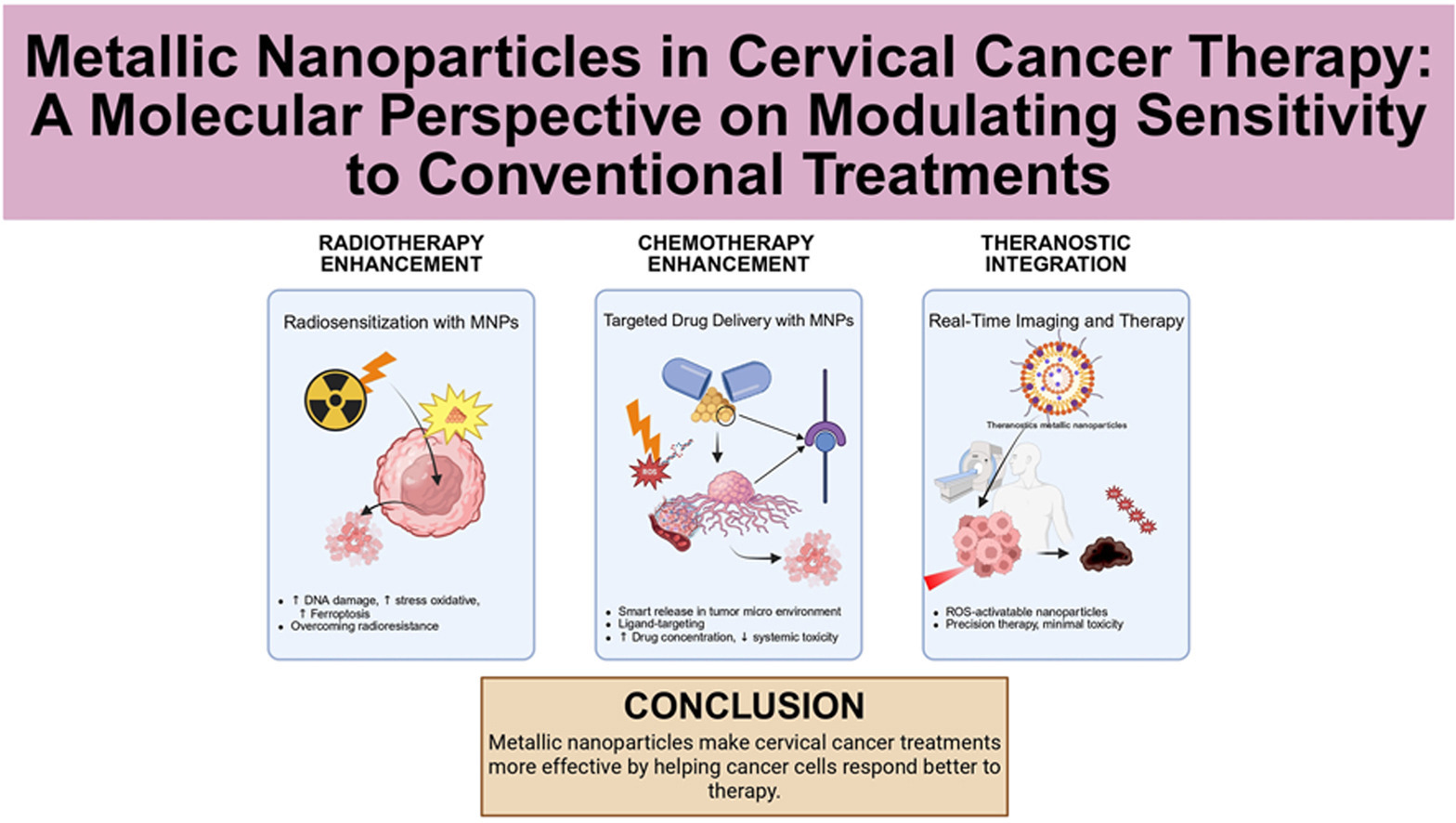
• Metallic nanoparticles enhance radiotherapy via radiosensitization effects.
• Smart drug-loaded MNPs improve chemotherapy precision and reduce toxicity.
• Dual-action MNPs trigger ROS and ferroptosis in cervical cancer cells.
• Theranostic MNPs integrate imaging and treatment in real-time interventions.
• Multifunctional nanoplatforms overcome therapy resistance in cervical cancer.
Abstract
Metallic nanoparticles (MNPs), particularly gold nanoparticles (AuNPs) and superparamagnetic iron oxide nanoparticles (SPIONs), are emerging as multifunctional platforms that enhance the sensitivity of cervical cancer to conventional treatments through synergistic mechanisms. Cervical cancer frequently exhibits resistance to radiotherapy (RT) and chemotherapy, driven by HPV-associated molecular alterations and tumor microenvironmental factors. High atomic number (Z) MNPs, such as AuNPs, act as effective radiosensitizers by amplifying localized radiation dose deposition, thereby increasing DNA double-strand breaks and impairing DNA repair processes during RT. In parallel, MNP-mediated reactive oxygen species (ROS) generation and ferroptosis induction further potentiate chemoradiotherapy-induced cytotoxicity and help overcome radioresistance. As targeted drug delivery systems, MNPs enable ligand-directed and stimuli-responsive release of chemotherapeutic agents, enhancing intracellular drug accumulation and circumventing drug resistance mechanisms while reducing systemic toxicity. Moreover, SPIONs and AuNP-based theranostic platforms facilitate image-guided treatment planning and monitoring, supporting precision and adaptive cervical cancer therapy. Collectively, these findings highlight the potential of clinically relevant MNPs as adjuvant modulators of chemoradiotherapy sensitivity, offering promising strategies to improve therapeutic efficacy and personalization in cervical cancer management.
Graphical abstract
Keywords
Metallic nanoparticles (MNPs); Cervical cancer; Radiosensitization; Drug resistance; HPV; Targeted drug delivery
文章导读