
期刊文章
过刊浏览
- Volumes 108-119 (2025)
-
Volumes 96-107 (2025)
-
Volume 107
Pages 1-376 (December 2025)
-
Volume 106
Pages 1-336 (November 2025)
-
Volume 105
Pages 1-356 (October 2025)
-
Volume 104
Pages 1-332 (September 2025)
-
Volume 103
Pages 1-314 (August 2025)
-
Volume 102
Pages 1-276 (July 2025)
-
Volume 101
Pages 1-166 (June 2025)
-
Volume 100
Pages 1-256 (May 2025)
-
Volume 99
Pages 1-242 (April 2025)
-
Volume 98
Pages 1-288 (March 2025)
-
Volume 97
Pages 1-256 (February 2025)
-
Volume 96
Pages 1-340 (January 2025)
-
Volume 107
-
Volumes 84-95 (2024)
-
Volume 95
Pages 1-392 (December 2024)
-
Volume 94
Pages 1-400 (November 2024)
-
Volume 93
Pages 1-376 (October 2024)
-
Volume 92
Pages 1-316 (September 2024)
-
Volume 91
Pages 1-378 (August 2024)
-
Volume 90
Pages 1-580 (July 2024)
-
Volume 89
Pages 1-278 (June 2024)
-
Volume 88
Pages 1-350 (May 2024)
-
Volume 87
Pages 1-338 (April 2024)
-
Volume 86
Pages 1-312 (March 2024)
-
Volume 85
Pages 1-334 (February 2024)
-
Volume 84
Pages 1-308 (January 2024)
-
Volume 95
-
Volumes 72-83 (2023)
-
Volume 83
Pages 1-258 (December 2023)
-
Volume 82
Pages 1-204 (November 2023)
-
Volume 81
Pages 1-188 (October 2023)
-
Volume 80
Pages 1-202 (September 2023)
-
Volume 79
Pages 1-172 (August 2023)
-
Volume 78
Pages 1-146 (July 2023)
-
Volume 77
Pages 1-152 (June 2023)
-
Volume 76
Pages 1-176 (May 2023)
-
Volume 75
Pages 1-228 (April 2023)
-
Volume 74
Pages 1-200 (March 2023)
-
Volume 73
Pages 1-138 (February 2023)
-
Volume 72
Pages 1-144 (January 2023)
-
Volume 83
-
Volumes 60-71 (2022)
-
Volume 71
Pages 1-108 (December 2022)
-
Volume 70
Pages 1-106 (November 2022)
-
Volume 69
Pages 1-122 (October 2022)
-
Volume 68
Pages 1-124 (September 2022)
-
Volume 67
Pages 1-102 (August 2022)
-
Volume 66
Pages 1-112 (July 2022)
-
Volume 65
Pages 1-138 (June 2022)
-
Volume 64
Pages 1-186 (May 2022)
-
Volume 63
Pages 1-124 (April 2022)
-
Volume 62
Pages 1-104 (March 2022)
-
Volume 61
Pages 1-120 (February 2022)
-
Volume 60
Pages 1-124 (January 2022)
-
Volume 71
- Volumes 54-59 (2021)
- Volumes 48-53 (2020)
- Volumes 42-47 (2019)
- Volumes 36-41 (2018)
- Volumes 30-35 (2017)
- Volumes 24-29 (2016)
- Volumes 18-23 (2015)
- Volumes 12-17 (2014)
- Volume 11 (2013)
- Volume 10 (2012)
- Volume 9 (2011)
- Volume 8 (2010)
- Volume 7 (2009)
- Volume 6 (2008)
- Volume 5 (2007)
- Volume 4 (2006)
- Volume 3 (2005)
- Volume 2 (2004)
- Volume 1 (2003)
Volume 113
Garmsirian, M., Behbahani, R. M., & Khosravi-Nikou, M. R. (2026). High-fidelity CFD analysis of catalyst regeneration in a pilot-scale MTO fluidized bed reactor: A comparative assessment of LES and RANS models. Particuology, 113, 281-297. https://doi.org/10.1016/j.partic.2026.02.033
High-fidelity CFD analysis of catalyst regeneration in a pilot-scale MTO fluidized bed reactor: A comparative assessment of LES and RANS models
Mahdieh Garmsirian, Reza Mosayebbi Behbahani *, Mohammad Reza Khosravi-Nikou
Department of Gas Engineering, Ahvaz Faculty of Petroleum, Petroleum University of Technology (PUT), Ahvaz, Iran
10.1016/j.partic.2026.02.033
Volume 113,
June 2026,
Pages 281-297
Received 9 December 2025, Revised 26 January 2026, Accepted 14 February 2026, Available online 21 March 2026, Version of Record 8 April 2026.
E-mail:
behbahani@put.ac.ir
Highlights
• Direct comparison of LES and RANS for pilot-scale MTO catalyst regeneration.
• LES predicts temperature, velocity, and species more accurately than RANS.
• RANS shows higher deviations, missing transient phenomena like bubbles.
• LES requires ∼9 × more computational resources than RANS.
• Guidelines for model selection and hybrid LES/RANS strategies for industry.
Abstract
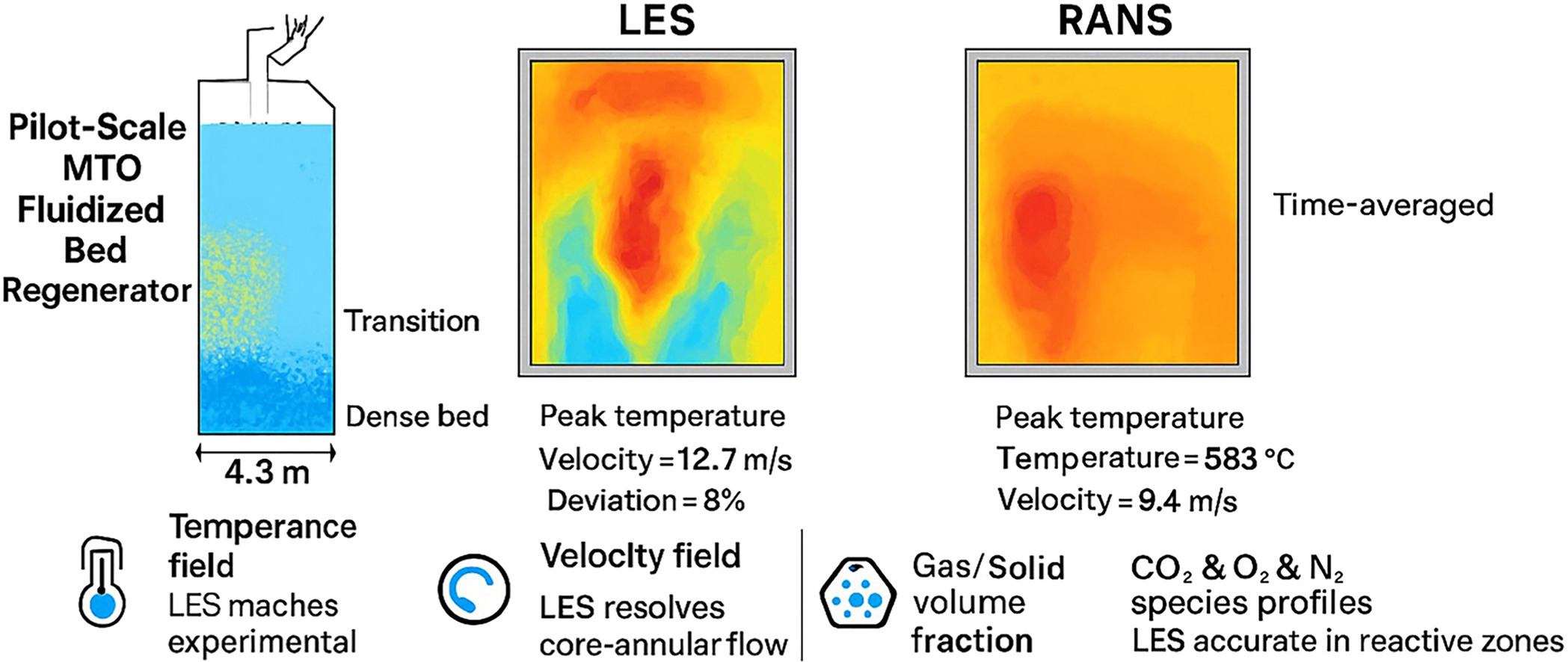
The regeneration of catalysts in fluidized bed reactors is a critical process in methanol-to-olefins (MTO) technology, where computational fluid dynamics (CFD) plays a pivotal role in optimizing performance. This study presents a comprehensive comparison of two turbulence modeling approaches Large Eddy Simulation (LES) and Reynolds-Averaged Navier-Stokes (RANS) for simulating the catalyst regeneration zone in a pilot-scale MTO reactor. Using ANSYS Fluent 2024 R2, both models were validated against published experimental data from the literature, evaluating their accuracy in predicting temperature distributions, velocity fields, gas-solid volume fractions, and species transport.
These results highlight the specific impact of turbulence modeling on temperature, velocity, etc. predictions., with deviations below 8% for critical parameters such as peak temperatures (669 °C vs. experimental 670–690 °C) and velocity profiles (12.7 m/s vs. PIV data). In contrast, RANS exhibits higher deviations (10–18%) due to its time-averaged nature, particularly in resolving transient phenomena like bubble dynamics and localized hot spots. However, LES demands significantly higher computational resources (∼1600 CPU-hours vs. RANS's ∼180 CPU-hours), highlighting a trade-off between fidelity and efficiency.
The study further proposes hybrid modeling strategies and design optimizations, such as refined gas distributor geometries and secondary air injection, to enhance combustion uniformity. These insights bridge the gap between academic research and industrial application, offering actionable guidelines for model selection in MTO reactor design and scale-up. The results underscore LES as the preferred choice for detailed analysis, while RANS remains viable for preliminary simulations where computational cost is a constraint.
Graphical abstract
Keywords
Catalyst regeneration; Fluidized bed reactor; CFD validation; Turbulence modeling; Combustion dynamics
文章导读