
期刊文章
过刊浏览
- Volumes 108-119 (2025)
-
Volumes 96-107 (2025)
-
Volume 107
Pages 1-376 (December 2025)
-
Volume 106
Pages 1-336 (November 2025)
-
Volume 105
Pages 1-356 (October 2025)
-
Volume 104
Pages 1-332 (September 2025)
-
Volume 103
Pages 1-314 (August 2025)
-
Volume 102
Pages 1-276 (July 2025)
-
Volume 101
Pages 1-166 (June 2025)
-
Volume 100
Pages 1-256 (May 2025)
-
Volume 99
Pages 1-242 (April 2025)
-
Volume 98
Pages 1-288 (March 2025)
-
Volume 97
Pages 1-256 (February 2025)
-
Volume 96
Pages 1-340 (January 2025)
-
Volume 107
-
Volumes 84-95 (2024)
-
Volume 95
Pages 1-392 (December 2024)
-
Volume 94
Pages 1-400 (November 2024)
-
Volume 93
Pages 1-376 (October 2024)
-
Volume 92
Pages 1-316 (September 2024)
-
Volume 91
Pages 1-378 (August 2024)
-
Volume 90
Pages 1-580 (July 2024)
-
Volume 89
Pages 1-278 (June 2024)
-
Volume 88
Pages 1-350 (May 2024)
-
Volume 87
Pages 1-338 (April 2024)
-
Volume 86
Pages 1-312 (March 2024)
-
Volume 85
Pages 1-334 (February 2024)
-
Volume 84
Pages 1-308 (January 2024)
-
Volume 95
-
Volumes 72-83 (2023)
-
Volume 83
Pages 1-258 (December 2023)
-
Volume 82
Pages 1-204 (November 2023)
-
Volume 81
Pages 1-188 (October 2023)
-
Volume 80
Pages 1-202 (September 2023)
-
Volume 79
Pages 1-172 (August 2023)
-
Volume 78
Pages 1-146 (July 2023)
-
Volume 77
Pages 1-152 (June 2023)
-
Volume 76
Pages 1-176 (May 2023)
-
Volume 75
Pages 1-228 (April 2023)
-
Volume 74
Pages 1-200 (March 2023)
-
Volume 73
Pages 1-138 (February 2023)
-
Volume 72
Pages 1-144 (January 2023)
-
Volume 83
-
Volumes 60-71 (2022)
-
Volume 71
Pages 1-108 (December 2022)
-
Volume 70
Pages 1-106 (November 2022)
-
Volume 69
Pages 1-122 (October 2022)
-
Volume 68
Pages 1-124 (September 2022)
-
Volume 67
Pages 1-102 (August 2022)
-
Volume 66
Pages 1-112 (July 2022)
-
Volume 65
Pages 1-138 (June 2022)
-
Volume 64
Pages 1-186 (May 2022)
-
Volume 63
Pages 1-124 (April 2022)
-
Volume 62
Pages 1-104 (March 2022)
-
Volume 61
Pages 1-120 (February 2022)
-
Volume 60
Pages 1-124 (January 2022)
-
Volume 71
- Volumes 54-59 (2021)
- Volumes 48-53 (2020)
- Volumes 42-47 (2019)
- Volumes 36-41 (2018)
- Volumes 30-35 (2017)
- Volumes 24-29 (2016)
- Volumes 18-23 (2015)
- Volumes 12-17 (2014)
- Volume 11 (2013)
- Volume 10 (2012)
- Volume 9 (2011)
- Volume 8 (2010)
- Volume 7 (2009)
- Volume 6 (2008)
- Volume 5 (2007)
- Volume 4 (2006)
- Volume 3 (2005)
- Volume 2 (2004)
- Volume 1 (2003)
Volume 113
Kumar, N., Sarkar, S., Anand, T. N. C., & Bakshi, S. (2026). Effect of over-pressure on size distribution and morphology of copper powder produced by gas-atomization. Particuology, 113, 298-311. https://doi.org/10.1016/j.partic.2026.03.025
Effect of over-pressure on size distribution and morphology of copper powder produced by gas-atomization
Niraj Kumar a, Supriya Sarkar b, T.N.C. Anand c, Shamit Bakshi a *
a Department of Mechanical Engineering, Indian Institute of Technology Madras, Chennai, India
b Alleima India Pvt. Ltd., Pune, Maharashtra, India
c Department of Mechanical Engineering, Indian Institute of Technology Palakkad, Kerala, India
10.1016/j.partic.2026.03.025
Volume 113,
June 2026,
Pages 298-311
Received 14 January 2026, Revised 5 March 2026, Accepted 19 March 2026, Available online 1 April 2026, Version of Record 8 April 2026.
E-mail:
shamit@iitm.ac.in
Highlights
• Over-pressure affects the size distribution and morphology of copper powder.
• Particle size (d50) of the powder increases with over-pressure.
• Sphericity, smoothness and flowability of the particles improved with over-pressure.
• Yield of coarse particles increases with over-pressure.
Abstract
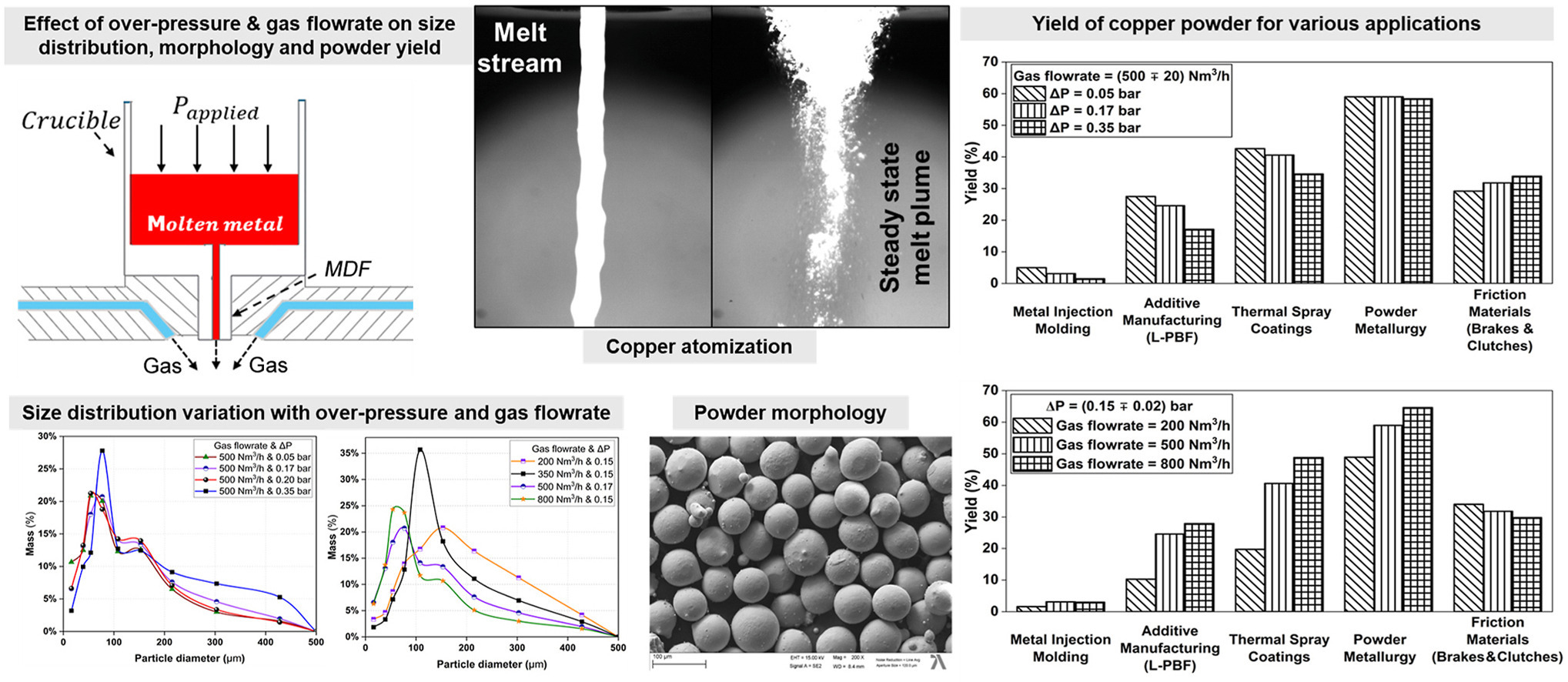
Copper powder is widely used in several industrial applications where specific particle size ranges and morphological characteristics are required. In this study, a systematic experimental investigation was carried out to examine the influence of over-pressure applied to the molten metal and atomizing gas flowrate on the particle size distribution, spread, morphology, flowability, and yield of gas-atomized copper powder using an over-expanded condition for the atomizer exit. It is seen that the over-pressure plays a critical role in governing not only the mass median diameter (d50) but also particle morphology, spread of the particle size distribution, and flow performance. For a fixed gas flowrate, increasing over-pressure results in coarser particles with improved sphericity in terms of lesser satellite formation, smoother surface, and enhanced flowability. The combined effect of over-pressure and gas flowrate on particle size spread and application-specific size windows was quantitatively established. High-speed visualization further revealed that variations in over-pressure influence melt stream stability and undisturbed jet length. The findings show that optimized combinations of higher gas flowrate and lower over-pressure improve powder yield within industrially relevant size ranges. Overall, this study provides mechanistic insight and practical guidance for tailoring copper powder characteristics through controlled adjustment of over-pressure and gas flowrate.
Graphical abstract
Keywords
Gas-atomization; Over-pressure; Gas-to-metal ratio (GMR); Yield; Mass median size (d50); Flowability
文章导读