
期刊文章
过刊浏览
- Volumes 108-119 (2025)
-
Volumes 96-107 (2025)
-
Volume 107
Pages 1-376 (December 2025)
-
Volume 106
Pages 1-336 (November 2025)
-
Volume 105
Pages 1-356 (October 2025)
-
Volume 104
Pages 1-332 (September 2025)
-
Volume 103
Pages 1-314 (August 2025)
-
Volume 102
Pages 1-276 (July 2025)
-
Volume 101
Pages 1-166 (June 2025)
-
Volume 100
Pages 1-256 (May 2025)
-
Volume 99
Pages 1-242 (April 2025)
-
Volume 98
Pages 1-288 (March 2025)
-
Volume 97
Pages 1-256 (February 2025)
-
Volume 96
Pages 1-340 (January 2025)
-
Volume 107
-
Volumes 84-95 (2024)
-
Volume 95
Pages 1-392 (December 2024)
-
Volume 94
Pages 1-400 (November 2024)
-
Volume 93
Pages 1-376 (October 2024)
-
Volume 92
Pages 1-316 (September 2024)
-
Volume 91
Pages 1-378 (August 2024)
-
Volume 90
Pages 1-580 (July 2024)
-
Volume 89
Pages 1-278 (June 2024)
-
Volume 88
Pages 1-350 (May 2024)
-
Volume 87
Pages 1-338 (April 2024)
-
Volume 86
Pages 1-312 (March 2024)
-
Volume 85
Pages 1-334 (February 2024)
-
Volume 84
Pages 1-308 (January 2024)
-
Volume 95
-
Volumes 72-83 (2023)
-
Volume 83
Pages 1-258 (December 2023)
-
Volume 82
Pages 1-204 (November 2023)
-
Volume 81
Pages 1-188 (October 2023)
-
Volume 80
Pages 1-202 (September 2023)
-
Volume 79
Pages 1-172 (August 2023)
-
Volume 78
Pages 1-146 (July 2023)
-
Volume 77
Pages 1-152 (June 2023)
-
Volume 76
Pages 1-176 (May 2023)
-
Volume 75
Pages 1-228 (April 2023)
-
Volume 74
Pages 1-200 (March 2023)
-
Volume 73
Pages 1-138 (February 2023)
-
Volume 72
Pages 1-144 (January 2023)
-
Volume 83
-
Volumes 60-71 (2022)
-
Volume 71
Pages 1-108 (December 2022)
-
Volume 70
Pages 1-106 (November 2022)
-
Volume 69
Pages 1-122 (October 2022)
-
Volume 68
Pages 1-124 (September 2022)
-
Volume 67
Pages 1-102 (August 2022)
-
Volume 66
Pages 1-112 (July 2022)
-
Volume 65
Pages 1-138 (June 2022)
-
Volume 64
Pages 1-186 (May 2022)
-
Volume 63
Pages 1-124 (April 2022)
-
Volume 62
Pages 1-104 (March 2022)
-
Volume 61
Pages 1-120 (February 2022)
-
Volume 60
Pages 1-124 (January 2022)
-
Volume 71
- Volumes 54-59 (2021)
- Volumes 48-53 (2020)
- Volumes 42-47 (2019)
- Volumes 36-41 (2018)
- Volumes 30-35 (2017)
- Volumes 24-29 (2016)
- Volumes 18-23 (2015)
- Volumes 12-17 (2014)
- Volume 11 (2013)
- Volume 10 (2012)
- Volume 9 (2011)
- Volume 8 (2010)
- Volume 7 (2009)
- Volume 6 (2008)
- Volume 5 (2007)
- Volume 4 (2006)
- Volume 3 (2005)
- Volume 2 (2004)
- Volume 1 (2003)
Volume 113
Dinç, N. İ., Türk, T., Marchand, J.-L., Ulusoy, U., & Burat, F. (2026). Effect of particle shape on the gravity and magnetic separation of wollastonite from pyroxene group minerals. Particuology, 113, 312-323. https://doi.org/10.1016/j.partic.2026.03.031
Effect of particle shape on the gravity and magnetic separation of wollastonite from pyroxene group minerals
Nazlım İlkyaz Dinç a, Tülay Türk a, Jean-Luc Marchand b, Ugur Ulusoy c, Fırat Burat a *
a Mineral Processing Engineering Department, TRecycle Research Group, Istanbul Technical University, Faculty of Mines, Maslak, 34469, Istanbul, Türkiye
b Saint Gobain, 12 place de l’Iris, 92096, La Défense Cedex, France
c Faculty of Engineering, Chemical Engineering Department, Sivas Cumhuriyet University, 58140, Sivas, Türkiye
10.1016/j.partic.2026.03.031
Volume 113,
June 2026,
Pages 312-323
Received 7 January 2026, Revised 13 February 2026, Accepted 26 March 2026, Available online 3 April 2026, Version of Record 9 April 2026.
E-mail:
buratf@itu.edu.tr
Highlights
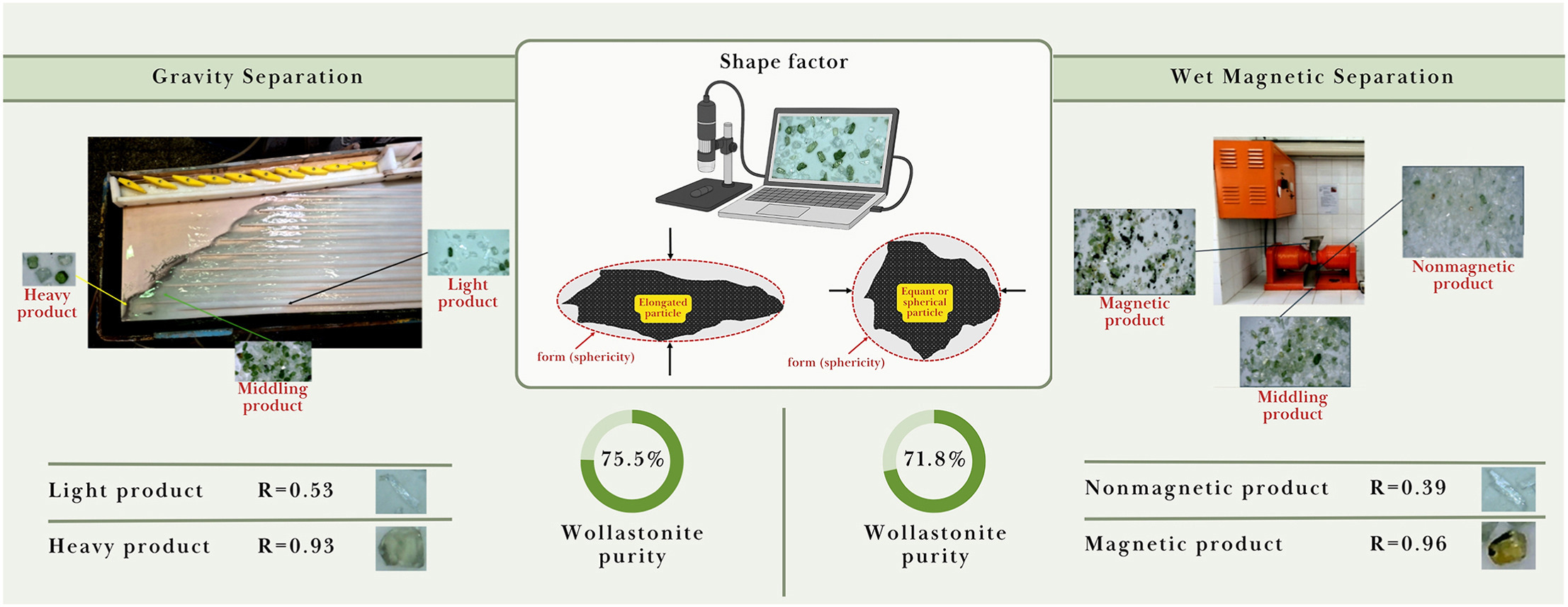
• Gravity and wet magnetic separation behavior are significantly influenced by particle shape.
• Wollastonite that resembles a needle preferentially reports to non-magnetic and light products.
• Particles of equant pyroxene concentrate in magnetic and heavy products.
• Wet magnetic separation concentrate produced 71.8% wollastonite and 0.79% Fe2O3.
• Selectivity and separation efficiency can be enhanced by shape-controlled grinding.
Abstract
Wollastonite is widely used as a reinforcing filler in glass and ceramic applications due to its alkali-free composition, low coefficient of thermal expansion, and needle-like morphology, which enhance mechanical strength, dimensional stability, and thermal resistance. Its suitability is also related to its high CaO and SiO2 contents and low levels of volatile impurities. This study evaluates the beneficiation performance of shaking table and wet magnetic separation, with particular emphasis on particle shape in addition to particle size, density, and magnetic susceptibility. Shaking table tests increased wollastonite content from 52.1% in the run-of-mine ore to 60.8% in the coarse light product and 75.5% in the fine light product, while reducing Fe2O3 to 1.37% and 1.01%, respectively. Wet magnetic separation further improved concentrate quality, producing a non-magnetic product containing 71.8% wollastonite with a reduced Fe2O3 content of 0.79%. Quantitative particle shape analysis based on aspect ratio and roundness revealed that elongated, needle-like particles preferentially reported to light and non-magnetic products, whereas more equant particles concentrated in heavy and magnetic fractions. These findings highlight the influence of morphology-driven separation behavior and indicate that controlling particle shape through appropriate grinding strategies can improve selectivity and support high-purity wollastonite production.
Graphical abstract
Keywords
Wollastonite; Particle shape; Shaking table; Wet magnetic separation; Gravity separation; Ceramic and glass raw materials
文章导读