
期刊文章
过刊浏览
- Volumes 108-119 (2025)
-
Volumes 96-107 (2025)
-
Volume 107
Pages 1-376 (December 2025)
-
Volume 106
Pages 1-336 (November 2025)
-
Volume 105
Pages 1-356 (October 2025)
-
Volume 104
Pages 1-332 (September 2025)
-
Volume 103
Pages 1-314 (August 2025)
-
Volume 102
Pages 1-276 (July 2025)
-
Volume 101
Pages 1-166 (June 2025)
-
Volume 100
Pages 1-256 (May 2025)
-
Volume 99
Pages 1-242 (April 2025)
-
Volume 98
Pages 1-288 (March 2025)
-
Volume 97
Pages 1-256 (February 2025)
-
Volume 96
Pages 1-340 (January 2025)
-
Volume 107
-
Volumes 84-95 (2024)
-
Volume 95
Pages 1-392 (December 2024)
-
Volume 94
Pages 1-400 (November 2024)
-
Volume 93
Pages 1-376 (October 2024)
-
Volume 92
Pages 1-316 (September 2024)
-
Volume 91
Pages 1-378 (August 2024)
-
Volume 90
Pages 1-580 (July 2024)
-
Volume 89
Pages 1-278 (June 2024)
-
Volume 88
Pages 1-350 (May 2024)
-
Volume 87
Pages 1-338 (April 2024)
-
Volume 86
Pages 1-312 (March 2024)
-
Volume 85
Pages 1-334 (February 2024)
-
Volume 84
Pages 1-308 (January 2024)
-
Volume 95
-
Volumes 72-83 (2023)
-
Volume 83
Pages 1-258 (December 2023)
-
Volume 82
Pages 1-204 (November 2023)
-
Volume 81
Pages 1-188 (October 2023)
-
Volume 80
Pages 1-202 (September 2023)
-
Volume 79
Pages 1-172 (August 2023)
-
Volume 78
Pages 1-146 (July 2023)
-
Volume 77
Pages 1-152 (June 2023)
-
Volume 76
Pages 1-176 (May 2023)
-
Volume 75
Pages 1-228 (April 2023)
-
Volume 74
Pages 1-200 (March 2023)
-
Volume 73
Pages 1-138 (February 2023)
-
Volume 72
Pages 1-144 (January 2023)
-
Volume 83
-
Volumes 60-71 (2022)
-
Volume 71
Pages 1-108 (December 2022)
-
Volume 70
Pages 1-106 (November 2022)
-
Volume 69
Pages 1-122 (October 2022)
-
Volume 68
Pages 1-124 (September 2022)
-
Volume 67
Pages 1-102 (August 2022)
-
Volume 66
Pages 1-112 (July 2022)
-
Volume 65
Pages 1-138 (June 2022)
-
Volume 64
Pages 1-186 (May 2022)
-
Volume 63
Pages 1-124 (April 2022)
-
Volume 62
Pages 1-104 (March 2022)
-
Volume 61
Pages 1-120 (February 2022)
-
Volume 60
Pages 1-124 (January 2022)
-
Volume 71
- Volumes 54-59 (2021)
- Volumes 48-53 (2020)
- Volumes 42-47 (2019)
- Volumes 36-41 (2018)
- Volumes 30-35 (2017)
- Volumes 24-29 (2016)
- Volumes 18-23 (2015)
- Volumes 12-17 (2014)
- Volume 11 (2013)
- Volume 10 (2012)
- Volume 9 (2011)
- Volume 8 (2010)
- Volume 7 (2009)
- Volume 6 (2008)
- Volume 5 (2007)
- Volume 4 (2006)
- Volume 3 (2005)
- Volume 2 (2004)
- Volume 1 (2003)
Volume 113
Chen, L., Liang, Q., Jiang, Z., Zou, X., Xu, T., Li, W., . . . Zhang, W. (2026). Maximizing the exposure of (311) facets of L12-Pt3Fe nanocatalysts via tuning supports for optimal hydrogen evolution. Particuology, 113, 324-331. https://doi.org/10.1016/j.partic.2026.03.033
Maximizing the exposure of (311) facets of L12-Pt3Fe nanocatalysts via tuning supports for optimal hydrogen evolution
Long Chen, Qing Liang *, Zhou Jiang, Xu Zou, Tiantian Xu, Wenwen Li, Fuxi Liu, Ye Liang, Donghang Hu, Wei Zhang *
Key Laboratory of Automobile Materials Ministry of Education, School of Materials Science & Engineering, Electron Microscopy Center, International Center of Future Science, Changbaishan Laboratory, Jilin University, Changchun, 130012, China
10.1016/j.partic.2026.03.033
Volume 113,
June 2026,
Pages 324-331
Received 27 January 2026, Revised 24 March 2026, Accepted 26 March 2026, Available online 3 April 2026, Version of Record 9 April 2026.
E-mail:
qingliang@jlu.edu.cn; weizhang@jlu.edu.cn
Highlights
• Pt3Fe/AC exhibits unprecedented (311) facet exposure in sub-2 nm NPs.
• Pt3Fe/AC shows a 22 mV overpotential at 10 mA cm−2, a 28.8 mV dec−1 Tafel slope.
• Sub-2 nm Pt3Fe NPs were exposed with 13.4% (311) facets.
• Pt3Fe/AC optimized the hydrogen adsorption free energy (ΔGH∗ = −0.23 eV) in HER.
Abstract
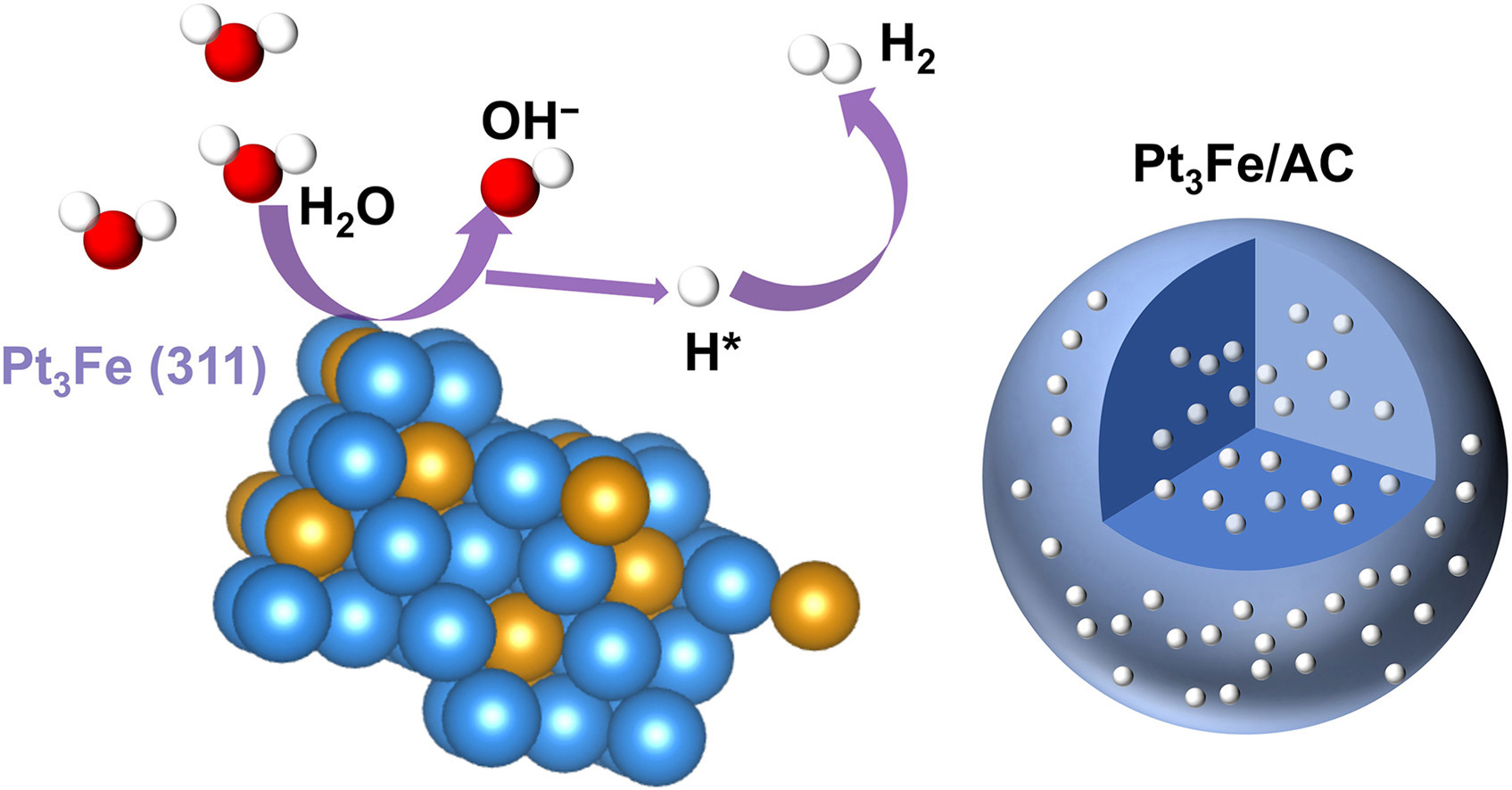
In the hydrogen evolution reaction (HER), tuning the d-band center of platinum through the incorporation of iron represents a promising strategy. We utilize three carbon supports to anchor L12-ordered Pt3Fe nanoparticles (NPs) for alkaline HER. As the choice of support renders changes in the size of Pt3Fe NPs, larger proportion of high-index (311) facets are exposed. Result reveals that ∼2 nm Pt3Fe/AC NPs were exposed with 13.4% high-index (311) facets. Density functional theory (DFT) calculation demonstrates that the exposed (311) facets play a critical role in enhancing catalytic performance. The optimized Pt3Fe/AC catalyst achieves an ultralow overpotential of 22 mV. Ascribed to the synergistic effect of support-induced ultra-small NP size and the presence of high-index facets (311) in L12-Pt3Fe NPs, it maximizes active sites exposure and thereby optimizes hydrogen adsorption kinetics. Our study provides new insights into the rational design of support-mediated nanocatalysts with desired facets for efficient energy conversion.
Graphical abstract
Keywords
Hydrogen evolution reaction; High-index facets; Structure-activity relationship; Pt-Fe intermetallic compounds
文章导读