
期刊文章
过刊浏览
- Volumes 108-119 (2025)
-
Volumes 96-107 (2025)
-
Volume 107
Pages 1-376 (December 2025)
-
Volume 106
Pages 1-336 (November 2025)
-
Volume 105
Pages 1-356 (October 2025)
-
Volume 104
Pages 1-332 (September 2025)
-
Volume 103
Pages 1-314 (August 2025)
-
Volume 102
Pages 1-276 (July 2025)
-
Volume 101
Pages 1-166 (June 2025)
-
Volume 100
Pages 1-256 (May 2025)
-
Volume 99
Pages 1-242 (April 2025)
-
Volume 98
Pages 1-288 (March 2025)
-
Volume 97
Pages 1-256 (February 2025)
-
Volume 96
Pages 1-340 (January 2025)
-
Volume 107
-
Volumes 84-95 (2024)
-
Volume 95
Pages 1-392 (December 2024)
-
Volume 94
Pages 1-400 (November 2024)
-
Volume 93
Pages 1-376 (October 2024)
-
Volume 92
Pages 1-316 (September 2024)
-
Volume 91
Pages 1-378 (August 2024)
-
Volume 90
Pages 1-580 (July 2024)
-
Volume 89
Pages 1-278 (June 2024)
-
Volume 88
Pages 1-350 (May 2024)
-
Volume 87
Pages 1-338 (April 2024)
-
Volume 86
Pages 1-312 (March 2024)
-
Volume 85
Pages 1-334 (February 2024)
-
Volume 84
Pages 1-308 (January 2024)
-
Volume 95
-
Volumes 72-83 (2023)
-
Volume 83
Pages 1-258 (December 2023)
-
Volume 82
Pages 1-204 (November 2023)
-
Volume 81
Pages 1-188 (October 2023)
-
Volume 80
Pages 1-202 (September 2023)
-
Volume 79
Pages 1-172 (August 2023)
-
Volume 78
Pages 1-146 (July 2023)
-
Volume 77
Pages 1-152 (June 2023)
-
Volume 76
Pages 1-176 (May 2023)
-
Volume 75
Pages 1-228 (April 2023)
-
Volume 74
Pages 1-200 (March 2023)
-
Volume 73
Pages 1-138 (February 2023)
-
Volume 72
Pages 1-144 (January 2023)
-
Volume 83
-
Volumes 60-71 (2022)
-
Volume 71
Pages 1-108 (December 2022)
-
Volume 70
Pages 1-106 (November 2022)
-
Volume 69
Pages 1-122 (October 2022)
-
Volume 68
Pages 1-124 (September 2022)
-
Volume 67
Pages 1-102 (August 2022)
-
Volume 66
Pages 1-112 (July 2022)
-
Volume 65
Pages 1-138 (June 2022)
-
Volume 64
Pages 1-186 (May 2022)
-
Volume 63
Pages 1-124 (April 2022)
-
Volume 62
Pages 1-104 (March 2022)
-
Volume 61
Pages 1-120 (February 2022)
-
Volume 60
Pages 1-124 (January 2022)
-
Volume 71
- Volumes 54-59 (2021)
- Volumes 48-53 (2020)
- Volumes 42-47 (2019)
- Volumes 36-41 (2018)
- Volumes 30-35 (2017)
- Volumes 24-29 (2016)
- Volumes 18-23 (2015)
- Volumes 12-17 (2014)
- Volume 11 (2013)
- Volume 10 (2012)
- Volume 9 (2011)
- Volume 8 (2010)
- Volume 7 (2009)
- Volume 6 (2008)
- Volume 5 (2007)
- Volume 4 (2006)
- Volume 3 (2005)
- Volume 2 (2004)
- Volume 1 (2003)
Volume 114
Ding, Y., Tao, X., Zhang, X., Liu, Z., Xu, X., & Jia, X. (2026). Core–shell engineering of energetic ammonium nitrate salts for enhanced moisture resistance and stability. Particuology, 114, 1-9. https://doi.org/10.1016/j.partic.2026.03.034
Core–shell engineering of energetic ammonium nitrate salts for enhanced moisture resistance and stability
Yanwen Ding a, Xiuyan Tao a, Xunjian Zhang a, Zhenbiao Liu a, Xiao Xu a, Xu Jia a b *
a School of Chemistry and Chemical Engineering, Nanjing University of Science and Technology, Nanjing, 210094, China
b China National Quality Inspection and Testing Center for Industrial Explosive Materials, Nanjing, 210094, China
10.1016/j.partic.2026.03.034
Volume 114,
July 2026,
Pages 1-9
Received 8 January 2026, Revised 17 February 2026, Accepted 26 March 2026, Available online 3 April 2026, Version of Record 10 April 2026.
E-mail:
jiaxu@njust.edu.cn
Highlights
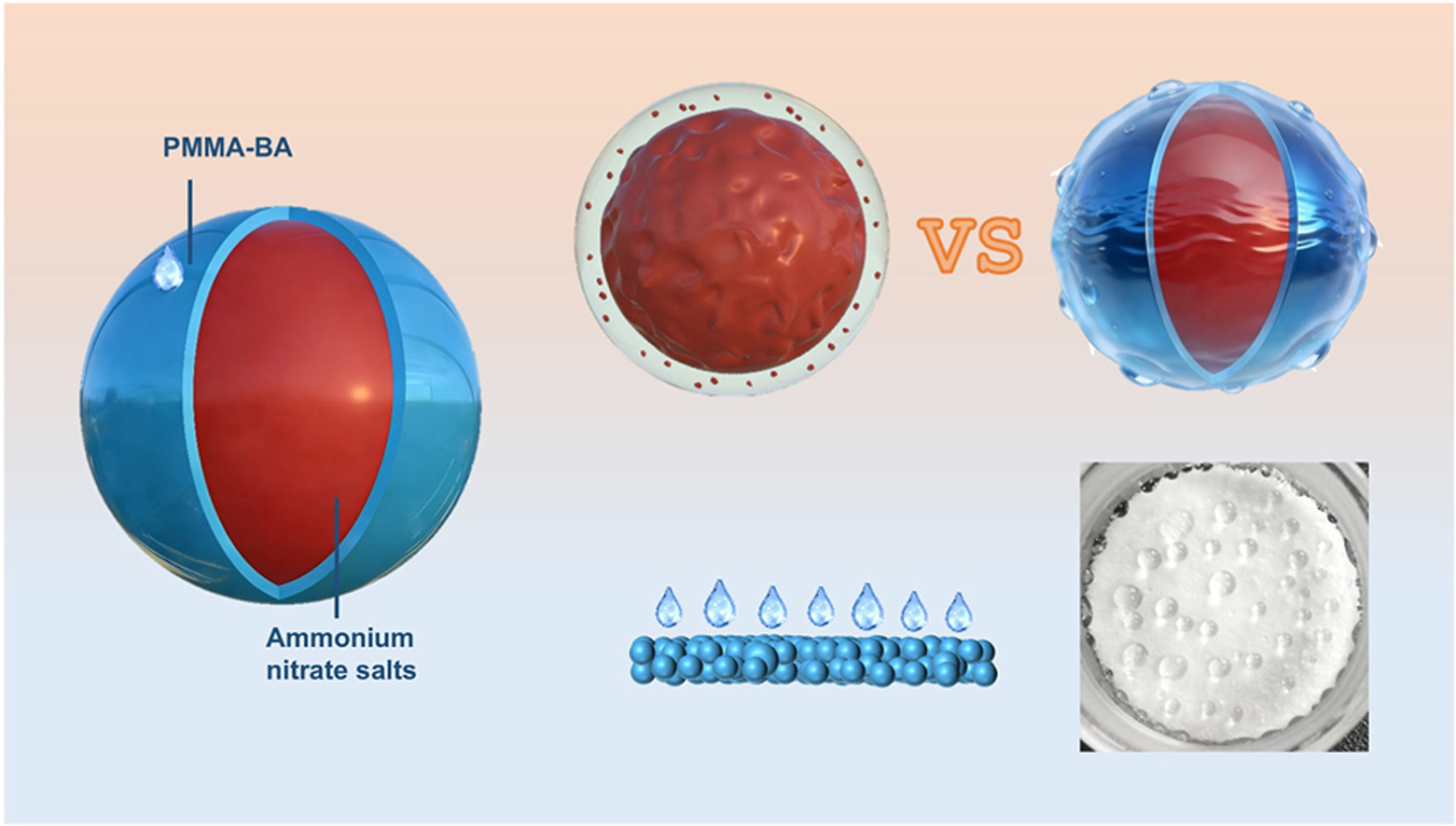
• A core-shell strategy using a PMMA-BA copolymer coating effectively suppresses moisture absorption in ammonium nitrate salts.
• Moisture absorption rates of AN and ADN decreased from 27.30% to 16.57% to just 5.95% and 4.66%, respectively.
• The copolymer shell enhances surface hydrophobicity, thermal stability, and friction resistance without lowering energy density.
• This method provides a simple, universal route to improve storage stability and application potential of hygroscopic energetic oxidizers.
Abstract
Ammonium nitrate salts represent an important class of energetic oxidizers. However, they are highly prone to moisture absorption, which creates difficulties for long-term storage and thus severely limits their application value. In this study, a moisture inhibition strategy was proposed by constructing a core-shell structure via copolymer surface coating. The commonly used ammonium nitrate (AN) and ammonium dinitramide (ADN) were selected as research objects, and a copolymer coating (PMMA-BA) was formed on their surfaces using methyl methacrylate (MMA) and butyl acrylate (BA). Through surface coating and isolation treatment, AN and ADN with high moisture absorption inhibition performance were successfully prepared. The results show that the moisture absorption of the energetic microspheres with a special core-shell structure is effectively suppressed after surface modification. The moisture absorption rates of AN@PMMA-BA and ADN@PMMA-BA are reduced from 27.30% to 16.57% to 5.95% and 4.66%, respectively. This confirms that the copolymer surface coating can effectively inhibit the moisture absorption of ammonium nitrate salts, providing a new approach to extend their storage life and enhance their application potential.
Graphical abstract
Keywords
Ammonium nitrate salt; Moisture absorption inhibition; Core-shell structure; Copolymer coating
文章导读