
期刊文章
过刊浏览
- Volumes 108-119 (2025)
-
Volumes 96-107 (2025)
-
Volume 107
Pages 1-376 (December 2025)
-
Volume 106
Pages 1-336 (November 2025)
-
Volume 105
Pages 1-356 (October 2025)
-
Volume 104
Pages 1-332 (September 2025)
-
Volume 103
Pages 1-314 (August 2025)
-
Volume 102
Pages 1-276 (July 2025)
-
Volume 101
Pages 1-166 (June 2025)
-
Volume 100
Pages 1-256 (May 2025)
-
Volume 99
Pages 1-242 (April 2025)
-
Volume 98
Pages 1-288 (March 2025)
-
Volume 97
Pages 1-256 (February 2025)
-
Volume 96
Pages 1-340 (January 2025)
-
Volume 107
-
Volumes 84-95 (2024)
-
Volume 95
Pages 1-392 (December 2024)
-
Volume 94
Pages 1-400 (November 2024)
-
Volume 93
Pages 1-376 (October 2024)
-
Volume 92
Pages 1-316 (September 2024)
-
Volume 91
Pages 1-378 (August 2024)
-
Volume 90
Pages 1-580 (July 2024)
-
Volume 89
Pages 1-278 (June 2024)
-
Volume 88
Pages 1-350 (May 2024)
-
Volume 87
Pages 1-338 (April 2024)
-
Volume 86
Pages 1-312 (March 2024)
-
Volume 85
Pages 1-334 (February 2024)
-
Volume 84
Pages 1-308 (January 2024)
-
Volume 95
-
Volumes 72-83 (2023)
-
Volume 83
Pages 1-258 (December 2023)
-
Volume 82
Pages 1-204 (November 2023)
-
Volume 81
Pages 1-188 (October 2023)
-
Volume 80
Pages 1-202 (September 2023)
-
Volume 79
Pages 1-172 (August 2023)
-
Volume 78
Pages 1-146 (July 2023)
-
Volume 77
Pages 1-152 (June 2023)
-
Volume 76
Pages 1-176 (May 2023)
-
Volume 75
Pages 1-228 (April 2023)
-
Volume 74
Pages 1-200 (March 2023)
-
Volume 73
Pages 1-138 (February 2023)
-
Volume 72
Pages 1-144 (January 2023)
-
Volume 83
-
Volumes 60-71 (2022)
-
Volume 71
Pages 1-108 (December 2022)
-
Volume 70
Pages 1-106 (November 2022)
-
Volume 69
Pages 1-122 (October 2022)
-
Volume 68
Pages 1-124 (September 2022)
-
Volume 67
Pages 1-102 (August 2022)
-
Volume 66
Pages 1-112 (July 2022)
-
Volume 65
Pages 1-138 (June 2022)
-
Volume 64
Pages 1-186 (May 2022)
-
Volume 63
Pages 1-124 (April 2022)
-
Volume 62
Pages 1-104 (March 2022)
-
Volume 61
Pages 1-120 (February 2022)
-
Volume 60
Pages 1-124 (January 2022)
-
Volume 71
- Volumes 54-59 (2021)
- Volumes 48-53 (2020)
- Volumes 42-47 (2019)
- Volumes 36-41 (2018)
- Volumes 30-35 (2017)
- Volumes 24-29 (2016)
- Volumes 18-23 (2015)
- Volumes 12-17 (2014)
- Volume 11 (2013)
- Volume 10 (2012)
- Volume 9 (2011)
- Volume 8 (2010)
- Volume 7 (2009)
- Volume 6 (2008)
- Volume 5 (2007)
- Volume 4 (2006)
- Volume 3 (2005)
- Volume 2 (2004)
- Volume 1 (2003)
Volume 114
Sun, Q., Ghebretatios, N., Chang, Z., Wang, W., Otota, B. A., Dong, B., . . . Chen, Z. (2026). Green closed-loop recycling process for all elements in spent LiMn2O4 cathode materials. Particuology, 114, 10-24. https://doi.org/10.1016/j.partic.2026.03.017
Green closed-loop recycling process for all elements in spent LiMn2O4 cathode materials
Qinglong Sun a, Natnael Ghebretatios a, Zhidong Chang a *, Wei Wang b *, Benard Amakanji Otota a, Bin Dong a, Jialong Li a, Yaqi Wang a, Leiying Zhang a, Zhiyi Chen a
a School of Chemistry and Biological Engineering, University of Science and Technology Beijing, Beijing, 100083, China
b State Key Laboratory of Biochemical Engineering-Separation Technology and Energy Chemistry Group, Institute of Process Engineering, Chinese Academy of Sciences, Beijing, 100190, China
10.1016/j.partic.2026.03.017
Volume 114,
July 2026,
Pages 10-24
Received 11 January 2026, Revised 5 March 2026, Accepted 6 March 2026, Available online 30 March 2026, Version of Record 10 April 2026.
E-mail:
zdchang@ustb.edu.cn; weiwang@ipe.ac.cn; dongbin@ustb.edu.cn
Highlights
• By combining NH4Cl roasting with ammonia leaching process, s-LMO achieved closed-loop recovery.
• Overall Li recovery rate exceeded 96%, achieving 99% selective precipitation of Mn.
• No impurity cations were introduced in the whole process.
• Battery-grade Li2CO3 and Mn3O4 recovered were used to regenerate LMO.
• The regenerated LMO exhibited great electrochemical performances.
Abstract
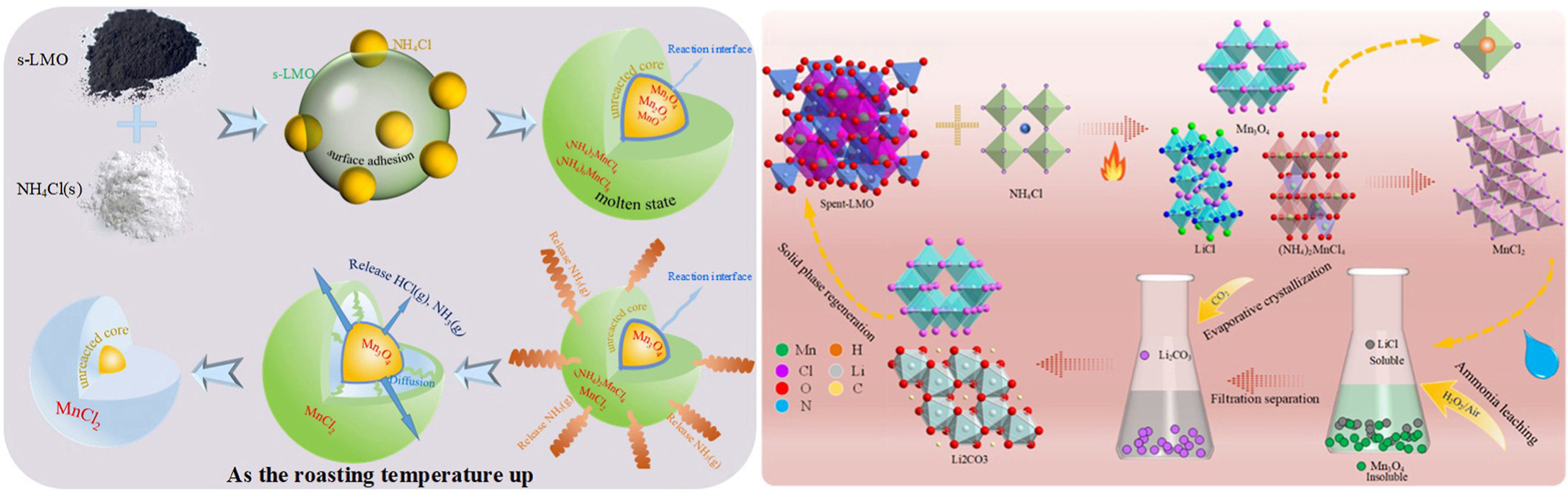
With the impending surge in retired lithium-ion batteries, developing efficient strategies for recovering valuable elements has attracted significant attention. This study presents an innovative closed-loop recycling method that integrates NH4Cl reductive roasting with a selective ammonia leaching system to achieve the complete recovery and regeneration of lithium and manganese from spent LiMn2O4 cathodes. The reaction mechanism was elucidated using XRD, SEM-EDS, and XPS demonstrating that Mn4+/Mn3+ in the LiMn2O4 spinel structure is simultaneously reduced and chlorinated by NH4+ from molten ammonium salts. This synergistic process efficiently converts the cathode material into water-soluble LiCl and (NH4)2MnCl4. Notably, residual nitrogen is stored and recycled as NH4+, with no impurity cations introduced during roasting. Under optimized roasting conditions (350 °C, 15 min, w(s-LMO)/w(NH4Cl) = 1:2.5), the chlorination extent of manganese reached 88%, with the residual fraction stabilized as Mn3O4, while the lithium conversion efficiency approached 96%. Subsequent leaching in an NH3·H2O–H2O system enabled the nearly complete separation of Li and Mn, yielding battery-grade Li2CO3. The incorporation of 2 % H2O2 as an oxidizing agent facilitated the selective precipitation of over 99 % of the manganese in the form of spherical nano-crystalline Mn3O4, while the lithium leaching efficiency remained virtually quantitative. The overall recovery rate for lithium reached 96%, while that for manganese approached 100%. Thermodynamic analysis and comprehensive characterization reveal the underlying mechanisms governing this selective manganese precipitation. Finally, the regenerated LiMn2O4 cathode material synthesized via the closed-loop process exhibited excellent structural integrity and electrochemical performance, confirming the viability and sustainability of the proposed methodology.
Graphical abstract
Keywords
Spent LiMn2O4 cathode material; Reductive chlorination; Ammoniacal leaching; Li/Mn separation; Full-element closed-loop recovery; Cathode material regeneration
文章导读