
期刊文章
过刊浏览
- Volumes 108-119 (2025)
-
Volumes 96-107 (2025)
-
Volume 107
Pages 1-376 (December 2025)
-
Volume 106
Pages 1-336 (November 2025)
-
Volume 105
Pages 1-356 (October 2025)
-
Volume 104
Pages 1-332 (September 2025)
-
Volume 103
Pages 1-314 (August 2025)
-
Volume 102
Pages 1-276 (July 2025)
-
Volume 101
Pages 1-166 (June 2025)
-
Volume 100
Pages 1-256 (May 2025)
-
Volume 99
Pages 1-242 (April 2025)
-
Volume 98
Pages 1-288 (March 2025)
-
Volume 97
Pages 1-256 (February 2025)
-
Volume 96
Pages 1-340 (January 2025)
-
Volume 107
-
Volumes 84-95 (2024)
-
Volume 95
Pages 1-392 (December 2024)
-
Volume 94
Pages 1-400 (November 2024)
-
Volume 93
Pages 1-376 (October 2024)
-
Volume 92
Pages 1-316 (September 2024)
-
Volume 91
Pages 1-378 (August 2024)
-
Volume 90
Pages 1-580 (July 2024)
-
Volume 89
Pages 1-278 (June 2024)
-
Volume 88
Pages 1-350 (May 2024)
-
Volume 87
Pages 1-338 (April 2024)
-
Volume 86
Pages 1-312 (March 2024)
-
Volume 85
Pages 1-334 (February 2024)
-
Volume 84
Pages 1-308 (January 2024)
-
Volume 95
-
Volumes 72-83 (2023)
-
Volume 83
Pages 1-258 (December 2023)
-
Volume 82
Pages 1-204 (November 2023)
-
Volume 81
Pages 1-188 (October 2023)
-
Volume 80
Pages 1-202 (September 2023)
-
Volume 79
Pages 1-172 (August 2023)
-
Volume 78
Pages 1-146 (July 2023)
-
Volume 77
Pages 1-152 (June 2023)
-
Volume 76
Pages 1-176 (May 2023)
-
Volume 75
Pages 1-228 (April 2023)
-
Volume 74
Pages 1-200 (March 2023)
-
Volume 73
Pages 1-138 (February 2023)
-
Volume 72
Pages 1-144 (January 2023)
-
Volume 83
-
Volumes 60-71 (2022)
-
Volume 71
Pages 1-108 (December 2022)
-
Volume 70
Pages 1-106 (November 2022)
-
Volume 69
Pages 1-122 (October 2022)
-
Volume 68
Pages 1-124 (September 2022)
-
Volume 67
Pages 1-102 (August 2022)
-
Volume 66
Pages 1-112 (July 2022)
-
Volume 65
Pages 1-138 (June 2022)
-
Volume 64
Pages 1-186 (May 2022)
-
Volume 63
Pages 1-124 (April 2022)
-
Volume 62
Pages 1-104 (March 2022)
-
Volume 61
Pages 1-120 (February 2022)
-
Volume 60
Pages 1-124 (January 2022)
-
Volume 71
- Volumes 54-59 (2021)
- Volumes 48-53 (2020)
- Volumes 42-47 (2019)
- Volumes 36-41 (2018)
- Volumes 30-35 (2017)
- Volumes 24-29 (2016)
- Volumes 18-23 (2015)
- Volumes 12-17 (2014)
- Volume 11 (2013)
- Volume 10 (2012)
- Volume 9 (2011)
- Volume 8 (2010)
- Volume 7 (2009)
- Volume 6 (2008)
- Volume 5 (2007)
- Volume 4 (2006)
- Volume 3 (2005)
- Volume 2 (2004)
- Volume 1 (2003)
Volume 114
Zhou, G., Nan, H., Yang, L., Wang, J., Yang, R., Qu, F., . . . Yang, P. (2026). Synergistic enhancement of corrosion and wear resistance in polyurethane composite coatings using modified molybdenum disulfide and silicon carbide nanocomposites. Particuology, 114, 25-35. https://doi.org/10.1016/j.partic.2026.03.035
Synergistic enhancement of corrosion and wear resistance in polyurethane composite coatings using modified molybdenum disulfide and silicon carbide nanocomposites
Guilin Zhou a b, Hui Nan b, Lijun Yang a, Jingchuan Wang a, Ruizhu Yang a, Fengsheng Qu a, Hongmin Wang c *, Hong Lin d *, Pan Yang a *
a Institute of Materials, China Academy of Engineering Physics, Jiangyou, 621908, China
b Key Laboratory of Qinghai Province for Light Alloy, Qinghai High Performance Light Metal Alloy and Deep Processing Engineering Technology Research Center, Qinghai University, Xi'ning, 810000, China
c Qinghai Second Geological Exploration Institute, Xi'ning, 810016, China
d State Key Laboratory of New Ceramics Materials, Tsinghua University, Beijing, 100084, China
10.1016/j.partic.2026.03.035
Volume 114,
July 2026,
Pages 25-35
Received 25 December 2025, Revised 17 March 2026, Accepted 27 March 2026, Available online 4 April 2026, Version of Record 11 April 2026.
E-mail:
472689346@qq.com; hong-lin@tsinghua.edu.cn; yangpan@caep.cn
Highlights
• A cross-linked network formed by KH560-PDA modified MoS2 effectively blocks corrosive agents.
• Dispersed SiC nanoparticles optimize stress distribution and reduce surface friction.
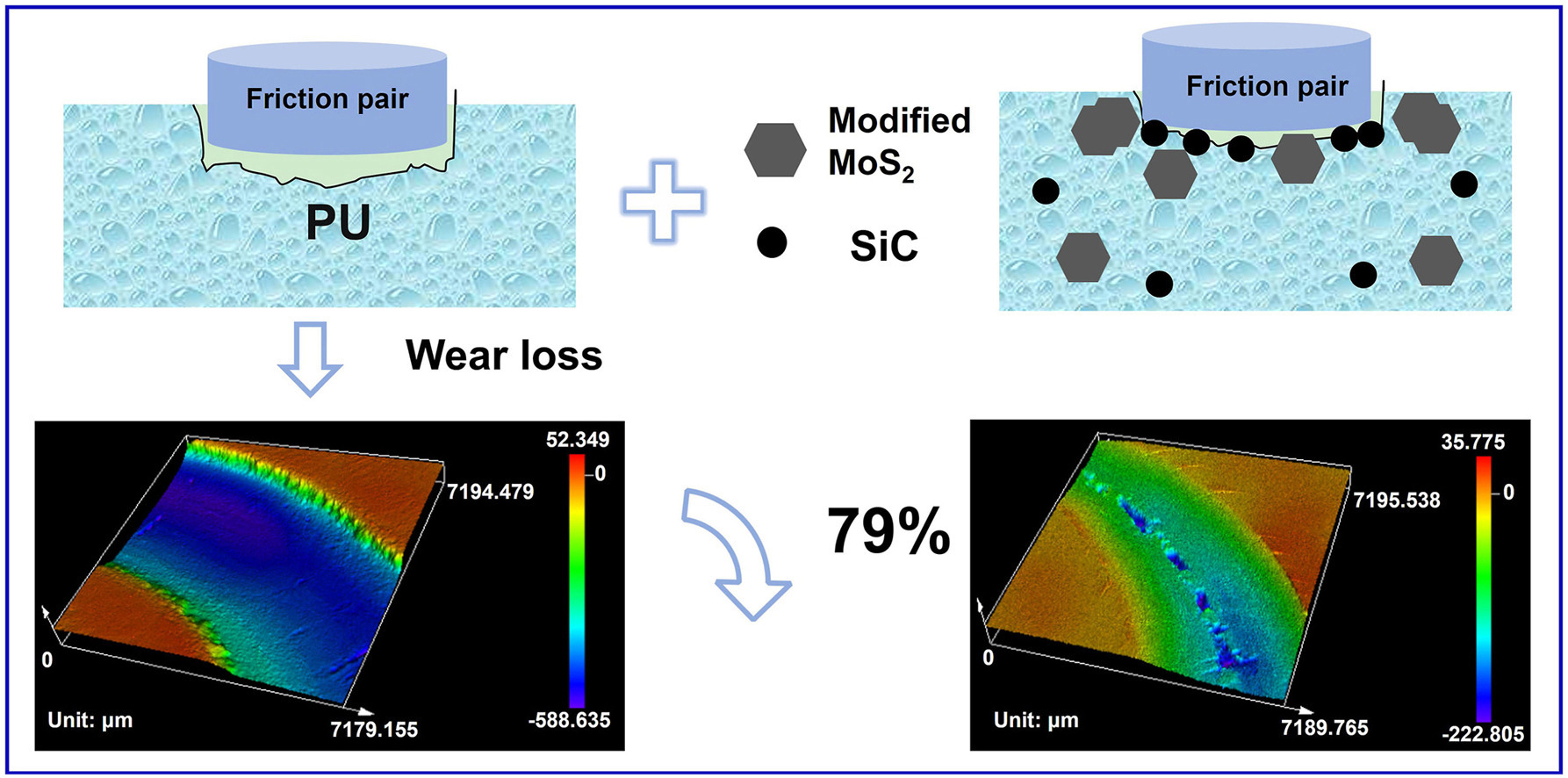
• KPM-10S/PU coating exhibits optimal performance with 342 times higher impedance and 79% lower wear loss than pure PU.
• KPM-10S/PU coating shows outstanding resistance in HNO3 and salt spray tests, with minimal degradation after 14 days.
• Elucidates MoS2-SiC synergistic corrosion-wear mechanism and identifies 10 wt% SiC for optimal performance.
Abstract
Polyurethane (PU) coatings, extensively used for metal surface protection, face limitations in harsh environments due to their insufficient wear resistance. A novel PU composite coating system, synergistically reinforced with modified molybdenum disulfide (MoS2) and silicon carbide (SiC) nanoparticles, was developed to enhance both corrosion and wear resistance. By modifying MoS2 via the silane coupling agent (KH560)-polydopamine (PDA) cross-linking, a dense network was formed to block corrosive agents, while dispersed SiC nanoparticles optimized stress distribution and reduced surface friction. The composite coating containing 10 wt% SiC (KPM-10S/PU) demonstrates comprehensive performance, exhibiting 342 times higher impedance compared to the pure PU, 79% reduction in the wear loss volume against 316L steel, and outstanding resistance in HNO3 and salt spray tests. Although 15 wt% SiC (KPM-15S/PU) achieved the highest initial impedance and the lowest friction coefficient, excessive SiC compromised matrix compatibility, increasing corrosion vulnerability. This work elucidates the corrosion blocking and wear inhibition reinforcement mechanism of MoS2-SiC composite, and provides a scalable strategy for designing multifunctional coatings in demanding environments of marine infrastructure.
Graphical abstract
Keywords
Polyurethane composite coatings; Synergistic enhancement; Molybdenum disulfide; Silicon carbide; Corrosion-wear resistance
文章导读