
期刊文章
过刊浏览
- Volumes 108-119 (2025)
-
Volumes 96-107 (2025)
-
Volume 107
Pages 1-376 (December 2025)
-
Volume 106
Pages 1-336 (November 2025)
-
Volume 105
Pages 1-356 (October 2025)
-
Volume 104
Pages 1-332 (September 2025)
-
Volume 103
Pages 1-314 (August 2025)
-
Volume 102
Pages 1-276 (July 2025)
-
Volume 101
Pages 1-166 (June 2025)
-
Volume 100
Pages 1-256 (May 2025)
-
Volume 99
Pages 1-242 (April 2025)
-
Volume 98
Pages 1-288 (March 2025)
-
Volume 97
Pages 1-256 (February 2025)
-
Volume 96
Pages 1-340 (January 2025)
-
Volume 107
-
Volumes 84-95 (2024)
-
Volume 95
Pages 1-392 (December 2024)
-
Volume 94
Pages 1-400 (November 2024)
-
Volume 93
Pages 1-376 (October 2024)
-
Volume 92
Pages 1-316 (September 2024)
-
Volume 91
Pages 1-378 (August 2024)
-
Volume 90
Pages 1-580 (July 2024)
-
Volume 89
Pages 1-278 (June 2024)
-
Volume 88
Pages 1-350 (May 2024)
-
Volume 87
Pages 1-338 (April 2024)
-
Volume 86
Pages 1-312 (March 2024)
-
Volume 85
Pages 1-334 (February 2024)
-
Volume 84
Pages 1-308 (January 2024)
-
Volume 95
-
Volumes 72-83 (2023)
-
Volume 83
Pages 1-258 (December 2023)
-
Volume 82
Pages 1-204 (November 2023)
-
Volume 81
Pages 1-188 (October 2023)
-
Volume 80
Pages 1-202 (September 2023)
-
Volume 79
Pages 1-172 (August 2023)
-
Volume 78
Pages 1-146 (July 2023)
-
Volume 77
Pages 1-152 (June 2023)
-
Volume 76
Pages 1-176 (May 2023)
-
Volume 75
Pages 1-228 (April 2023)
-
Volume 74
Pages 1-200 (March 2023)
-
Volume 73
Pages 1-138 (February 2023)
-
Volume 72
Pages 1-144 (January 2023)
-
Volume 83
-
Volumes 60-71 (2022)
-
Volume 71
Pages 1-108 (December 2022)
-
Volume 70
Pages 1-106 (November 2022)
-
Volume 69
Pages 1-122 (October 2022)
-
Volume 68
Pages 1-124 (September 2022)
-
Volume 67
Pages 1-102 (August 2022)
-
Volume 66
Pages 1-112 (July 2022)
-
Volume 65
Pages 1-138 (June 2022)
-
Volume 64
Pages 1-186 (May 2022)
-
Volume 63
Pages 1-124 (April 2022)
-
Volume 62
Pages 1-104 (March 2022)
-
Volume 61
Pages 1-120 (February 2022)
-
Volume 60
Pages 1-124 (January 2022)
-
Volume 71
- Volumes 54-59 (2021)
- Volumes 48-53 (2020)
- Volumes 42-47 (2019)
- Volumes 36-41 (2018)
- Volumes 30-35 (2017)
- Volumes 24-29 (2016)
- Volumes 18-23 (2015)
- Volumes 12-17 (2014)
- Volume 11 (2013)
- Volume 10 (2012)
- Volume 9 (2011)
- Volume 8 (2010)
- Volume 7 (2009)
- Volume 6 (2008)
- Volume 5 (2007)
- Volume 4 (2006)
- Volume 3 (2005)
- Volume 2 (2004)
- Volume 1 (2003)
Volume 114
Sefidan, A. M., Sellier, M., & Hewett, J. N. (2026). Effects of injection conditions on the first impact of milk droplets onto the chamber surfaces in the spray drying process. Particuology, 114, 36-47. https://doi.org/10.1016/j.partic.2026.03.037
Effects of injection conditions on the first impact of milk droplets onto the chamber surfaces in the spray drying process (Open Access)
Ali M. Sefidan a *, Mathieu Sellier b, James N. Hewett b
a Department of Energy and Mechanical Engineering, Aalto University, 02150, Espoo, Finland
b Department of Mechanical Engineering, University of Canterbury, Christchurch, 8140, New Zealand
10.1016/j.partic.2026.03.037
Volume 114,
July 2026,
Pages 36-47
Received 12 February 2025, Revised 12 February 2026, Accepted 26 March 2026, Available online 7 April 2026, Version of Record 12 April 2026.
E-mail:
ali.mohammadisefidan@aalto.fi
Highlights
• Numerical modeling of milk droplet impact in spray drying using an Euler-Lagrange approach.
• A four-stage droplet evaporation model was coupled with Euler-Lagrange to track moisture content and temperature evolution.
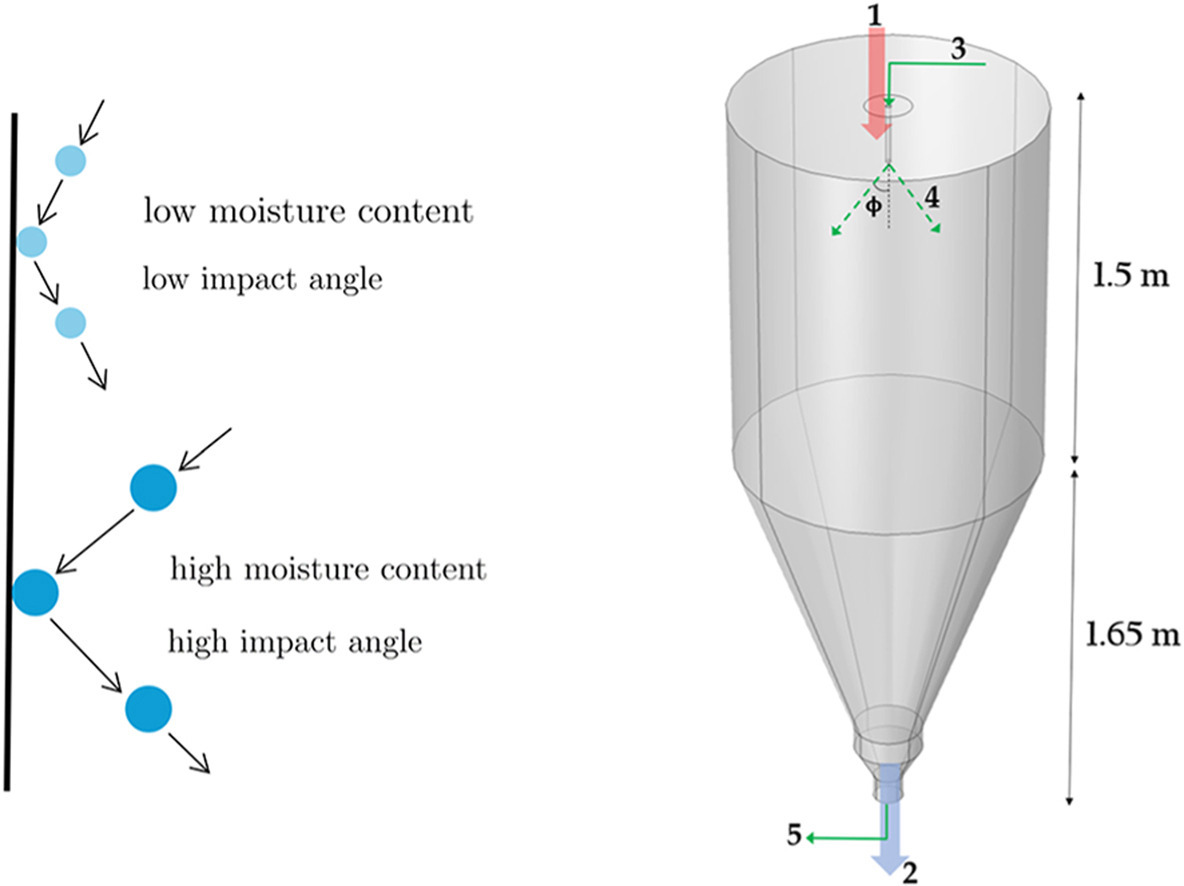
• Smaller droplets hit the chamber walls at lower impact angles with lower velocity and moisture content.
• Higher injection angles yield smaller impact angles, lower moisture content, and reduced surface temperatures.
Abstract
Through spray drying, a liquid containing solid particles is converted into dry powder by evaporating the solvent. Many industries, such as the dairy industry, use this method to make dry powder as it extends the shelf life of the product and makes it more dense for transport. Milk powder production in dairy plants is highly challenging because partially wet milk droplets can deposit on the surfaces of drying chambers. Through the use of a numerical model, this study examines the effects of injection parameters on droplet conditions at the point of impact with the chamber surfaces during the spray drying process of skim milk. The process was numerically modelled using a four-stage droplet evaporation model coupled with an Euler-Lagrange simulation that describes the trajectory of the milk droplets inside the dryer. According to the results, a greater proportion of smaller droplets impact the wall at smaller angles, with lower velocity magnitudes, and contain less moisture than larger droplets. As a result of a larger injection angle, more droplets hit the chamber surfaces with smaller impact angles, resulting in lower moisture content and lower temperatures at impact. A higher injection velocity resulted in a greater proportion of droplets impacting the surface of the chamber with lower temperatures and a greater moisture content.
Graphical abstract
Keywords
Spray drying; Euler-Lagrange model; Droplet drying model; Droplet impact
文章导读