
期刊文章
过刊浏览
- Volumes 108-119 (2025)
-
Volumes 96-107 (2025)
-
Volume 107
Pages 1-376 (December 2025)
-
Volume 106
Pages 1-336 (November 2025)
-
Volume 105
Pages 1-356 (October 2025)
-
Volume 104
Pages 1-332 (September 2025)
-
Volume 103
Pages 1-314 (August 2025)
-
Volume 102
Pages 1-276 (July 2025)
-
Volume 101
Pages 1-166 (June 2025)
-
Volume 100
Pages 1-256 (May 2025)
-
Volume 99
Pages 1-242 (April 2025)
-
Volume 98
Pages 1-288 (March 2025)
-
Volume 97
Pages 1-256 (February 2025)
-
Volume 96
Pages 1-340 (January 2025)
-
Volume 107
-
Volumes 84-95 (2024)
-
Volume 95
Pages 1-392 (December 2024)
-
Volume 94
Pages 1-400 (November 2024)
-
Volume 93
Pages 1-376 (October 2024)
-
Volume 92
Pages 1-316 (September 2024)
-
Volume 91
Pages 1-378 (August 2024)
-
Volume 90
Pages 1-580 (July 2024)
-
Volume 89
Pages 1-278 (June 2024)
-
Volume 88
Pages 1-350 (May 2024)
-
Volume 87
Pages 1-338 (April 2024)
-
Volume 86
Pages 1-312 (March 2024)
-
Volume 85
Pages 1-334 (February 2024)
-
Volume 84
Pages 1-308 (January 2024)
-
Volume 95
-
Volumes 72-83 (2023)
-
Volume 83
Pages 1-258 (December 2023)
-
Volume 82
Pages 1-204 (November 2023)
-
Volume 81
Pages 1-188 (October 2023)
-
Volume 80
Pages 1-202 (September 2023)
-
Volume 79
Pages 1-172 (August 2023)
-
Volume 78
Pages 1-146 (July 2023)
-
Volume 77
Pages 1-152 (June 2023)
-
Volume 76
Pages 1-176 (May 2023)
-
Volume 75
Pages 1-228 (April 2023)
-
Volume 74
Pages 1-200 (March 2023)
-
Volume 73
Pages 1-138 (February 2023)
-
Volume 72
Pages 1-144 (January 2023)
-
Volume 83
-
Volumes 60-71 (2022)
-
Volume 71
Pages 1-108 (December 2022)
-
Volume 70
Pages 1-106 (November 2022)
-
Volume 69
Pages 1-122 (October 2022)
-
Volume 68
Pages 1-124 (September 2022)
-
Volume 67
Pages 1-102 (August 2022)
-
Volume 66
Pages 1-112 (July 2022)
-
Volume 65
Pages 1-138 (June 2022)
-
Volume 64
Pages 1-186 (May 2022)
-
Volume 63
Pages 1-124 (April 2022)
-
Volume 62
Pages 1-104 (March 2022)
-
Volume 61
Pages 1-120 (February 2022)
-
Volume 60
Pages 1-124 (January 2022)
-
Volume 71
- Volumes 54-59 (2021)
- Volumes 48-53 (2020)
- Volumes 42-47 (2019)
- Volumes 36-41 (2018)
- Volumes 30-35 (2017)
- Volumes 24-29 (2016)
- Volumes 18-23 (2015)
- Volumes 12-17 (2014)
- Volume 11 (2013)
- Volume 10 (2012)
- Volume 9 (2011)
- Volume 8 (2010)
- Volume 7 (2009)
- Volume 6 (2008)
- Volume 5 (2007)
- Volume 4 (2006)
- Volume 3 (2005)
- Volume 2 (2004)
- Volume 1 (2003)
Volume 114
Sun, J., Wei, G., Zhou, D., & An, X. (2026). Computational fluid dynamics-discrete element method investigation on spout deflection in spout-fluidized beds formed by cohesive non-spherical particles. Particuology, 114, 48-61. https://doi.org/10.1016/j.partic.2026.03.038
Computational fluid dynamics-discrete element method investigation on spout deflection in spout-fluidized beds formed by cohesive non-spherical particles
Jiani Sun a, Guangchao Wei a *, Dan Zhou a, Xizhong An b *
a School of Transportation and Vehicle Engineering, Shandong University of Technology, Zibo, 255000, China
b Key Laboratory for Ecological Metallurgy of Multimetallic Mineral of Ministry of Education, School of Metallurgy, Northeastern University, Shenyang, 110819, China
10.1016/j.partic.2026.03.038
Volume 114,
July 2026,
Pages 48-61
Received 1 February 2026, Revised 12 March 2026, Accepted 31 March 2026, Available online 9 April 2026, Version of Record 15 April 2026.
E-mail:
weigc@sdut.edu.cn; anxz@mail.neu.edu.cn
Highlights
• Spout deflection mechanisms are resolved in cohesive non-spherical particle bed.
• Cohesive force dominates over particle morphology in deflection governing.
• Non-spherical particles amplify deflection sensitivity under weak cohesive force.
Abstract
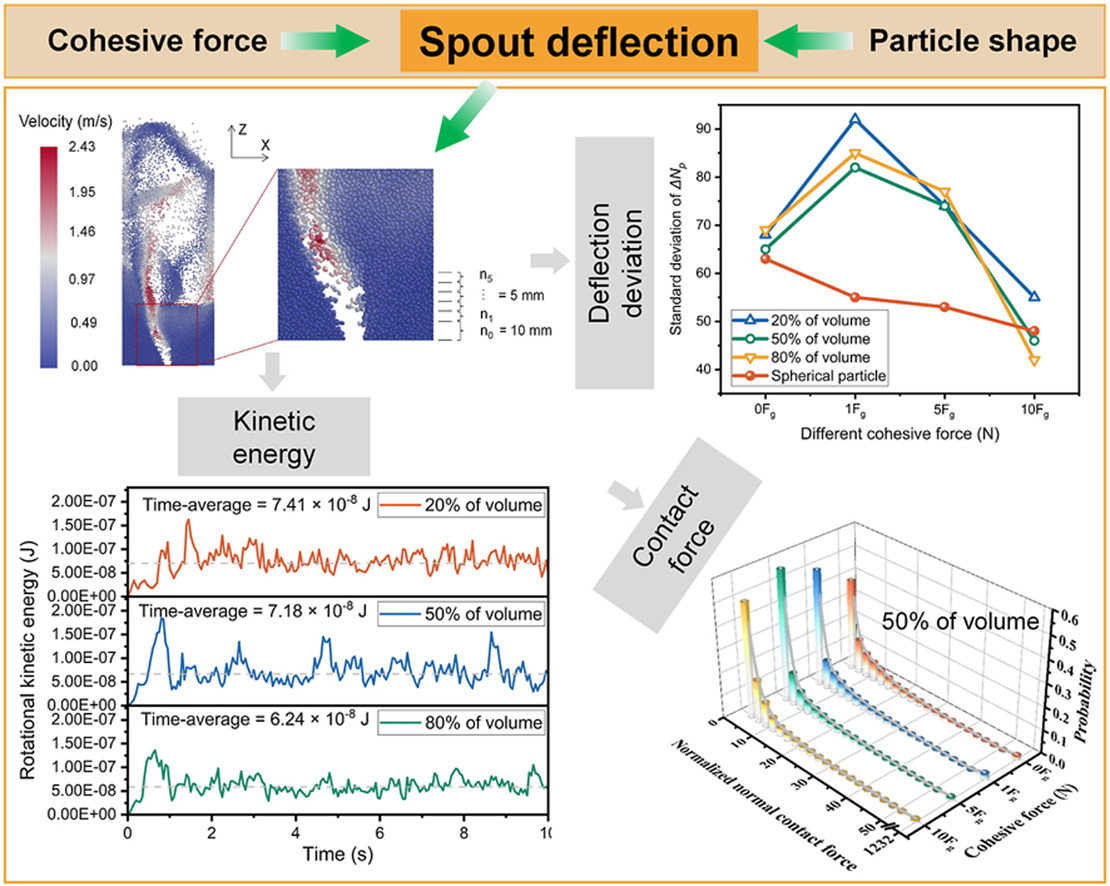
In this article, computational fluid dynamics-discrete element method (CFD-DEM) simulations were carried out to investigate the spout deflection dynamics in spout-fluidized beds formed by cohesive non-spherical particles. The work aims to clarify how particle cohesion and morphology jointly regulate bed stability and the associated flow structures. Rigorous validation of the prediction model precedes numerical simulations. The results reveal that increasing cohesive force systematically suppresses spout deflection, reduces high-velocity particle motions, and enhances bed-height fluctuations. Non-spherical particles further modulate these behaviours, and their influence varies with the cohesion level due to particle interlocking. Analysis of the normalized normal contact forces shows that most forces fall within F∗n ≤ 4, and their probability first increases and then decreases with rising cohesion, with stronger effects at higher non-spherical contents. Time-averaged rotational energy decreases with increasing non-spherical particle content, while dominant frequencies remain primarily within 0 to 2 Hz. In addition, a concise predictive correlation is proposed to quantitatively describe the combined effects of cohesive force and non-spherical particle content on spout deflection intensity.
Graphical abstract
Keywords
Spout deflection; Cohesive particle; Non-spherical particle content; CFD-DEM simulation; Micro dynamics
文章导读