
期刊文章
过刊浏览
- Volumes 108-119 (2025)
-
Volumes 96-107 (2025)
-
Volume 107
Pages 1-376 (December 2025)
-
Volume 106
Pages 1-336 (November 2025)
-
Volume 105
Pages 1-356 (October 2025)
-
Volume 104
Pages 1-332 (September 2025)
-
Volume 103
Pages 1-314 (August 2025)
-
Volume 102
Pages 1-276 (July 2025)
-
Volume 101
Pages 1-166 (June 2025)
-
Volume 100
Pages 1-256 (May 2025)
-
Volume 99
Pages 1-242 (April 2025)
-
Volume 98
Pages 1-288 (March 2025)
-
Volume 97
Pages 1-256 (February 2025)
-
Volume 96
Pages 1-340 (January 2025)
-
Volume 107
-
Volumes 84-95 (2024)
-
Volume 95
Pages 1-392 (December 2024)
-
Volume 94
Pages 1-400 (November 2024)
-
Volume 93
Pages 1-376 (October 2024)
-
Volume 92
Pages 1-316 (September 2024)
-
Volume 91
Pages 1-378 (August 2024)
-
Volume 90
Pages 1-580 (July 2024)
-
Volume 89
Pages 1-278 (June 2024)
-
Volume 88
Pages 1-350 (May 2024)
-
Volume 87
Pages 1-338 (April 2024)
-
Volume 86
Pages 1-312 (March 2024)
-
Volume 85
Pages 1-334 (February 2024)
-
Volume 84
Pages 1-308 (January 2024)
-
Volume 95
-
Volumes 72-83 (2023)
-
Volume 83
Pages 1-258 (December 2023)
-
Volume 82
Pages 1-204 (November 2023)
-
Volume 81
Pages 1-188 (October 2023)
-
Volume 80
Pages 1-202 (September 2023)
-
Volume 79
Pages 1-172 (August 2023)
-
Volume 78
Pages 1-146 (July 2023)
-
Volume 77
Pages 1-152 (June 2023)
-
Volume 76
Pages 1-176 (May 2023)
-
Volume 75
Pages 1-228 (April 2023)
-
Volume 74
Pages 1-200 (March 2023)
-
Volume 73
Pages 1-138 (February 2023)
-
Volume 72
Pages 1-144 (January 2023)
-
Volume 83
-
Volumes 60-71 (2022)
-
Volume 71
Pages 1-108 (December 2022)
-
Volume 70
Pages 1-106 (November 2022)
-
Volume 69
Pages 1-122 (October 2022)
-
Volume 68
Pages 1-124 (September 2022)
-
Volume 67
Pages 1-102 (August 2022)
-
Volume 66
Pages 1-112 (July 2022)
-
Volume 65
Pages 1-138 (June 2022)
-
Volume 64
Pages 1-186 (May 2022)
-
Volume 63
Pages 1-124 (April 2022)
-
Volume 62
Pages 1-104 (March 2022)
-
Volume 61
Pages 1-120 (February 2022)
-
Volume 60
Pages 1-124 (January 2022)
-
Volume 71
- Volumes 54-59 (2021)
- Volumes 48-53 (2020)
- Volumes 42-47 (2019)
- Volumes 36-41 (2018)
- Volumes 30-35 (2017)
- Volumes 24-29 (2016)
- Volumes 18-23 (2015)
- Volumes 12-17 (2014)
- Volume 11 (2013)
- Volume 10 (2012)
- Volume 9 (2011)
- Volume 8 (2010)
- Volume 7 (2009)
- Volume 6 (2008)
- Volume 5 (2007)
- Volume 4 (2006)
- Volume 3 (2005)
- Volume 2 (2004)
- Volume 1 (2003)
Volume 114
Sasakura, D., & Kimura, S. (2026). Verification method for the required sample size in determining particle morphology of pharmaceutical particles via image analysis using relative standard deviation as a model-free approach. Particuology, 114, 62-73. https://doi.org/10.1016/j.partic.2026.04.002
Verification method for the required sample size in determining particle morphology of pharmaceutical particles via image analysis using relative standard deviation as a model-free approach
Daisuke Sasakura a *, Sho Kimura b
a Malvern Panalytical, a Division of Spectris Co., Ltd, Daiichi Building 7-3, Hamamatuchou 1-Chome, Minato-ku, Tokyo, 105-0013, Japan
b Department of Regional Agricultural Engineering, Faculty of Agriculture, University of the Ryukyus, 1 Senbaru, Nishihara, Okinawa, 903-0213, Japan
10.1016/j.partic.2026.04.002
Volume 114,
July 2026,
Pages 62-73
Received 3 February 2026, Revised 20 March 2026, Accepted 2 April 2026, Available online 12 April 2026, Version of Record 18 April 2026.
E-mail:
daisuke.sasakura@malvernpanalytical.com
Highlights
• A novel model-free framework verifies particle count for irregular morphologies.
• Non-parametric strategy eliminates reliance on predefined geometric assumptions.
• Protocol ensures high transparency and ICH/USP regulatory compliance for APIs.
• Method is versatile and independent of SIA or DIA analytical techniques.
• Framework is empirically validated using large-scale, realistic API datasets.
Abstract
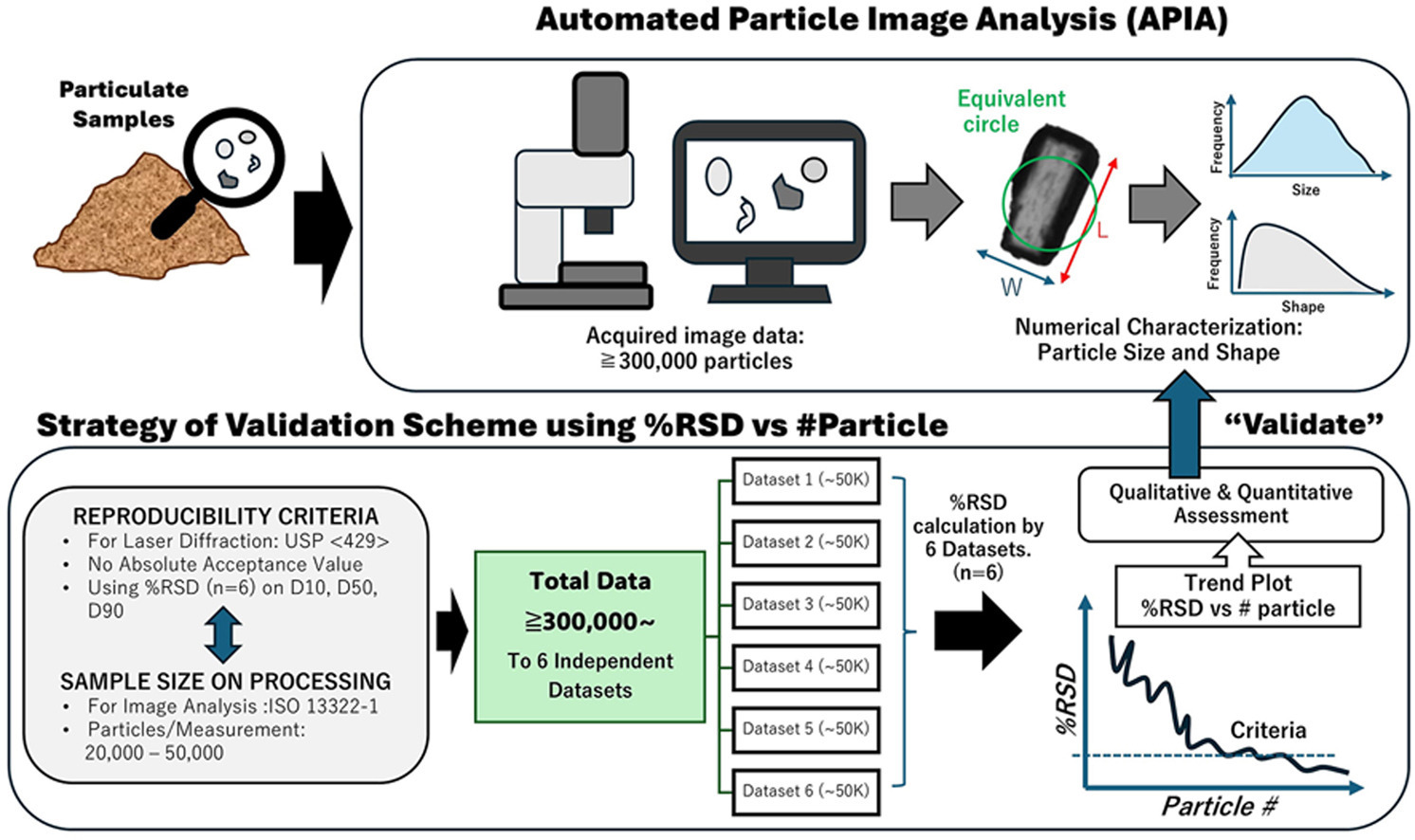
In pharmaceutical formulation development, accurate understanding of particle size and shape is critical for product quality, manufacturability, and regulatory compliance. Automated particle image analysis (APIA) enables high-throughput morphological characterization; however, determining the required particle number for reliable analysis remains challenging. Conventional parametric or simulation-based approaches often rely on restrictive assumptions regarding particle geometry or size distribution, limiting applicability to multimodal or irregular particles frequently encountered in practice. This study presents a strategically designed, model-free validation framework that leverages large-scale experimental APIA datasets to determine particle count requirements without assumptions regarding shape, size distribution, or analytical method. The framework is flexible, versatile, and applicable across diverse particle morphologies, and is largely independent of specific APIA system configurations if numerical morphological data are available. To meet pharmaceutical regulatory expectations, it integrates key elements from multiple certified standards, providing a compliance-ready solution. Sample size adequacy is evaluated through trend analysis of percentage relative standard deviation (%RSD), offering intuitive visualization for both quantitative and qualitative assessment. With modest computational requirements and a reproducible workflow, this framework supports robust characterization while facilitating effective communication among scientists and external stakeholders.
Graphical abstract
Keywords
Particle size; Particle shape; Particle image analysis; Non-spherical shaped particle; Active pharmaceutical ingredient; Method validation
文章导读