
期刊文章
过刊浏览
- Volumes 108-119 (2025)
-
Volumes 96-107 (2025)
-
Volume 107
Pages 1-376 (December 2025)
-
Volume 106
Pages 1-336 (November 2025)
-
Volume 105
Pages 1-356 (October 2025)
-
Volume 104
Pages 1-332 (September 2025)
-
Volume 103
Pages 1-314 (August 2025)
-
Volume 102
Pages 1-276 (July 2025)
-
Volume 101
Pages 1-166 (June 2025)
-
Volume 100
Pages 1-256 (May 2025)
-
Volume 99
Pages 1-242 (April 2025)
-
Volume 98
Pages 1-288 (March 2025)
-
Volume 97
Pages 1-256 (February 2025)
-
Volume 96
Pages 1-340 (January 2025)
-
Volume 107
-
Volumes 84-95 (2024)
-
Volume 95
Pages 1-392 (December 2024)
-
Volume 94
Pages 1-400 (November 2024)
-
Volume 93
Pages 1-376 (October 2024)
-
Volume 92
Pages 1-316 (September 2024)
-
Volume 91
Pages 1-378 (August 2024)
-
Volume 90
Pages 1-580 (July 2024)
-
Volume 89
Pages 1-278 (June 2024)
-
Volume 88
Pages 1-350 (May 2024)
-
Volume 87
Pages 1-338 (April 2024)
-
Volume 86
Pages 1-312 (March 2024)
-
Volume 85
Pages 1-334 (February 2024)
-
Volume 84
Pages 1-308 (January 2024)
-
Volume 95
-
Volumes 72-83 (2023)
-
Volume 83
Pages 1-258 (December 2023)
-
Volume 82
Pages 1-204 (November 2023)
-
Volume 81
Pages 1-188 (October 2023)
-
Volume 80
Pages 1-202 (September 2023)
-
Volume 79
Pages 1-172 (August 2023)
-
Volume 78
Pages 1-146 (July 2023)
-
Volume 77
Pages 1-152 (June 2023)
-
Volume 76
Pages 1-176 (May 2023)
-
Volume 75
Pages 1-228 (April 2023)
-
Volume 74
Pages 1-200 (March 2023)
-
Volume 73
Pages 1-138 (February 2023)
-
Volume 72
Pages 1-144 (January 2023)
-
Volume 83
-
Volumes 60-71 (2022)
-
Volume 71
Pages 1-108 (December 2022)
-
Volume 70
Pages 1-106 (November 2022)
-
Volume 69
Pages 1-122 (October 2022)
-
Volume 68
Pages 1-124 (September 2022)
-
Volume 67
Pages 1-102 (August 2022)
-
Volume 66
Pages 1-112 (July 2022)
-
Volume 65
Pages 1-138 (June 2022)
-
Volume 64
Pages 1-186 (May 2022)
-
Volume 63
Pages 1-124 (April 2022)
-
Volume 62
Pages 1-104 (March 2022)
-
Volume 61
Pages 1-120 (February 2022)
-
Volume 60
Pages 1-124 (January 2022)
-
Volume 71
- Volumes 54-59 (2021)
- Volumes 48-53 (2020)
- Volumes 42-47 (2019)
- Volumes 36-41 (2018)
- Volumes 30-35 (2017)
- Volumes 24-29 (2016)
- Volumes 18-23 (2015)
- Volumes 12-17 (2014)
- Volume 11 (2013)
- Volume 10 (2012)
- Volume 9 (2011)
- Volume 8 (2010)
- Volume 7 (2009)
- Volume 6 (2008)
- Volume 5 (2007)
- Volume 4 (2006)
- Volume 3 (2005)
- Volume 2 (2004)
- Volume 1 (2003)
Volume 114
Chang, H., Ba, S., Han, J., Yang, L., & Wu, J. (2026). Study on the morphology-preserving mixing and performance of tungsten-based delay composites via resonant acoustic mixing technology. Particuology, 114, 74-85. https://doi.org/10.1016/j.partic.2026.03.036
Study on the morphology-preserving mixing and performance of tungsten-based delay composites via resonant acoustic mixing technology
Henan Chang a, Shuhong Ba a *, Jimin Han b *, Li Yang b, Jinlong Wu a
a College of Equipment Engineering, Shenyangligong University, Shenyang, 110159, China
b State Key Laboratory of Explosion Science and Safety Protection, Beijing Institute of Technology, Beijing, 100081, China
10.1016/j.partic.2026.03.036
Volume 114,
July 2026,
Pages 74-85
Received 5 December 2025, Revised 28 March 2026, Accepted 31 March 2026, Available online 3 April 2026, Version of Record 18 April 2026.
E-mail:
bashuhong@sylu.edu.cn; hanjimin@bit.edu.cn
Highlights
• Uniform mixing and morphology preservation achieved in tungsten-based delay agent.
• Morphology preservation mechanism in pyrotechnic combustion revealed.
• Compared resonant acoustic, ball milling, hand mixing for tungsten agent.
• Improved delay accuracy achieved via resonant acoustic mixing.
• Mixing mechanism simulated, showing uniformity and morphology preservation.
Abstract
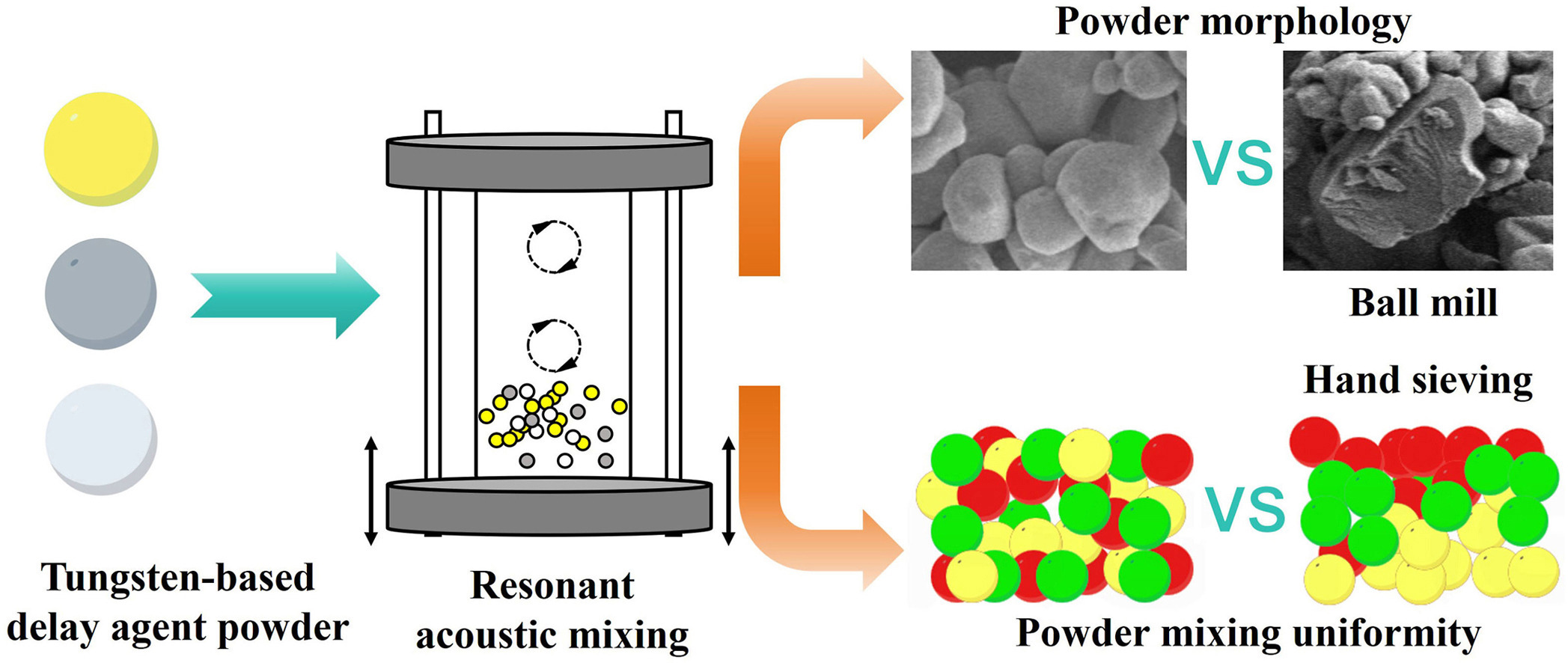
The preparation of energetic composites has long been challenged by the need to balance uniform dispersion of high-energy components with preservation of their structural integrity. Conventional mixing methods are particularly problematic for systems with large density contrasts: excessive shear forces promote particle fragmentation, whereas insufficient mixing intensity results in non-uniformity, both of which compromise performance reliability. In this study, tungsten powder (W), barium chromate (BaCrO4), potassium perchlorate (KClO4), diatomaceous earth, and fluororubber were combined to formulate tungsten-based delay compositions using three approaches: resonant acoustic mixing, mechanical ball milling, and hand mixing. The mixed samples were characterized by morphology, particle size distribution, mixing uniformity, combustion performance, and thermal properties. Discrete element simulations were further employed to elucidate the underlying mechanisms of resonant acoustic mixing and ball milling. The results demonstrate that resonant acoustic mixing achieves uniform blending while preserving particle morphology, yielding a delay time scatter coefficient as low as 1.20%. By contrast, ball milling caused extensive fragmentation, leading to double-peak DSC profiles characteristic of stepwise reactions and incomplete combustion. Hand mixing preserved particle shapes but yielded poor uniformity and inferior delay accuracy. Overall, this study demonstrates that particle morphological integrity and mixing uniformity play crucial roles in controlling combustion behavior, and highlights the superior performance of resonant acoustic mixing technology in processing high-density-gradient energetic composites.
Graphical abstract
Keywords
Resonant acoustic mixing; Tungsten-based delay agent; Morphology preservation; Uniform mixing
文章导读