
期刊文章
过刊浏览
- Volumes 108-119 (2025)
-
Volumes 96-107 (2025)
-
Volume 107
Pages 1-376 (December 2025)
-
Volume 106
Pages 1-336 (November 2025)
-
Volume 105
Pages 1-356 (October 2025)
-
Volume 104
Pages 1-332 (September 2025)
-
Volume 103
Pages 1-314 (August 2025)
-
Volume 102
Pages 1-276 (July 2025)
-
Volume 101
Pages 1-166 (June 2025)
-
Volume 100
Pages 1-256 (May 2025)
-
Volume 99
Pages 1-242 (April 2025)
-
Volume 98
Pages 1-288 (March 2025)
-
Volume 97
Pages 1-256 (February 2025)
-
Volume 96
Pages 1-340 (January 2025)
-
Volume 107
-
Volumes 84-95 (2024)
-
Volume 95
Pages 1-392 (December 2024)
-
Volume 94
Pages 1-400 (November 2024)
-
Volume 93
Pages 1-376 (October 2024)
-
Volume 92
Pages 1-316 (September 2024)
-
Volume 91
Pages 1-378 (August 2024)
-
Volume 90
Pages 1-580 (July 2024)
-
Volume 89
Pages 1-278 (June 2024)
-
Volume 88
Pages 1-350 (May 2024)
-
Volume 87
Pages 1-338 (April 2024)
-
Volume 86
Pages 1-312 (March 2024)
-
Volume 85
Pages 1-334 (February 2024)
-
Volume 84
Pages 1-308 (January 2024)
-
Volume 95
-
Volumes 72-83 (2023)
-
Volume 83
Pages 1-258 (December 2023)
-
Volume 82
Pages 1-204 (November 2023)
-
Volume 81
Pages 1-188 (October 2023)
-
Volume 80
Pages 1-202 (September 2023)
-
Volume 79
Pages 1-172 (August 2023)
-
Volume 78
Pages 1-146 (July 2023)
-
Volume 77
Pages 1-152 (June 2023)
-
Volume 76
Pages 1-176 (May 2023)
-
Volume 75
Pages 1-228 (April 2023)
-
Volume 74
Pages 1-200 (March 2023)
-
Volume 73
Pages 1-138 (February 2023)
-
Volume 72
Pages 1-144 (January 2023)
-
Volume 83
-
Volumes 60-71 (2022)
-
Volume 71
Pages 1-108 (December 2022)
-
Volume 70
Pages 1-106 (November 2022)
-
Volume 69
Pages 1-122 (October 2022)
-
Volume 68
Pages 1-124 (September 2022)
-
Volume 67
Pages 1-102 (August 2022)
-
Volume 66
Pages 1-112 (July 2022)
-
Volume 65
Pages 1-138 (June 2022)
-
Volume 64
Pages 1-186 (May 2022)
-
Volume 63
Pages 1-124 (April 2022)
-
Volume 62
Pages 1-104 (March 2022)
-
Volume 61
Pages 1-120 (February 2022)
-
Volume 60
Pages 1-124 (January 2022)
-
Volume 71
- Volumes 54-59 (2021)
- Volumes 48-53 (2020)
- Volumes 42-47 (2019)
- Volumes 36-41 (2018)
- Volumes 30-35 (2017)
- Volumes 24-29 (2016)
- Volumes 18-23 (2015)
- Volumes 12-17 (2014)
- Volume 11 (2013)
- Volume 10 (2012)
- Volume 9 (2011)
- Volume 8 (2010)
- Volume 7 (2009)
- Volume 6 (2008)
- Volume 5 (2007)
- Volume 4 (2006)
- Volume 3 (2005)
- Volume 2 (2004)
- Volume 1 (2003)
Volume 114
Lv, P., Jiao, J., Tian, Y., Liu, Q., & Wang, X. (2026). Evolution of the layering structure in dense liquid-particle flows down an inclined rough channel. Particuology, 114, 86-100. https://doi.org/10.1016/j.partic.2026.04.005
Evolution of the layering structure in dense liquid-particle flows down an inclined rough channel
Pengfei Lv a, Jiajun Jiao a, Yuxin Tian a, Qingquan Liu a, Xiaoliang Wang a b c *
a School of Aerospace Engineering, Beijing Institute of Technology, Beijing, 100081, China
b Institute of Large Structures for Advanced Industrial Equipment, Beijing Institute of Technology, Zhuhai, 519088, China
c State Key Laboratory of Environment Characteristics and Effects for Near-space, Beijing Institute of Technology, Beijing, 100081, China
10.1016/j.partic.2026.04.005
Volume 114,
July 2026,
Pages 86-100
Received 5 December 2025, Revised 15 March 2026, Accepted 7 April 2026, Available online 18 April 2026, Version of Record 24 April 2026.
E-mail:
wangxiaoliang36@bit.edu.cn
Highlights
• Refractive index matching enables internal visualization of dense granular flows.
• Three layering flows are observed: ordered friction, disordered friction, collision.
• Two layers collapse to one at low inclination, but persist at high inclination.
• Layering evolution is governed by a stress framework based on shear-normal balance.
Abstract
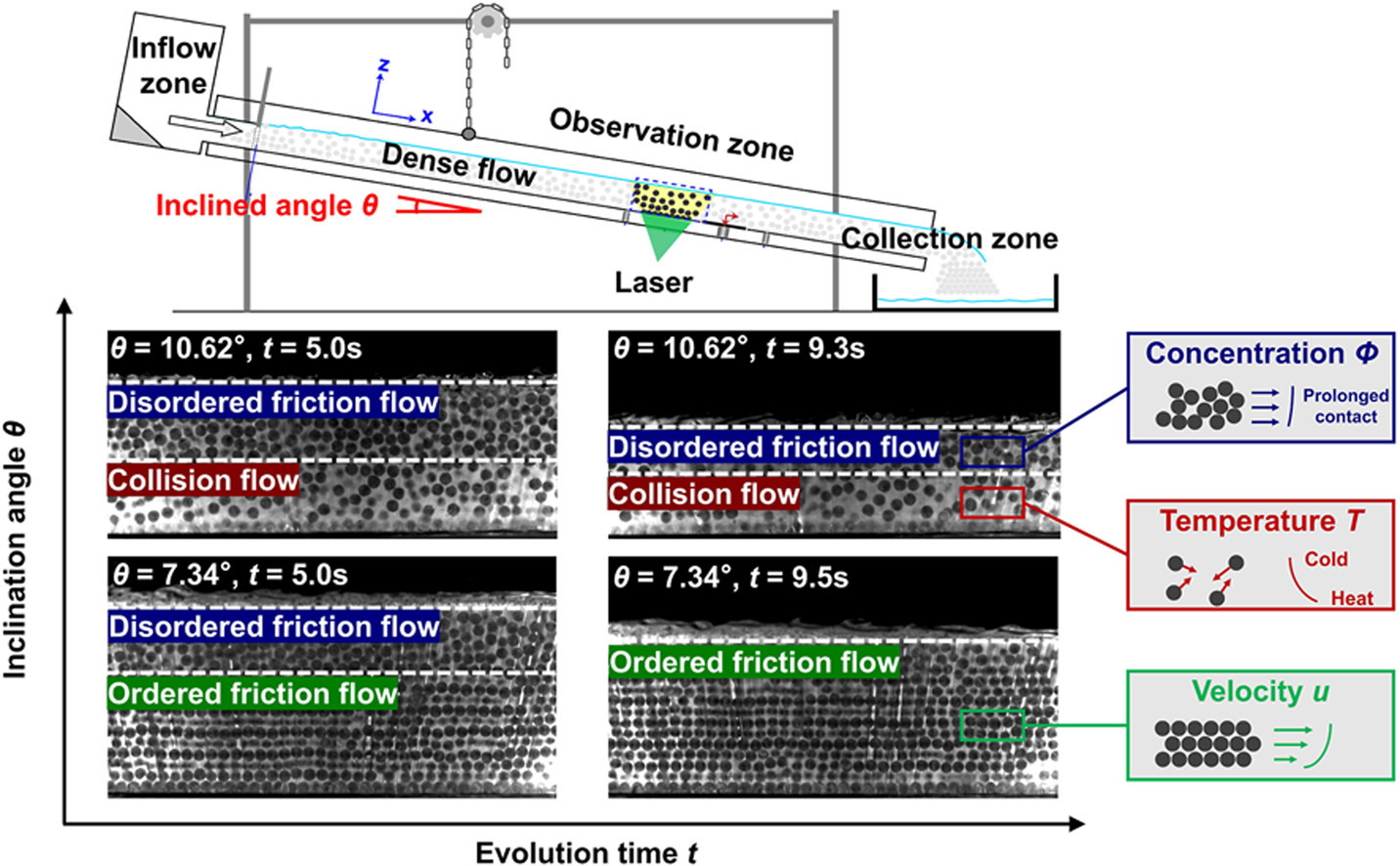
Dense liquid-particle flows are common in natural and industrial settings, yet their internal dynamics remain poorly understood. Under conditions of high particle concentration and strong particle–fluid coupling, these flows exhibit pronounced layering and temporal evolution. In this study, refractive index matching combined with particle tracking velocimetry (RIM-PTV) is employed in an inclined channel to directly visualize internal structures at two representative inclinations. Particle concentration, velocity, shear rate, and granular temperature are measured and reconstructed, revealing that the flow evolves through four stages: front, quasi-steady, fluctuation, and decline. Inclination strongly influences layering evolution. At low inclination, the flow gradually transitions from a dual-layer structure of ordered friction flow beneath disordered friction flow to a single-layer ordered friction structure during the fluctuation stage, with the upper layer collapsing under near-critical frictional conditions. At high inclination, a dual-layer structure of basal collision flow beneath disordered friction flow persists throughout. A stress-based analysis, using the effective friction coefficient and inertial number, reveals that the evolution is governed by the competition between shear driving and normal compression, which determine the persistence or collapse of layering structures. These results provide experimentally resolved evidence for stage-wise layering evolution in dense liquid-particle flows and establish a benchmark for developing predictive rheological and dynamical models.
Graphical abstract
Keywords
Dense liquid-particle flow; Refractive index matching; Flow evolution; Layering structure
文章导读