
期刊文章
过刊浏览
- Volumes 108-119 (2025)
-
Volumes 96-107 (2025)
-
Volume 107
Pages 1-376 (December 2025)
-
Volume 106
Pages 1-336 (November 2025)
-
Volume 105
Pages 1-356 (October 2025)
-
Volume 104
Pages 1-332 (September 2025)
-
Volume 103
Pages 1-314 (August 2025)
-
Volume 102
Pages 1-276 (July 2025)
-
Volume 101
Pages 1-166 (June 2025)
-
Volume 100
Pages 1-256 (May 2025)
-
Volume 99
Pages 1-242 (April 2025)
-
Volume 98
Pages 1-288 (March 2025)
-
Volume 97
Pages 1-256 (February 2025)
-
Volume 96
Pages 1-340 (January 2025)
-
Volume 107
-
Volumes 84-95 (2024)
-
Volume 95
Pages 1-392 (December 2024)
-
Volume 94
Pages 1-400 (November 2024)
-
Volume 93
Pages 1-376 (October 2024)
-
Volume 92
Pages 1-316 (September 2024)
-
Volume 91
Pages 1-378 (August 2024)
-
Volume 90
Pages 1-580 (July 2024)
-
Volume 89
Pages 1-278 (June 2024)
-
Volume 88
Pages 1-350 (May 2024)
-
Volume 87
Pages 1-338 (April 2024)
-
Volume 86
Pages 1-312 (March 2024)
-
Volume 85
Pages 1-334 (February 2024)
-
Volume 84
Pages 1-308 (January 2024)
-
Volume 95
-
Volumes 72-83 (2023)
-
Volume 83
Pages 1-258 (December 2023)
-
Volume 82
Pages 1-204 (November 2023)
-
Volume 81
Pages 1-188 (October 2023)
-
Volume 80
Pages 1-202 (September 2023)
-
Volume 79
Pages 1-172 (August 2023)
-
Volume 78
Pages 1-146 (July 2023)
-
Volume 77
Pages 1-152 (June 2023)
-
Volume 76
Pages 1-176 (May 2023)
-
Volume 75
Pages 1-228 (April 2023)
-
Volume 74
Pages 1-200 (March 2023)
-
Volume 73
Pages 1-138 (February 2023)
-
Volume 72
Pages 1-144 (January 2023)
-
Volume 83
-
Volumes 60-71 (2022)
-
Volume 71
Pages 1-108 (December 2022)
-
Volume 70
Pages 1-106 (November 2022)
-
Volume 69
Pages 1-122 (October 2022)
-
Volume 68
Pages 1-124 (September 2022)
-
Volume 67
Pages 1-102 (August 2022)
-
Volume 66
Pages 1-112 (July 2022)
-
Volume 65
Pages 1-138 (June 2022)
-
Volume 64
Pages 1-186 (May 2022)
-
Volume 63
Pages 1-124 (April 2022)
-
Volume 62
Pages 1-104 (March 2022)
-
Volume 61
Pages 1-120 (February 2022)
-
Volume 60
Pages 1-124 (January 2022)
-
Volume 71
- Volumes 54-59 (2021)
- Volumes 48-53 (2020)
- Volumes 42-47 (2019)
- Volumes 36-41 (2018)
- Volumes 30-35 (2017)
- Volumes 24-29 (2016)
- Volumes 18-23 (2015)
- Volumes 12-17 (2014)
- Volume 11 (2013)
- Volume 10 (2012)
- Volume 9 (2011)
- Volume 8 (2010)
- Volume 7 (2009)
- Volume 6 (2008)
- Volume 5 (2007)
- Volume 4 (2006)
- Volume 3 (2005)
- Volume 2 (2004)
- Volume 1 (2003)
Volume 114
Talebi, F. A., Haydari, Z., Hodges, C., Stockdale, A., Mehrabi, M., Rabbani, A., . . . Hassanpour, A. (2026). Quantifying ibuprofen powder adhesion: Impact of surface roughness and substrate material. Particuology, 114, 101-120. https://doi.org/10.1016/j.partic.2026.04.001
Quantifying ibuprofen powder adhesion: Impact of surface roughness and substrate material (Open Access)
Fatemeh A. Talebi a, Zobaideh Haydari a, Christopher Hodges a, Andrew Stockdale a, Mozhdeh Mehrabi a, Arash Rabbani b, David Harbottle a, Ali Hassanpour a *
a School of Chemical and Process Engineering, University of Leeds, LS2 9JT, United Kingdom
b School of Computer Science, University of Leeds, LS2 9JT, United Kingdom
10.1016/j.partic.2026.04.001
Volume 114,
July 2026,
Pages 101-120
Received 22 July 2025, Revised 23 March 2026, Accepted 1 April 2026, Available online 12 April 2026, Version of Record 24 April 2026.
E-mail:
a.hassanpour@leeds.ac.uk
Highlights
• The effective work of adhesion, Г, was determined by employing the drop test method.
• Influence of substrate material on effective work of adhesion, Г, is studied.
• Effect of surface roughness on effective work of adhesion, Г, is examined.
• The surface energy trend from contact angle measurement aligned with adhesion values.
Abstract
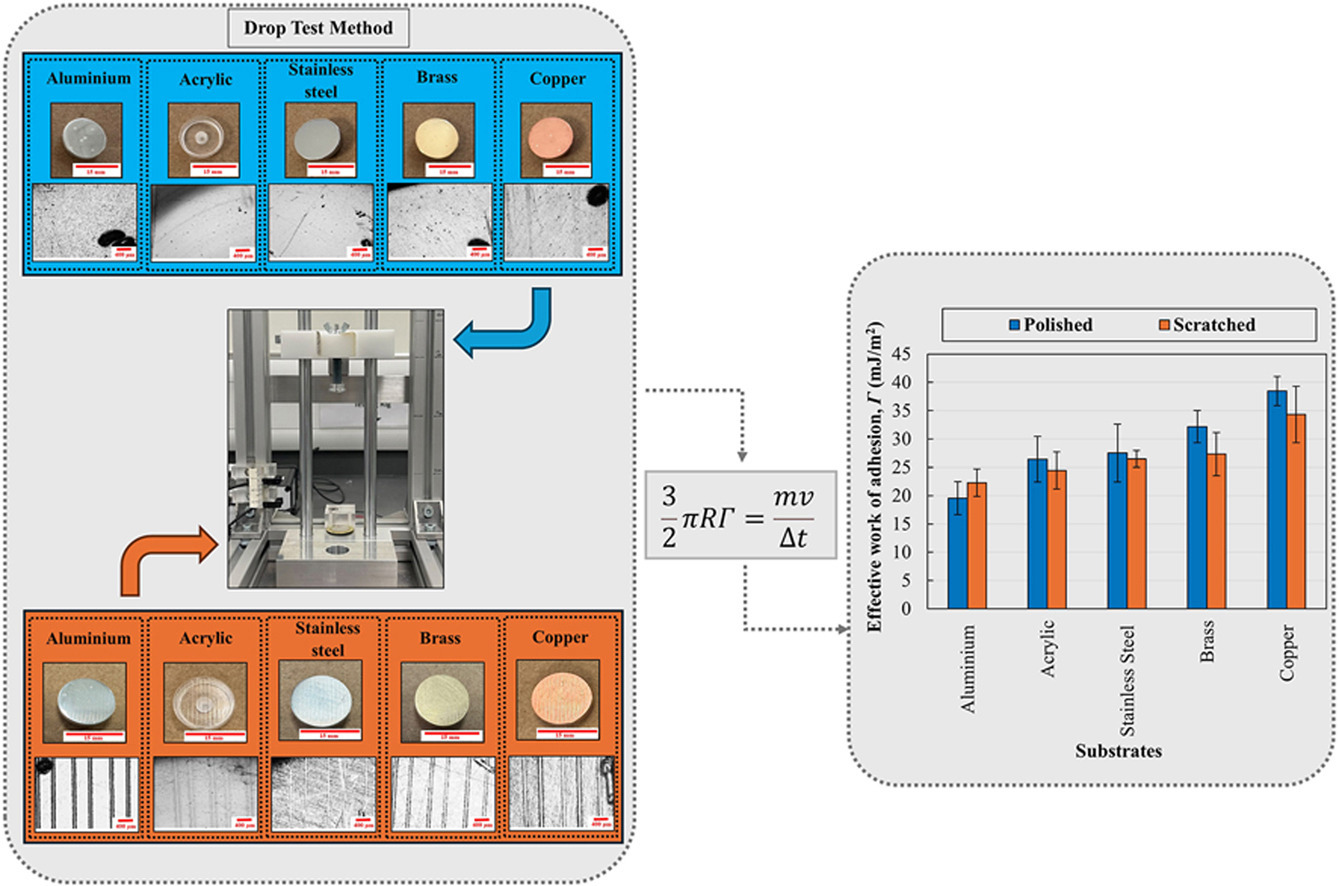
Powder adhesion influences its behaviour during pharmaceutical processing, where particle-particle and particle-surface interactions often hinder consistent powder mobility and lead to unacceptable content uniformity. This study investigates how substrate material and surface roughness affect the effective work of adhesion, Γ, of ibuprofen powders measured using the drop test method. Five substrates; aluminium, acrylic, stainless steel, brass and copper, were examined in both polished and scratched conditions. The effective work of adhesion of the polished aluminium, acrylic, stainless steel, brass and copper were 19.6 ± 2.9, 26.4 ± 4.02, 27.5 ± 5.1, 32.2 ± 2.8 and 38.5 ± 2.6 mJ/m2, respectively. Contact angle measurements confirmed that surface free energy trends were consistent with the adhesion values. Aluminium's low adhesion was attributed to its naturally formed oxide layer and rougher surface. A scratch-test rig was utilised to introduce scratches across five substrates, where adhesion values followed the same trend to polished surfaces. Generally, roughness reduced the adhesion except for aluminium, where deeper valleys in the polished state, likely arising from polishing and scratching variations or from uncontrolled surface handling prior to scratching, resulted in higher adhesion values. Additionally, we developed an automated algorithm to analyze substrate images and quantify the critical particle diameter and effective work of adhesion. While the results aligned with manual findings for polished surfaces, scratched surfaces showed discrepancies due to higher levels of image noise.
Graphical abstract
Keywords
Effective work of adhesion; Drop test method; Substrate material; Surface roughness; Automated algorithm; Surface free energy
文章导读