
期刊文章
过刊浏览
- Volumes 108-119 (2025)
-
Volumes 96-107 (2025)
-
Volume 107
Pages 1-376 (December 2025)
-
Volume 106
Pages 1-336 (November 2025)
-
Volume 105
Pages 1-356 (October 2025)
-
Volume 104
Pages 1-332 (September 2025)
-
Volume 103
Pages 1-314 (August 2025)
-
Volume 102
Pages 1-276 (July 2025)
-
Volume 101
Pages 1-166 (June 2025)
-
Volume 100
Pages 1-256 (May 2025)
-
Volume 99
Pages 1-242 (April 2025)
-
Volume 98
Pages 1-288 (March 2025)
-
Volume 97
Pages 1-256 (February 2025)
-
Volume 96
Pages 1-340 (January 2025)
-
Volume 107
-
Volumes 84-95 (2024)
-
Volume 95
Pages 1-392 (December 2024)
-
Volume 94
Pages 1-400 (November 2024)
-
Volume 93
Pages 1-376 (October 2024)
-
Volume 92
Pages 1-316 (September 2024)
-
Volume 91
Pages 1-378 (August 2024)
-
Volume 90
Pages 1-580 (July 2024)
-
Volume 89
Pages 1-278 (June 2024)
-
Volume 88
Pages 1-350 (May 2024)
-
Volume 87
Pages 1-338 (April 2024)
-
Volume 86
Pages 1-312 (March 2024)
-
Volume 85
Pages 1-334 (February 2024)
-
Volume 84
Pages 1-308 (January 2024)
-
Volume 95
-
Volumes 72-83 (2023)
-
Volume 83
Pages 1-258 (December 2023)
-
Volume 82
Pages 1-204 (November 2023)
-
Volume 81
Pages 1-188 (October 2023)
-
Volume 80
Pages 1-202 (September 2023)
-
Volume 79
Pages 1-172 (August 2023)
-
Volume 78
Pages 1-146 (July 2023)
-
Volume 77
Pages 1-152 (June 2023)
-
Volume 76
Pages 1-176 (May 2023)
-
Volume 75
Pages 1-228 (April 2023)
-
Volume 74
Pages 1-200 (March 2023)
-
Volume 73
Pages 1-138 (February 2023)
-
Volume 72
Pages 1-144 (January 2023)
-
Volume 83
-
Volumes 60-71 (2022)
-
Volume 71
Pages 1-108 (December 2022)
-
Volume 70
Pages 1-106 (November 2022)
-
Volume 69
Pages 1-122 (October 2022)
-
Volume 68
Pages 1-124 (September 2022)
-
Volume 67
Pages 1-102 (August 2022)
-
Volume 66
Pages 1-112 (July 2022)
-
Volume 65
Pages 1-138 (June 2022)
-
Volume 64
Pages 1-186 (May 2022)
-
Volume 63
Pages 1-124 (April 2022)
-
Volume 62
Pages 1-104 (March 2022)
-
Volume 61
Pages 1-120 (February 2022)
-
Volume 60
Pages 1-124 (January 2022)
-
Volume 71
- Volumes 54-59 (2021)
- Volumes 48-53 (2020)
- Volumes 42-47 (2019)
- Volumes 36-41 (2018)
- Volumes 30-35 (2017)
- Volumes 24-29 (2016)
- Volumes 18-23 (2015)
- Volumes 12-17 (2014)
- Volume 11 (2013)
- Volume 10 (2012)
- Volume 9 (2011)
- Volume 8 (2010)
- Volume 7 (2009)
- Volume 6 (2008)
- Volume 5 (2007)
- Volume 4 (2006)
- Volume 3 (2005)
- Volume 2 (2004)
- Volume 1 (2003)
Volume 114
Tavanaei, A., Baltussen, M. W., Buist, K. A., & Kuipers, J. A. M. (2026). A numerical study of the influence of pre-wetting on the static liquid hold-up and wetting efficiency in a trickle bed reactor. Particuology, 114, 121-129. https://doi.org/10.1016/j.partic.2026.03.032
A numerical study of the influence of pre-wetting on the static liquid hold-up and wetting efficiency in a trickle bed reactor (Open Access)
Arvin Tavanaei, Maike W. Baltussen *, Kay A. Buist, J.A.M. (Hans) Kuipers
Department of Chemical Engineering and Chemistry, Eindhoven University of Technology, P.O. Box 513, 5600 MB, Eindhoven, the Netherlands
10.1016/j.partic.2026.03.032
Volume 114,
July 2026,
Pages 121-129
Received 26 January 2026, Revised 23 March 2026, Accepted 26 March 2026, Available online 11 April 2026, Version of Record 29 April 2026.
E-mail:
m.w.baltussen@tue.nl
Highlights
• Numerical study of the effect of pre-wetting on flow in trickle bed reactors.
• Higher initial wetting leads to increased static holdup.
• Wetting patterns are influenced more by initial wetting than liquid flow rate.
• Wetting efficiency is primarily governed by the liquid flow rate.
Abstract
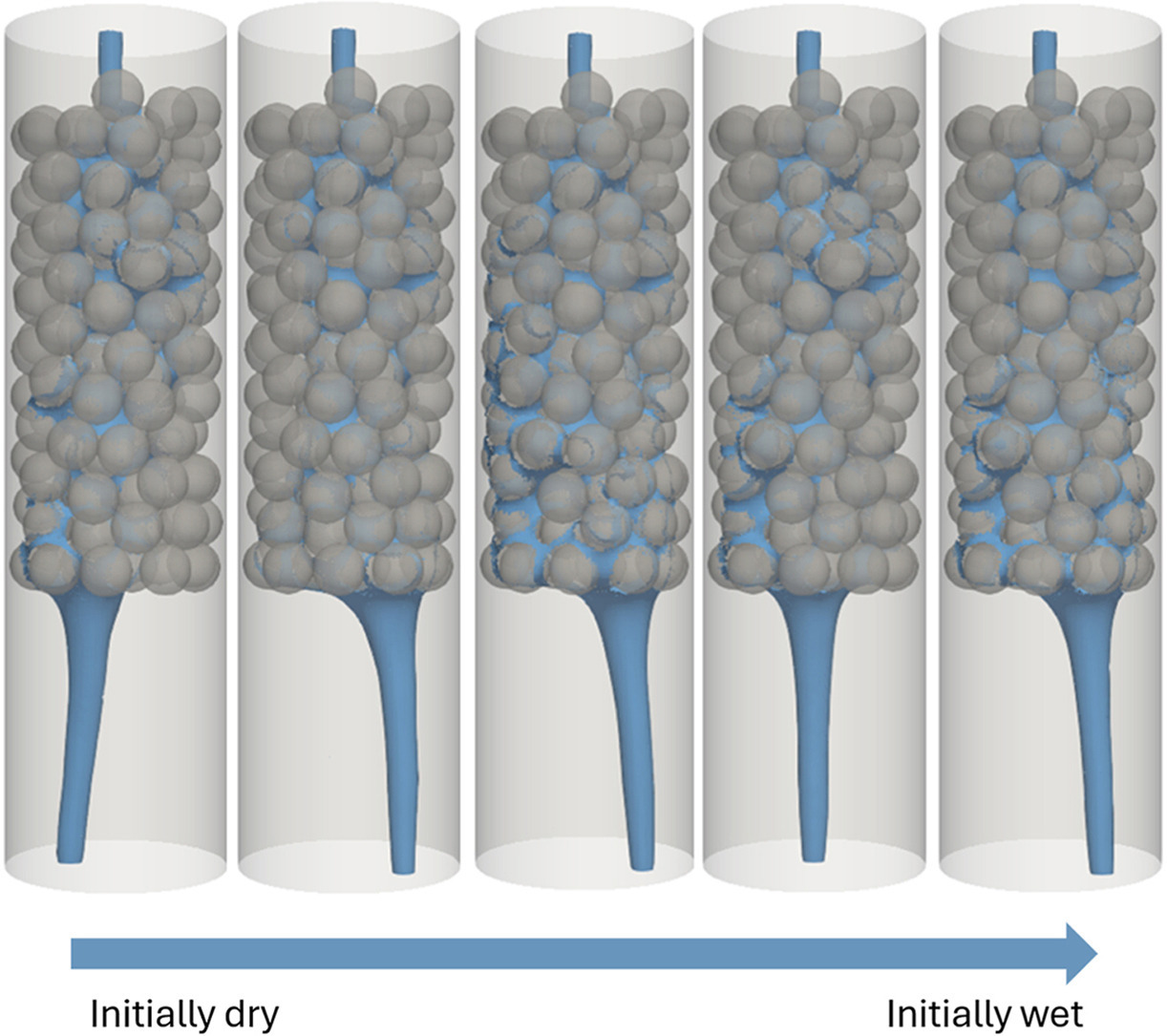
Trickle beds are widely used in chemical processes due to their significant advantages over other multiphase reactors. However, their operation presents challenges, primarily due to complex hydrodynamic characteristics. One of the most critical challenges is the non-uniform liquid distribution, which leads to inhomogeneous particle wetting and possible adverse effects on process yield and selectivity. In this study, the effects of initial wetting conditions on static liquid hold-up and wetting efficiency were studied using particle-resolved Direct Numerical Simulation (DNS). Our results reveal that the local distribution of initial wetting significantly influences the liquid pathways after start-up, enhancing wetting efficiency compared to that of an initially dry bed. Local variations in pre-wetted beds, however, have minimal impact on wetting efficiency, particularly at high liquid fluxes. Notably, liquid flux plays a more significant role in determining the wetting efficiency of pre-wetted beds.
Graphical abstract
Keywords
Trickle bed; Wetting; Direct numerical simulation; Volume of fluid; Immersed boundary method
文章导读