
期刊文章
过刊浏览
- Volumes 108-119 (2025)
-
Volumes 96-107 (2025)
-
Volume 107
Pages 1-376 (December 2025)
-
Volume 106
Pages 1-336 (November 2025)
-
Volume 105
Pages 1-356 (October 2025)
-
Volume 104
Pages 1-332 (September 2025)
-
Volume 103
Pages 1-314 (August 2025)
-
Volume 102
Pages 1-276 (July 2025)
-
Volume 101
Pages 1-166 (June 2025)
-
Volume 100
Pages 1-256 (May 2025)
-
Volume 99
Pages 1-242 (April 2025)
-
Volume 98
Pages 1-288 (March 2025)
-
Volume 97
Pages 1-256 (February 2025)
-
Volume 96
Pages 1-340 (January 2025)
-
Volume 107
-
Volumes 84-95 (2024)
-
Volume 95
Pages 1-392 (December 2024)
-
Volume 94
Pages 1-400 (November 2024)
-
Volume 93
Pages 1-376 (October 2024)
-
Volume 92
Pages 1-316 (September 2024)
-
Volume 91
Pages 1-378 (August 2024)
-
Volume 90
Pages 1-580 (July 2024)
-
Volume 89
Pages 1-278 (June 2024)
-
Volume 88
Pages 1-350 (May 2024)
-
Volume 87
Pages 1-338 (April 2024)
-
Volume 86
Pages 1-312 (March 2024)
-
Volume 85
Pages 1-334 (February 2024)
-
Volume 84
Pages 1-308 (January 2024)
-
Volume 95
-
Volumes 72-83 (2023)
-
Volume 83
Pages 1-258 (December 2023)
-
Volume 82
Pages 1-204 (November 2023)
-
Volume 81
Pages 1-188 (October 2023)
-
Volume 80
Pages 1-202 (September 2023)
-
Volume 79
Pages 1-172 (August 2023)
-
Volume 78
Pages 1-146 (July 2023)
-
Volume 77
Pages 1-152 (June 2023)
-
Volume 76
Pages 1-176 (May 2023)
-
Volume 75
Pages 1-228 (April 2023)
-
Volume 74
Pages 1-200 (March 2023)
-
Volume 73
Pages 1-138 (February 2023)
-
Volume 72
Pages 1-144 (January 2023)
-
Volume 83
-
Volumes 60-71 (2022)
-
Volume 71
Pages 1-108 (December 2022)
-
Volume 70
Pages 1-106 (November 2022)
-
Volume 69
Pages 1-122 (October 2022)
-
Volume 68
Pages 1-124 (September 2022)
-
Volume 67
Pages 1-102 (August 2022)
-
Volume 66
Pages 1-112 (July 2022)
-
Volume 65
Pages 1-138 (June 2022)
-
Volume 64
Pages 1-186 (May 2022)
-
Volume 63
Pages 1-124 (April 2022)
-
Volume 62
Pages 1-104 (March 2022)
-
Volume 61
Pages 1-120 (February 2022)
-
Volume 60
Pages 1-124 (January 2022)
-
Volume 71
- Volumes 54-59 (2021)
- Volumes 48-53 (2020)
- Volumes 42-47 (2019)
- Volumes 36-41 (2018)
- Volumes 30-35 (2017)
- Volumes 24-29 (2016)
- Volumes 18-23 (2015)
- Volumes 12-17 (2014)
- Volume 11 (2013)
- Volume 10 (2012)
- Volume 9 (2011)
- Volume 8 (2010)
- Volume 7 (2009)
- Volume 6 (2008)
- Volume 5 (2007)
- Volume 4 (2006)
- Volume 3 (2005)
- Volume 2 (2004)
- Volume 1 (2003)
Volume 114
MAP-Net: A multi-layer attention physics-informed network for accurate prediction of cyclone separation efficiency
Lixin Yang a b, Peixiao Ji a b, Jianyi Chen a b *
a State Key Laboratory of Heavy Oil Processing, China University of Petroleum, Beijing, 102249, China
b Beijing Key Laboratory of Process Fluid Filtration and Separation, 102249, China
10.1016/j.partic.2026.04.003
Volume 114,
July 2026,
Pages 130-140
Received 2 March 2026, Revised 31 March 2026, Accepted 2 April 2026, Available online 15 April 2026, Version of Record 30 April 2026.
E-mail:
jychen@cup.edu.cn
Highlights
• A novel MAP-Net integrating physical constraints and attention mechanisms is proposed for separation efficiency prediction.
• The hybrid model significantly improves prediction accuracy and generalization capability compared to pure data-driven approaches.
• MAP-Net exhibits strong interpretability by successfully capturing both macroscopic physical trends and complex microscopic nonlinearities.
Abstract
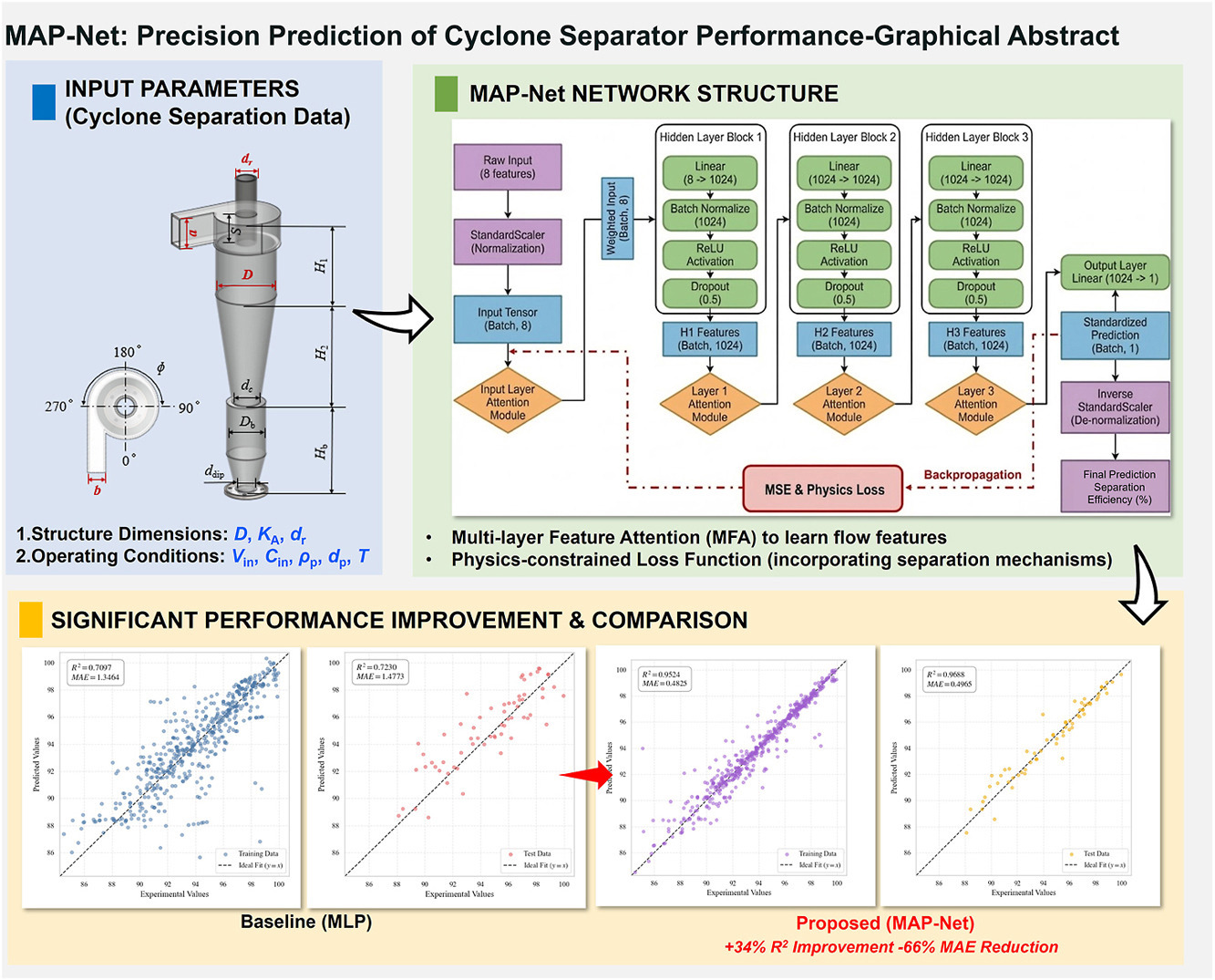
Accurate prediction of the separation efficiency of cyclone separators is of great significance for industrial process optimization and energy saving and emission reduction. Addressing the limitations of traditional empirical models (narrow application range), numerical simulations (high computational costs), and pure data-driven models (poor generalization ability under small sample sizes and tendency to violate physical mechanisms), this study proposes a deep learning model integrating physical priors and attention mechanisms—the Multi-layer Attention Physics Network (MAP-Net). First, a high-fidelity comprehensive database covering multi-dimensional geometric dimensions and operating conditions was constructed. On this basis, MAP-Net utilizes a Multi-Layer Perceptron (MLP) as its backbone architecture. On one hand, a Multi-layer Feature Attention (MFA) mechanism is introduced to enhance the adaptive extraction capability for key flow field features; on the other hand, a corresponding physics-constrained loss function is constructed based on the gas-solid two-phase separation mechanism within the cyclone separator and embedded into the model training process. The results indicate that compared with the common MLP, the coefficient of determination (R2) of MAP-Net increased from 0.7230 to 0.9688, and the Mean Absolute Error (MAE) decreased significantly from 1.4773 to 0.4965, demonstrating a significant improvement in prediction accuracy. The proposed model possesses high accuracy, strong robustness, and physical interpretability, offering corresponding guidance and support for the rapid design and separation prediction of cyclone separators.
Graphical abstract
Keywords
Cyclone separator; Separation efficiency; Neural network; Physics constraint; Attention mechanism
文章导读