
期刊文章
过刊浏览
- Volumes 108-119 (2025)
-
Volumes 96-107 (2025)
-
Volume 107
Pages 1-376 (December 2025)
-
Volume 106
Pages 1-336 (November 2025)
-
Volume 105
Pages 1-356 (October 2025)
-
Volume 104
Pages 1-332 (September 2025)
-
Volume 103
Pages 1-314 (August 2025)
-
Volume 102
Pages 1-276 (July 2025)
-
Volume 101
Pages 1-166 (June 2025)
-
Volume 100
Pages 1-256 (May 2025)
-
Volume 99
Pages 1-242 (April 2025)
-
Volume 98
Pages 1-288 (March 2025)
-
Volume 97
Pages 1-256 (February 2025)
-
Volume 96
Pages 1-340 (January 2025)
-
Volume 107
-
Volumes 84-95 (2024)
-
Volume 95
Pages 1-392 (December 2024)
-
Volume 94
Pages 1-400 (November 2024)
-
Volume 93
Pages 1-376 (October 2024)
-
Volume 92
Pages 1-316 (September 2024)
-
Volume 91
Pages 1-378 (August 2024)
-
Volume 90
Pages 1-580 (July 2024)
-
Volume 89
Pages 1-278 (June 2024)
-
Volume 88
Pages 1-350 (May 2024)
-
Volume 87
Pages 1-338 (April 2024)
-
Volume 86
Pages 1-312 (March 2024)
-
Volume 85
Pages 1-334 (February 2024)
-
Volume 84
Pages 1-308 (January 2024)
-
Volume 95
-
Volumes 72-83 (2023)
-
Volume 83
Pages 1-258 (December 2023)
-
Volume 82
Pages 1-204 (November 2023)
-
Volume 81
Pages 1-188 (October 2023)
-
Volume 80
Pages 1-202 (September 2023)
-
Volume 79
Pages 1-172 (August 2023)
-
Volume 78
Pages 1-146 (July 2023)
-
Volume 77
Pages 1-152 (June 2023)
-
Volume 76
Pages 1-176 (May 2023)
-
Volume 75
Pages 1-228 (April 2023)
-
Volume 74
Pages 1-200 (March 2023)
-
Volume 73
Pages 1-138 (February 2023)
-
Volume 72
Pages 1-144 (January 2023)
-
Volume 83
-
Volumes 60-71 (2022)
-
Volume 71
Pages 1-108 (December 2022)
-
Volume 70
Pages 1-106 (November 2022)
-
Volume 69
Pages 1-122 (October 2022)
-
Volume 68
Pages 1-124 (September 2022)
-
Volume 67
Pages 1-102 (August 2022)
-
Volume 66
Pages 1-112 (July 2022)
-
Volume 65
Pages 1-138 (June 2022)
-
Volume 64
Pages 1-186 (May 2022)
-
Volume 63
Pages 1-124 (April 2022)
-
Volume 62
Pages 1-104 (March 2022)
-
Volume 61
Pages 1-120 (February 2022)
-
Volume 60
Pages 1-124 (January 2022)
-
Volume 71
- Volumes 54-59 (2021)
- Volumes 48-53 (2020)
- Volumes 42-47 (2019)
- Volumes 36-41 (2018)
- Volumes 30-35 (2017)
- Volumes 24-29 (2016)
- Volumes 18-23 (2015)
- Volumes 12-17 (2014)
- Volume 11 (2013)
- Volume 10 (2012)
- Volume 9 (2011)
- Volume 8 (2010)
- Volume 7 (2009)
- Volume 6 (2008)
- Volume 5 (2007)
- Volume 4 (2006)
- Volume 3 (2005)
- Volume 2 (2004)
- Volume 1 (2003)
Volume 114
Qiao, Z., Huang, J., Qin, X., Qu, J., & Zhang, J. (2026). Rapid synthesis of nano-sized Beta zeolite via guar gum assistance: Tailoring particle morphology for improved diffusion in lactide production. Particuology, 114, 141-154. https://doi.org/10.1016/j.partic.2026.04.007
Rapid synthesis of nano-sized Beta zeolite via guar gum assistance: Tailoring particle morphology for improved diffusion in lactide production (Open Access)
Ziyuan Qiao, Jianbin Huang, Xiaoyuan Qin, Jindong Qu, Jian Zhang *
State Key Laboratory of Green Biomanufacturing, Beijing Advanced Innovation Center for Soft Matter, Science and Engineering, Beijing University of Chemical Technology, China
10.1016/j.partic.2026.04.007
Volume 114,
July 2026,
Pages 141-154
Received 11 February 2026, Revised 30 March 2026, Accepted 10 April 2026, Available online 24 April 2026, Version of Record 30 April 2026.
E-mail:
jianzhangbuct@buct.edu.cn
Highlights
• Guar gum enables rapid high-temperature synthesis of nano-sized Beta zeolite.
• Guar gum suppresses Ostwald ripening, giving <100 nm Beta with intercrystalline pores.
• Tailored Beta delivers 79.2% lactide yield, far above the control zeolite (52.5%).
• Shortened diffusion paths from smaller crystals limit overpolymerization and coking.
Abstract
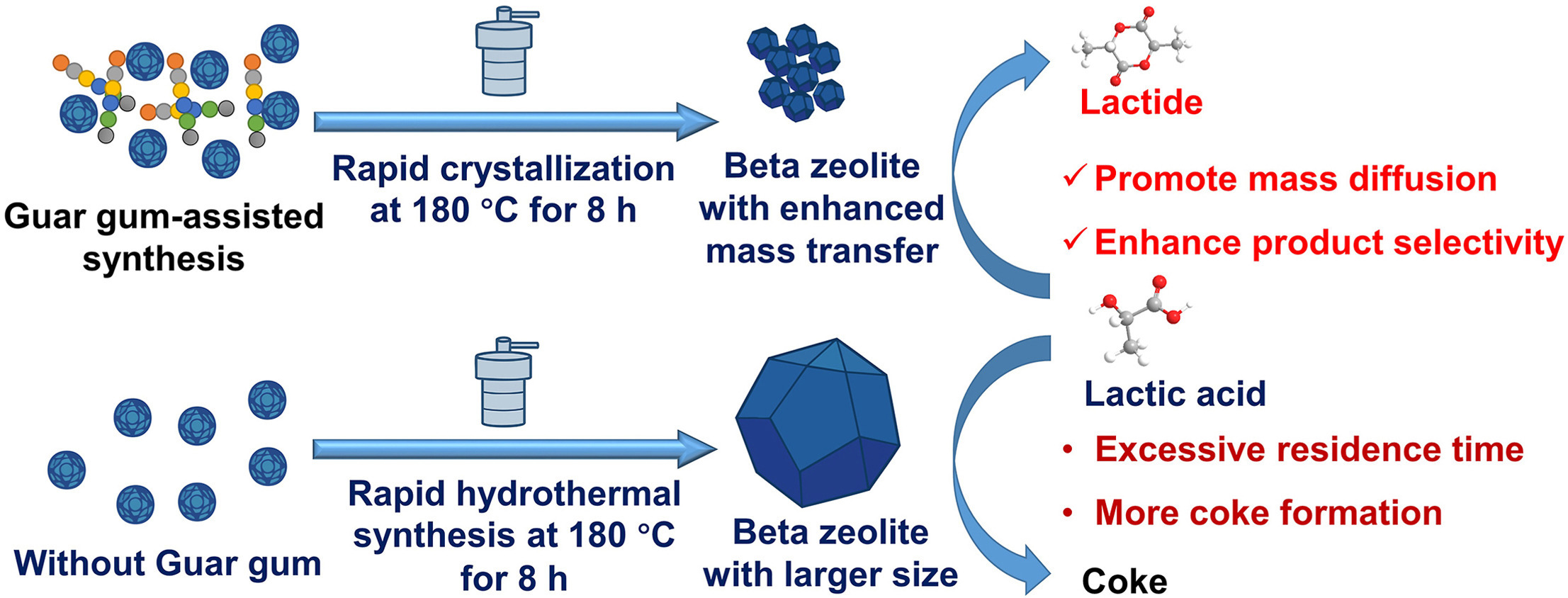
Beta zeolite serves as a crucial catalyst for the direct one-step synthesis of lactide from lactic acid, yet its application encounters persistent challenges including prolonged synthesis duration and excessive crystal ripening, which substantially compromise the efficient and high-quality production of zeolites at industrial scale. To address this, we developed a rapid hydrothermal synthesis route at 180 °C, employing an inexpensive bio-derived polysaccharide, guar gum, as a crystal growth modulator. By systematically optimizing key parameters (guar gum/SiO2 ratio, aging temperature/duration, crystallization time), we successfully tailored the zeolite's texture. The introduction of guar gum effectively suppressed Ostwald ripening, yielding Beta zeolite with significantly reduced primary crystal size (<100 nm) and developed intercrystalline porosity within a remarkably short period of 8 h. Compared to a rapidly synthesized counterpart without guar gum, the optimized catalyst exhibited a substantially higher specific surface area (586 vs. 384 m2 g−1) and a mesopore population centered at 20–60 nm. In the conversion of lactic acid to lactide, this nano-structured catalyst delivered a markedly higher lactide yield of 79.2%, a 51% improvement over the control sample (52.5%). Gel permeation chromatography and thermogravimetric analysis confirmed that the tailored particle architecture shortened diffusion paths, effectively mitigating oligomer overpolymerization and coking. This work provides a facile and scalable strategy for controlling zeolite crystal growth at the nanoscale, demonstrating the significant impact of particle morphology engineering on catalytic process efficiency.
Graphical abstract
Keywords
Fast crystallization; Beta zeolite; Mass transfer; Lactide
文章导读