
期刊文章
过刊浏览
- Volumes 108-119 (2025)
-
Volumes 96-107 (2025)
-
Volume 107
Pages 1-376 (December 2025)
-
Volume 106
Pages 1-336 (November 2025)
-
Volume 105
Pages 1-356 (October 2025)
-
Volume 104
Pages 1-332 (September 2025)
-
Volume 103
Pages 1-314 (August 2025)
-
Volume 102
Pages 1-276 (July 2025)
-
Volume 101
Pages 1-166 (June 2025)
-
Volume 100
Pages 1-256 (May 2025)
-
Volume 99
Pages 1-242 (April 2025)
-
Volume 98
Pages 1-288 (March 2025)
-
Volume 97
Pages 1-256 (February 2025)
-
Volume 96
Pages 1-340 (January 2025)
-
Volume 107
-
Volumes 84-95 (2024)
-
Volume 95
Pages 1-392 (December 2024)
-
Volume 94
Pages 1-400 (November 2024)
-
Volume 93
Pages 1-376 (October 2024)
-
Volume 92
Pages 1-316 (September 2024)
-
Volume 91
Pages 1-378 (August 2024)
-
Volume 90
Pages 1-580 (July 2024)
-
Volume 89
Pages 1-278 (June 2024)
-
Volume 88
Pages 1-350 (May 2024)
-
Volume 87
Pages 1-338 (April 2024)
-
Volume 86
Pages 1-312 (March 2024)
-
Volume 85
Pages 1-334 (February 2024)
-
Volume 84
Pages 1-308 (January 2024)
-
Volume 95
-
Volumes 72-83 (2023)
-
Volume 83
Pages 1-258 (December 2023)
-
Volume 82
Pages 1-204 (November 2023)
-
Volume 81
Pages 1-188 (October 2023)
-
Volume 80
Pages 1-202 (September 2023)
-
Volume 79
Pages 1-172 (August 2023)
-
Volume 78
Pages 1-146 (July 2023)
-
Volume 77
Pages 1-152 (June 2023)
-
Volume 76
Pages 1-176 (May 2023)
-
Volume 75
Pages 1-228 (April 2023)
-
Volume 74
Pages 1-200 (March 2023)
-
Volume 73
Pages 1-138 (February 2023)
-
Volume 72
Pages 1-144 (January 2023)
-
Volume 83
-
Volumes 60-71 (2022)
-
Volume 71
Pages 1-108 (December 2022)
-
Volume 70
Pages 1-106 (November 2022)
-
Volume 69
Pages 1-122 (October 2022)
-
Volume 68
Pages 1-124 (September 2022)
-
Volume 67
Pages 1-102 (August 2022)
-
Volume 66
Pages 1-112 (July 2022)
-
Volume 65
Pages 1-138 (June 2022)
-
Volume 64
Pages 1-186 (May 2022)
-
Volume 63
Pages 1-124 (April 2022)
-
Volume 62
Pages 1-104 (March 2022)
-
Volume 61
Pages 1-120 (February 2022)
-
Volume 60
Pages 1-124 (January 2022)
-
Volume 71
- Volumes 54-59 (2021)
- Volumes 48-53 (2020)
- Volumes 42-47 (2019)
- Volumes 36-41 (2018)
- Volumes 30-35 (2017)
- Volumes 24-29 (2016)
- Volumes 18-23 (2015)
- Volumes 12-17 (2014)
- Volume 11 (2013)
- Volume 10 (2012)
- Volume 9 (2011)
- Volume 8 (2010)
- Volume 7 (2009)
- Volume 6 (2008)
- Volume 5 (2007)
- Volume 4 (2006)
- Volume 3 (2005)
- Volume 2 (2004)
- Volume 1 (2003)
Volume 114
Ullah, K., Yan, H., Shao, Y., Zhang, H., Zhang, H., & Zhu, J. (2026). A review on innovations in antimicrobial nanotechnology: Integrating silver nanoparticles and carbon nanomaterials. Particuology, 114, 164-185. https://doi.org/10.1016/j.partic.2026.04.004
A review on innovations in antimicrobial nanotechnology: Integrating silver nanoparticles and carbon nanomaterials
Khalil Ullah a, Hui Yan a, Yuanyuan Shao b, Hui Zhang c, Haiping Zhang a *, Jesse Zhu d
a School of Chemical Engineering and Technology, Tianjin University, China
b Nottingham Ningbo China Beacons of Excellence Research and Innovation Institute, The University of Nottingham Ningbo China, China
c School of Chemical Engineering and Light Industry, Guangdong University of Technology, China
d School of Engineering, Eastern Institute of Technology, Ningbo, China
10.1016/j.partic.2026.04.004
Volume 114,
July 2026,
Pages 164-185
Received 7 January 2026, Revised 30 March 2026, Accepted 3 April 2026, Available online 22 April 2026, Version of Record 4 May 2026.
E-mail:
hpzhang@tju.edu.cn
Highlights
• AgNPs-CNMs hybrids enable synergistic antimicrobial mechanisms via ROS and membrane disruption.
• Carbon matrices stabilize AgNPs, control Ag+ release, and prevent aggregation.
• Composites exhibit enhanced biofilm inhibition and drug-resistant pathogen eradication.
• Multifunctional applications span medical implants, water purification, and smart coatings.
• Toxicity, scalability, and environmental persistence remain critical translational challenges.
Abstract
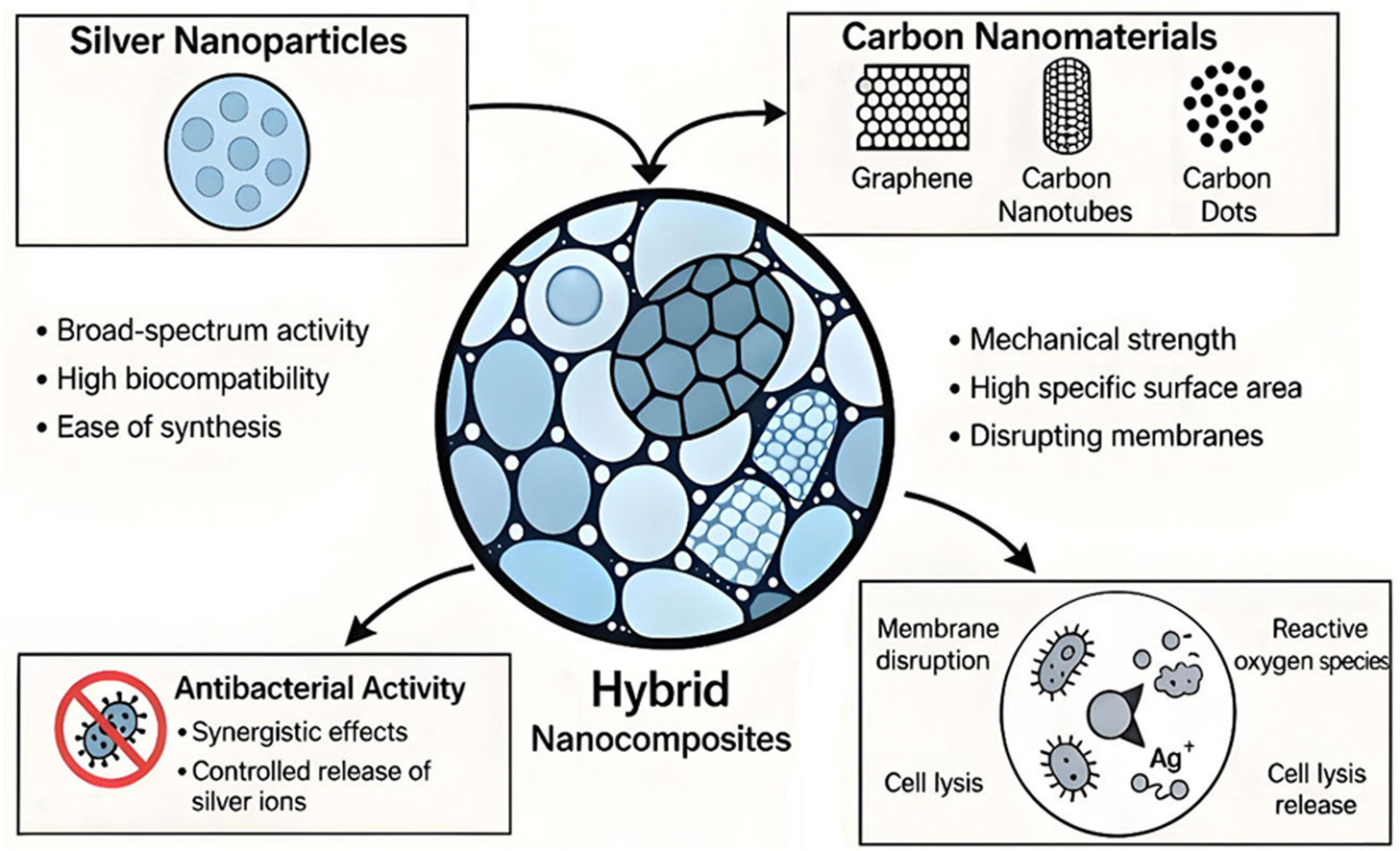
The development of advanced antibacterial agents has been significantly accelerated by nanotechnology. Particular attention is directed at Silver Nanoparticles (AgNPs) and carbon nanomaterials (CNMs) that have great potential. AgNPs are valued for their broad-spectrum antimicrobial activity, high biocompatibility, and ease of synthesis. In parallel, CNMs, including graphene, carbon nanotubes and carbon dots are favorable for their exceptional mechanical strength, high specific surface area, and a unique physical mechanism for disrupting microbial membranes. More recently, synergistic integration of AgNPs and CNMs into hybrid materials has emerged as a cutting-edge strategy that encourages synergies in antibacterial activity. This study presents a design-oriented, mechanism-driven analysis of CNMs@AgNPs systems by systematically linking carbon nanomaterial type, composite architecture, antibacterial mechanisms, and application relevance. These nanocomposites exhibit enhanced stability, controlled release of silver ions, and superior antibacterial effects, even to those against drug-resistant pathogens. The research is systematically examining the recent advances in CNMs@AgNPs hybrids, with a special focus on their synthesis strategies, structure characterization, antibacterial activity and mechanism, and their prospective applications in medicinal, environmental, and industrial sectors. The review paper further addresses the critical challenges and environmental impact surrounding the use of antimicrobial nanoparticles to guide the future research and development of safe, effective antimicrobial nanoparticles.
Graphical abstract
Keywords
Nanotechnology; Hybrid nanocomposites; Antibacterial activity; Silver; Carbon nanomaterials
文章导读