
期刊文章
过刊浏览
- Volumes 108-119 (2025)
-
Volumes 96-107 (2025)
-
Volume 107
Pages 1-376 (December 2025)
-
Volume 106
Pages 1-336 (November 2025)
-
Volume 105
Pages 1-356 (October 2025)
-
Volume 104
Pages 1-332 (September 2025)
-
Volume 103
Pages 1-314 (August 2025)
-
Volume 102
Pages 1-276 (July 2025)
-
Volume 101
Pages 1-166 (June 2025)
-
Volume 100
Pages 1-256 (May 2025)
-
Volume 99
Pages 1-242 (April 2025)
-
Volume 98
Pages 1-288 (March 2025)
-
Volume 97
Pages 1-256 (February 2025)
-
Volume 96
Pages 1-340 (January 2025)
-
Volume 107
-
Volumes 84-95 (2024)
-
Volume 95
Pages 1-392 (December 2024)
-
Volume 94
Pages 1-400 (November 2024)
-
Volume 93
Pages 1-376 (October 2024)
-
Volume 92
Pages 1-316 (September 2024)
-
Volume 91
Pages 1-378 (August 2024)
-
Volume 90
Pages 1-580 (July 2024)
-
Volume 89
Pages 1-278 (June 2024)
-
Volume 88
Pages 1-350 (May 2024)
-
Volume 87
Pages 1-338 (April 2024)
-
Volume 86
Pages 1-312 (March 2024)
-
Volume 85
Pages 1-334 (February 2024)
-
Volume 84
Pages 1-308 (January 2024)
-
Volume 95
-
Volumes 72-83 (2023)
-
Volume 83
Pages 1-258 (December 2023)
-
Volume 82
Pages 1-204 (November 2023)
-
Volume 81
Pages 1-188 (October 2023)
-
Volume 80
Pages 1-202 (September 2023)
-
Volume 79
Pages 1-172 (August 2023)
-
Volume 78
Pages 1-146 (July 2023)
-
Volume 77
Pages 1-152 (June 2023)
-
Volume 76
Pages 1-176 (May 2023)
-
Volume 75
Pages 1-228 (April 2023)
-
Volume 74
Pages 1-200 (March 2023)
-
Volume 73
Pages 1-138 (February 2023)
-
Volume 72
Pages 1-144 (January 2023)
-
Volume 83
-
Volumes 60-71 (2022)
-
Volume 71
Pages 1-108 (December 2022)
-
Volume 70
Pages 1-106 (November 2022)
-
Volume 69
Pages 1-122 (October 2022)
-
Volume 68
Pages 1-124 (September 2022)
-
Volume 67
Pages 1-102 (August 2022)
-
Volume 66
Pages 1-112 (July 2022)
-
Volume 65
Pages 1-138 (June 2022)
-
Volume 64
Pages 1-186 (May 2022)
-
Volume 63
Pages 1-124 (April 2022)
-
Volume 62
Pages 1-104 (March 2022)
-
Volume 61
Pages 1-120 (February 2022)
-
Volume 60
Pages 1-124 (January 2022)
-
Volume 71
- Volumes 54-59 (2021)
- Volumes 48-53 (2020)
- Volumes 42-47 (2019)
- Volumes 36-41 (2018)
- Volumes 30-35 (2017)
- Volumes 24-29 (2016)
- Volumes 18-23 (2015)
- Volumes 12-17 (2014)
- Volume 11 (2013)
- Volume 10 (2012)
- Volume 9 (2011)
- Volume 8 (2010)
- Volume 7 (2009)
- Volume 6 (2008)
- Volume 5 (2007)
- Volume 4 (2006)
- Volume 3 (2005)
- Volume 2 (2004)
- Volume 1 (2003)
Volume 114
Mumeen, A., Rufai, O., & Jin, Y.-C. (2026). MPS simulation of dense granular flows using a gradient-expansion nonlocal μ(I) rheology. Particuology, 114, 186-206. https://doi.org/10.1016/j.partic.2026.04.013
MPS simulation of dense granular flows using a gradient-expansion nonlocal μ(I) rheology
Akinkunmi Mumeen, Olalekan Rufai, Yee-Chung Jin *
Faculty of Engineering and Applied Science, University of Regina, Saskatchewan, S4S 0A2, Canada
10.1016/j.partic.2026.04.013
Volume 114,
July 2026,
Pages 186-206
Received 31 January 2026, Revised 1 April 2026, Accepted 13 April 2026, Available online 28 April 2026, Version of Record 4 May 2026.
E-mail:
yee-chung.jin@uregina.ca
Highlights
• Energy evolution governed by static and dynamic friction contributions.
• Gradient expansion nonlocal μ(I) model within a meshfree MPS framework.
• Nonlocal fluidity diffusion capturing cooperative effect in transitions.
• Strength-based μ(I) friction limits providing consistent flow prediction.
• Basal stress redistribution and surge formation in downslope collapse.
Abstract
Dense granular flows are common in many natural and industrial processes; yet, capturing their transition between inertial motion and quasi-static arrest remains difficult within continuum frameworks. This study presents a Lagrangian numerical framework combining the Moving Particle Semi-implicit (MPS) method with a strength-based nonlocal μ(I) rheology. It employs a gradient-expansion approach in which fluidity diffuses via a stabilized Laplacian operator, allowing the model to simulate creeping motion, a finite shear-band thickness, and smooth transitions between flowing and static zones. Both static and dynamic friction coefficients are derived from geomechanical functions tied to the internal friction angle, eliminating the need for empirical calibration. Validation against granular column-collapse experiments on flat and inclined beds accurately predicts the front propagation, internal velocity fields, and deposit shape across different aspect ratios and slopes. The nonlocal formulation addresses the cooperative effects deficiency of the local μ(I) model, particularly during the transition from inertial spreading to arrest. Energy analyses indicate that the dynamic friction coefficient governs post-yield mobility and runout, while the static coefficient primarily influences flow initiation. The framework offers a physically grounded, numerically robust tool for dense granular flows, eliminating the need for parameter calibration and enhancing predictive consistency.
Graphical abstract
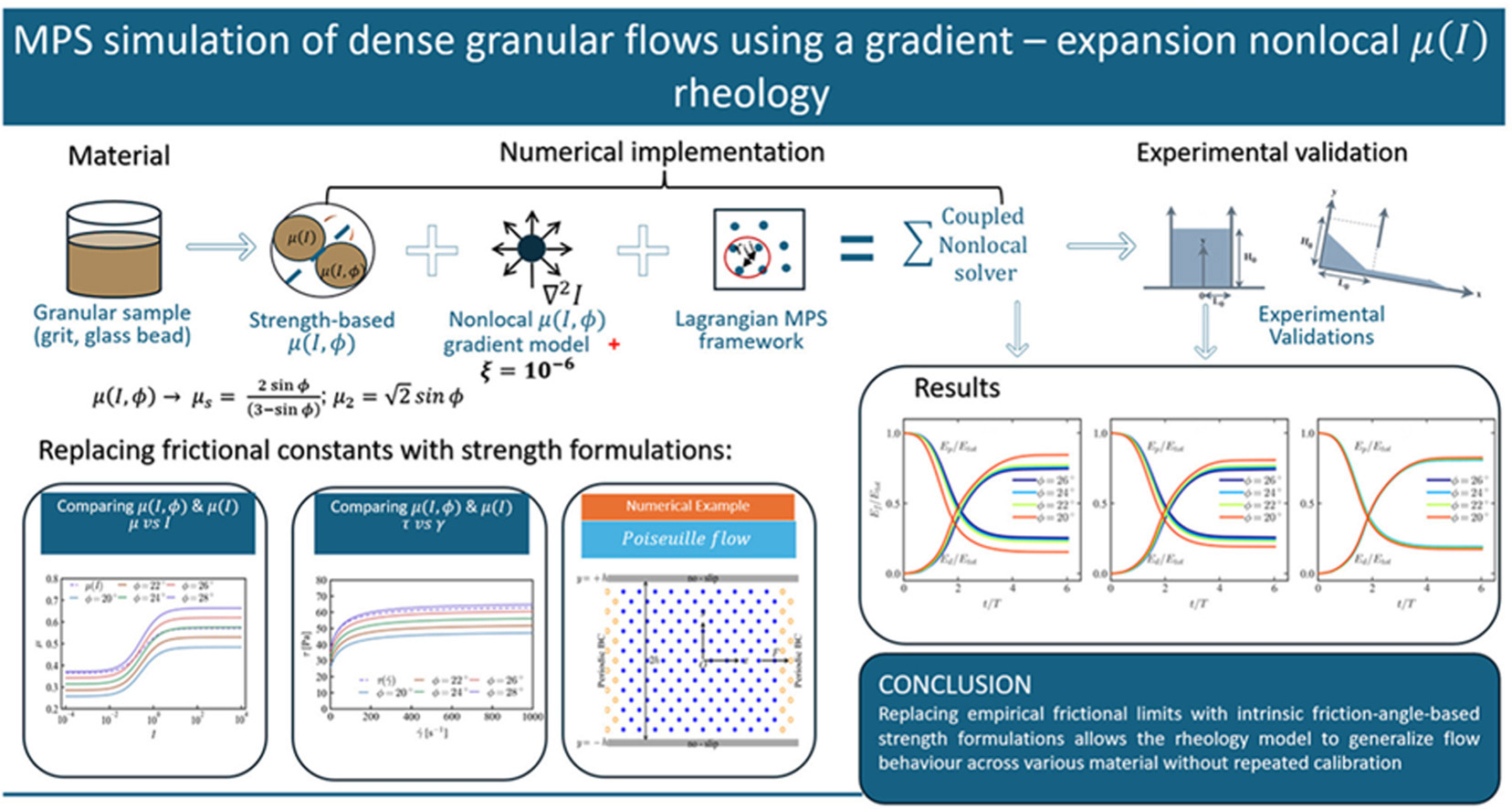
Keywords
Gradient expansion model (GEM); μ(I)rheology; MPS method; Granular flow; Strength parameter
文章导读