
期刊文章
过刊浏览
- Volumes 108-119 (2025)
-
Volumes 96-107 (2025)
-
Volume 107
Pages 1-376 (December 2025)
-
Volume 106
Pages 1-336 (November 2025)
-
Volume 105
Pages 1-356 (October 2025)
-
Volume 104
Pages 1-332 (September 2025)
-
Volume 103
Pages 1-314 (August 2025)
-
Volume 102
Pages 1-276 (July 2025)
-
Volume 101
Pages 1-166 (June 2025)
-
Volume 100
Pages 1-256 (May 2025)
-
Volume 99
Pages 1-242 (April 2025)
-
Volume 98
Pages 1-288 (March 2025)
-
Volume 97
Pages 1-256 (February 2025)
-
Volume 96
Pages 1-340 (January 2025)
-
Volume 107
-
Volumes 84-95 (2024)
-
Volume 95
Pages 1-392 (December 2024)
-
Volume 94
Pages 1-400 (November 2024)
-
Volume 93
Pages 1-376 (October 2024)
-
Volume 92
Pages 1-316 (September 2024)
-
Volume 91
Pages 1-378 (August 2024)
-
Volume 90
Pages 1-580 (July 2024)
-
Volume 89
Pages 1-278 (June 2024)
-
Volume 88
Pages 1-350 (May 2024)
-
Volume 87
Pages 1-338 (April 2024)
-
Volume 86
Pages 1-312 (March 2024)
-
Volume 85
Pages 1-334 (February 2024)
-
Volume 84
Pages 1-308 (January 2024)
-
Volume 95
-
Volumes 72-83 (2023)
-
Volume 83
Pages 1-258 (December 2023)
-
Volume 82
Pages 1-204 (November 2023)
-
Volume 81
Pages 1-188 (October 2023)
-
Volume 80
Pages 1-202 (September 2023)
-
Volume 79
Pages 1-172 (August 2023)
-
Volume 78
Pages 1-146 (July 2023)
-
Volume 77
Pages 1-152 (June 2023)
-
Volume 76
Pages 1-176 (May 2023)
-
Volume 75
Pages 1-228 (April 2023)
-
Volume 74
Pages 1-200 (March 2023)
-
Volume 73
Pages 1-138 (February 2023)
-
Volume 72
Pages 1-144 (January 2023)
-
Volume 83
-
Volumes 60-71 (2022)
-
Volume 71
Pages 1-108 (December 2022)
-
Volume 70
Pages 1-106 (November 2022)
-
Volume 69
Pages 1-122 (October 2022)
-
Volume 68
Pages 1-124 (September 2022)
-
Volume 67
Pages 1-102 (August 2022)
-
Volume 66
Pages 1-112 (July 2022)
-
Volume 65
Pages 1-138 (June 2022)
-
Volume 64
Pages 1-186 (May 2022)
-
Volume 63
Pages 1-124 (April 2022)
-
Volume 62
Pages 1-104 (March 2022)
-
Volume 61
Pages 1-120 (February 2022)
-
Volume 60
Pages 1-124 (January 2022)
-
Volume 71
- Volumes 54-59 (2021)
- Volumes 48-53 (2020)
- Volumes 42-47 (2019)
- Volumes 36-41 (2018)
- Volumes 30-35 (2017)
- Volumes 24-29 (2016)
- Volumes 18-23 (2015)
- Volumes 12-17 (2014)
- Volume 11 (2013)
- Volume 10 (2012)
- Volume 9 (2011)
- Volume 8 (2010)
- Volume 7 (2009)
- Volume 6 (2008)
- Volume 5 (2007)
- Volume 4 (2006)
- Volume 3 (2005)
- Volume 2 (2004)
- Volume 1 (2003)
Volume 114
Su, Y., Li, R., Yang, F., Yu, Z., Sun, Z., Zhang, Y., . . . Zhang, B. (2026). Mechanical behavior of non-spherical particle liquid bridge based on equivalent morphology. Particuology, 114, 207-221. https://doi.org/10.1016/j.partic.2026.04.006
Mechanical behavior of non-spherical particle liquid bridge based on equivalent morphology
Yifan Su a b, Renhe Li a b, Fan Yang a b, Ziyang Yu a b, Zongsheng Sun a b, Yadong Zhang a b, Hongxiang Xu c, Bo Zhang a b *
a Key Laboratory of Coal Processing and Efficient Utilization of Ministry of Education, China University of Mining and Technology, Xuzhou, 221116, China
b Jiangsu Key Laboratory for Clean Utilization of Carbon Resources, China University of Mining and Technology, Xuzhou, 221116, China
c School of Chemical and Environmental Engineering, China University of Mining and Technology Beijing, Beijing, 100083, China
10.1016/j.partic.2026.04.006
Volume 114,
July 2026,
Pages 207-221
Received 20 November 2025, Revised 2 April 2026, Accepted 8 April 2026, Available online 19 April 2026, Version of Record 8 May 2026.
E-mail:
zhangbocumt@126.com; bzhang@cumt.edu.cn
Highlights
• Construct equivalent non-spherical particles to study liquid bridge breakage.
• Particle size and liquid bridge volume influence liquid bridge fracture.
• Solid–liquid contact area governs the magnitude of liquid bridge force.
• Liquid bridge fracture is dictated by edge effects and contact angle hysteresis.
Abstract
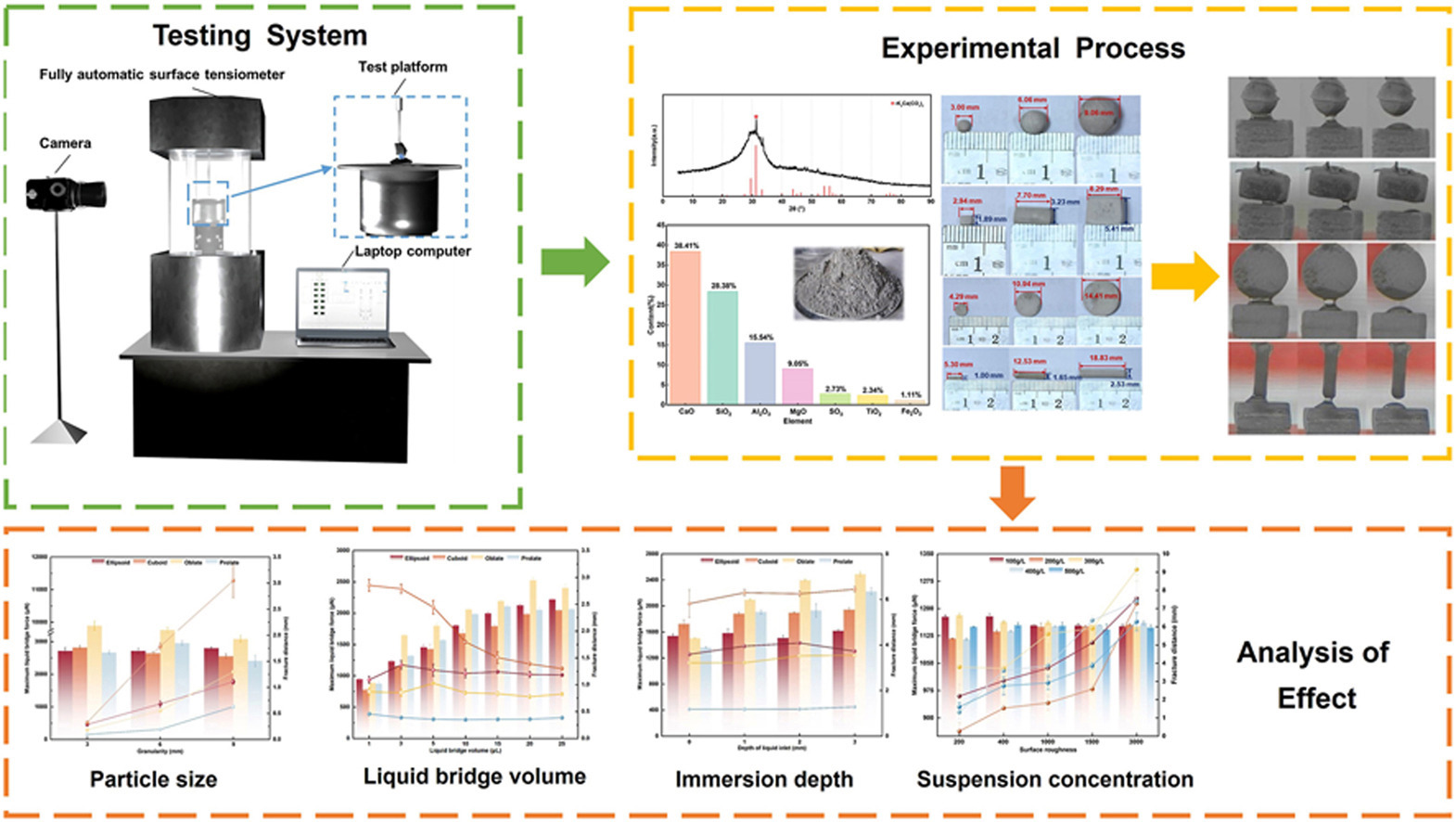
This study investigates liquid bridge force and fracture behavior in non-spherical wet particles using four equivalent morphological models (ellipsoid, cuboid, oblate cylinder, prolate cylinder) to represent coal particles. The effects of particle size, liquid volume, immersion depth, and kaolinite suspension were examined. Results show that increasing particle size from 3 mm to 9 mm raises the maximum liquid bridge force of cuboid particles from 520.38 μN to 11,275.30 μN. Peak forces occur at liquid volumes of 1–5 μL, with cuboid particles exhibiting the largest variation (1328.87 μN). Greater immersion depth extends fracture distance by up to 25% but minimally affects peak force. In kaolinite suspensions, fracture distance stabilizes at 6 mm while data dispersion increases. The solid–liquid contact area dominates the liquid bridge force, and fracture is controlled by edge effects and contact angle hysteresis. These findings aid optimization of non-spherical wet particle separation.
Graphical abstract
Keywords
Liquid bridge; Non-spherical particles; Equivalent morphology; Clay minerals; Fracture mechanism
文章导读