
期刊文章
过刊浏览
- Volumes 108-119 (2025)
-
Volumes 96-107 (2025)
-
Volume 107
Pages 1-376 (December 2025)
-
Volume 106
Pages 1-336 (November 2025)
-
Volume 105
Pages 1-356 (October 2025)
-
Volume 104
Pages 1-332 (September 2025)
-
Volume 103
Pages 1-314 (August 2025)
-
Volume 102
Pages 1-276 (July 2025)
-
Volume 101
Pages 1-166 (June 2025)
-
Volume 100
Pages 1-256 (May 2025)
-
Volume 99
Pages 1-242 (April 2025)
-
Volume 98
Pages 1-288 (March 2025)
-
Volume 97
Pages 1-256 (February 2025)
-
Volume 96
Pages 1-340 (January 2025)
-
Volume 107
-
Volumes 84-95 (2024)
-
Volume 95
Pages 1-392 (December 2024)
-
Volume 94
Pages 1-400 (November 2024)
-
Volume 93
Pages 1-376 (October 2024)
-
Volume 92
Pages 1-316 (September 2024)
-
Volume 91
Pages 1-378 (August 2024)
-
Volume 90
Pages 1-580 (July 2024)
-
Volume 89
Pages 1-278 (June 2024)
-
Volume 88
Pages 1-350 (May 2024)
-
Volume 87
Pages 1-338 (April 2024)
-
Volume 86
Pages 1-312 (March 2024)
-
Volume 85
Pages 1-334 (February 2024)
-
Volume 84
Pages 1-308 (January 2024)
-
Volume 95
-
Volumes 72-83 (2023)
-
Volume 83
Pages 1-258 (December 2023)
-
Volume 82
Pages 1-204 (November 2023)
-
Volume 81
Pages 1-188 (October 2023)
-
Volume 80
Pages 1-202 (September 2023)
-
Volume 79
Pages 1-172 (August 2023)
-
Volume 78
Pages 1-146 (July 2023)
-
Volume 77
Pages 1-152 (June 2023)
-
Volume 76
Pages 1-176 (May 2023)
-
Volume 75
Pages 1-228 (April 2023)
-
Volume 74
Pages 1-200 (March 2023)
-
Volume 73
Pages 1-138 (February 2023)
-
Volume 72
Pages 1-144 (January 2023)
-
Volume 83
-
Volumes 60-71 (2022)
-
Volume 71
Pages 1-108 (December 2022)
-
Volume 70
Pages 1-106 (November 2022)
-
Volume 69
Pages 1-122 (October 2022)
-
Volume 68
Pages 1-124 (September 2022)
-
Volume 67
Pages 1-102 (August 2022)
-
Volume 66
Pages 1-112 (July 2022)
-
Volume 65
Pages 1-138 (June 2022)
-
Volume 64
Pages 1-186 (May 2022)
-
Volume 63
Pages 1-124 (April 2022)
-
Volume 62
Pages 1-104 (March 2022)
-
Volume 61
Pages 1-120 (February 2022)
-
Volume 60
Pages 1-124 (January 2022)
-
Volume 71
- Volumes 54-59 (2021)
- Volumes 48-53 (2020)
- Volumes 42-47 (2019)
- Volumes 36-41 (2018)
- Volumes 30-35 (2017)
- Volumes 24-29 (2016)
- Volumes 18-23 (2015)
- Volumes 12-17 (2014)
- Volume 11 (2013)
- Volume 10 (2012)
- Volume 9 (2011)
- Volume 8 (2010)
- Volume 7 (2009)
- Volume 6 (2008)
- Volume 5 (2007)
- Volume 4 (2006)
- Volume 3 (2005)
- Volume 2 (2004)
- Volume 1 (2003)
Volume 114
Fong, S., Ali, M. L., Mehlhose, S., Fradet, Q., Putra, R. D., Schedl, A., & Riedel, U. (2026). Carburization in direct reduction: Effects of various CO-H2 gas mixtures. Particuology, 114, 236-255. https://doi.org/10.1016/j.partic.2026.04.014
Carburization in direct reduction: Effects of various CO-H2 gas mixtures (Open Access)
Syafinah Fong a *, Mohammed Liaket Ali a, Sven Mehlhose a, Quentin Fradet a, Rafiandy Dwi Putra b, Andreas Schedl b, Uwe Riedel a
a German Aerospace Center (DLR), Institute of Low-Carbon Industrial Processes, Äußere Oybiner Straße 14/16, 02763, Zittau, Germany
b Deutsches Biomasseforschungszentrum gemeinnützige GmbH (DBFZ), Thermo-chemical Conversion Department, Torgauer Straße 116, 04347, Leipzig, Germany
10.1016/j.partic.2026.04.014
Volume 114,
July 2026,
Pages 236-255
Received 25 November 2025, Revised 20 February 2026, Accepted 16 April 2026, Available online 26 April 2026, Version of Record 9 May 2026.
E-mail:
syafinah.bintimohdfawzifong@dlr.de
Highlights
• Pure H2 gives fast reduction, full metallization, and a dense uniform α-Fe structure.
• Pure CO exhibits slow reduction and forms iron whiskers at 1273 K with minimal carbon.
• H2/CO forms carburized structures, which potentially hinder reduction.
• Simulated biogenic gas attains high metallization with controlled carburization.
• The 1D porous-solid model links oxygen removal, carbon uptake, and carbide formation.
Abstract
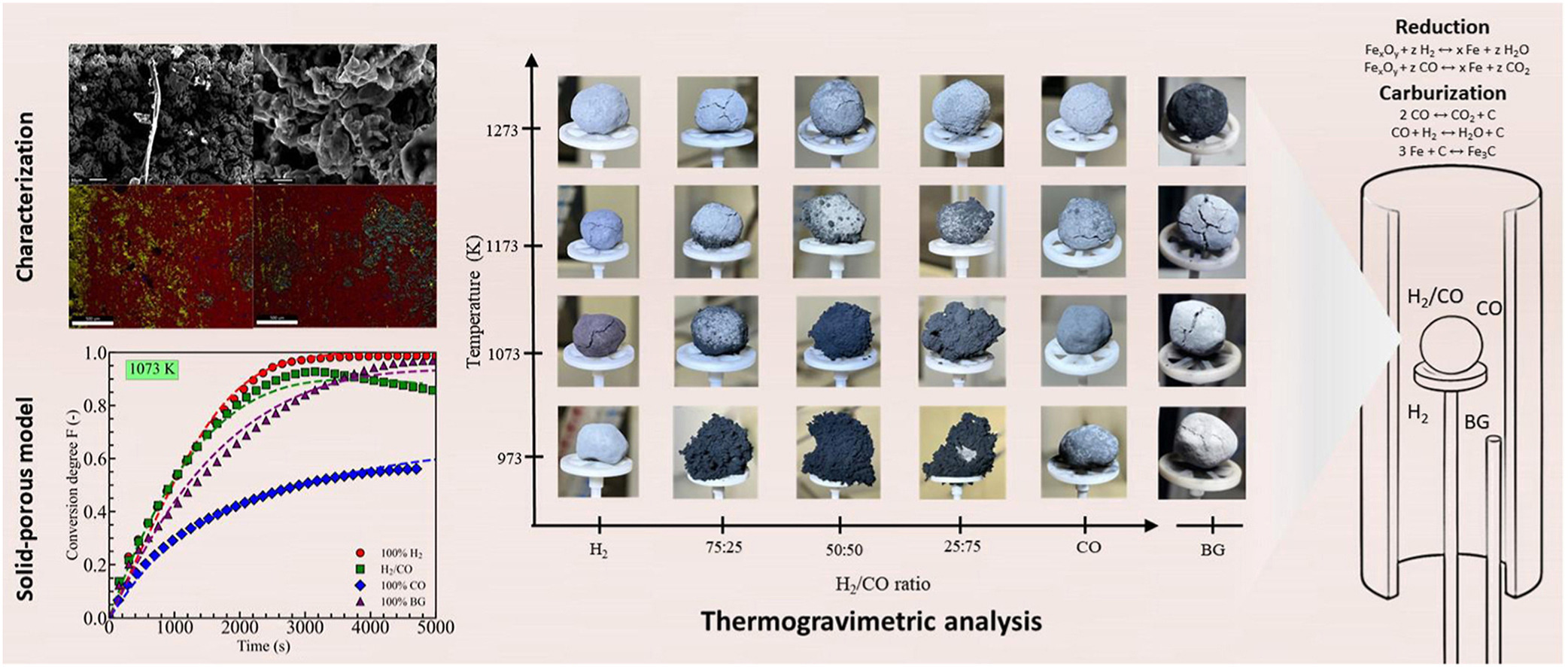
Hydrogen and carbon monoxide govern distinct pathways in direct reduction of iron ores, influencing process efficiency and product quality. H2 enables rapid, nearly CO2-free reduction, but is strongly endothermic and yields carbon-free direct reduced iron. In contrast, CO enables reduction and supplies in-situ carbon for secondary steelmaking. Balancing these gases, and establishing renewable CO sources such as biomass-derived syngas, is central for decarbonizing steelmaking. Systematic datasets linking carburization with reduction kinetics and product characteristics under industrially relevant conditions remain scarce. Single DR-grade pellets were reduced isothermally (973–1273 K) in H2/CO atmospheres under moderate flow conditions. Weight evolution was tracked by thermogravimetry, and characterization (SEM–EDS, XRD, nanoindentation) resolved carbon distribution, phase composition, and mechanical properties. Complementary trials with simulated biogenic gas showed slower early reduction than syngas but higher final metallization; only at 973 K did a slight late-stage mass gain indicate controlled carburization. Gas composition and temperature governed the balance between Fe3C formation and free-carbon deposition. The resulting dataset enabled calibration of a porous–solid model that couples oxygen removal, carbon deposition, and carbide formation, providing a mechanistic basis for optimizing metallization and controlled carburization in hydrogen-rich and renewable CO-containing DR processes.
Graphical abstract
Keywords
Direct reduction; Carburization; Biogenic gas; TGA; Sustainable steelmaking
文章导读