
期刊文章
过刊浏览
- Volumes 108-119 (2025)
-
Volumes 96-107 (2025)
-
Volume 107
Pages 1-376 (December 2025)
-
Volume 106
Pages 1-336 (November 2025)
-
Volume 105
Pages 1-356 (October 2025)
-
Volume 104
Pages 1-332 (September 2025)
-
Volume 103
Pages 1-314 (August 2025)
-
Volume 102
Pages 1-276 (July 2025)
-
Volume 101
Pages 1-166 (June 2025)
-
Volume 100
Pages 1-256 (May 2025)
-
Volume 99
Pages 1-242 (April 2025)
-
Volume 98
Pages 1-288 (March 2025)
-
Volume 97
Pages 1-256 (February 2025)
-
Volume 96
Pages 1-340 (January 2025)
-
Volume 107
-
Volumes 84-95 (2024)
-
Volume 95
Pages 1-392 (December 2024)
-
Volume 94
Pages 1-400 (November 2024)
-
Volume 93
Pages 1-376 (October 2024)
-
Volume 92
Pages 1-316 (September 2024)
-
Volume 91
Pages 1-378 (August 2024)
-
Volume 90
Pages 1-580 (July 2024)
-
Volume 89
Pages 1-278 (June 2024)
-
Volume 88
Pages 1-350 (May 2024)
-
Volume 87
Pages 1-338 (April 2024)
-
Volume 86
Pages 1-312 (March 2024)
-
Volume 85
Pages 1-334 (February 2024)
-
Volume 84
Pages 1-308 (January 2024)
-
Volume 95
-
Volumes 72-83 (2023)
-
Volume 83
Pages 1-258 (December 2023)
-
Volume 82
Pages 1-204 (November 2023)
-
Volume 81
Pages 1-188 (October 2023)
-
Volume 80
Pages 1-202 (September 2023)
-
Volume 79
Pages 1-172 (August 2023)
-
Volume 78
Pages 1-146 (July 2023)
-
Volume 77
Pages 1-152 (June 2023)
-
Volume 76
Pages 1-176 (May 2023)
-
Volume 75
Pages 1-228 (April 2023)
-
Volume 74
Pages 1-200 (March 2023)
-
Volume 73
Pages 1-138 (February 2023)
-
Volume 72
Pages 1-144 (January 2023)
-
Volume 83
-
Volumes 60-71 (2022)
-
Volume 71
Pages 1-108 (December 2022)
-
Volume 70
Pages 1-106 (November 2022)
-
Volume 69
Pages 1-122 (October 2022)
-
Volume 68
Pages 1-124 (September 2022)
-
Volume 67
Pages 1-102 (August 2022)
-
Volume 66
Pages 1-112 (July 2022)
-
Volume 65
Pages 1-138 (June 2022)
-
Volume 64
Pages 1-186 (May 2022)
-
Volume 63
Pages 1-124 (April 2022)
-
Volume 62
Pages 1-104 (March 2022)
-
Volume 61
Pages 1-120 (February 2022)
-
Volume 60
Pages 1-124 (January 2022)
-
Volume 71
- Volumes 54-59 (2021)
- Volumes 48-53 (2020)
- Volumes 42-47 (2019)
- Volumes 36-41 (2018)
- Volumes 30-35 (2017)
- Volumes 24-29 (2016)
- Volumes 18-23 (2015)
- Volumes 12-17 (2014)
- Volume 11 (2013)
- Volume 10 (2012)
- Volume 9 (2011)
- Volume 8 (2010)
- Volume 7 (2009)
- Volume 6 (2008)
- Volume 5 (2007)
- Volume 4 (2006)
- Volume 3 (2005)
- Volume 2 (2004)
- Volume 1 (2003)
Volume 114
Sasakura, D., & Kimura, S. (2026a). Validation of soil particle size and shape distributions in particle image analysis using convergence analysis. Particuology, 114, 256-269. https://doi.org/10.1016/j.partic.2026.04.015
Validation of soil particle size and shape distributions in particle image analysis using convergence analysis
Daisuke Sasakura a *, Sho Kimura b
a Malvern Panalytical, A Division of Spectris Co., Ltd., Daiichi Building 7-3, Hamamatsucho 1-Chome, Minato-ku, Tokyo, 105-0013, Japan
b Department of Regional Agricultural Engineering, Faculty of Agriculture, University of the Ryukyus, 1 Senbaru, Nishihara, Okinawa, 903-0213, Japan
10.1016/j.partic.2026.04.015
Volume 114,
July 2026,
Pages 256-269
Received 26 October 2025, Revised 17 April 2026, Accepted 26 April 2026, Available online 1 May 2026, Version of Record 9 May 2026.
E-mail:
daisuke.sasakura@malvernpanalytical.com
Highlights
• Development of a new comprehensive particle morphology verification method.
• Performed automated particle image analysis (APIA) targeting on soil samples.
• APIA enables rapid, quantitative particle shape analysis across large datasets.
• The study proposes a convergence-based method to validate APIA particle counts.
• This simple, low-cost approach improves reliability in soil and material sciences.
Abstract
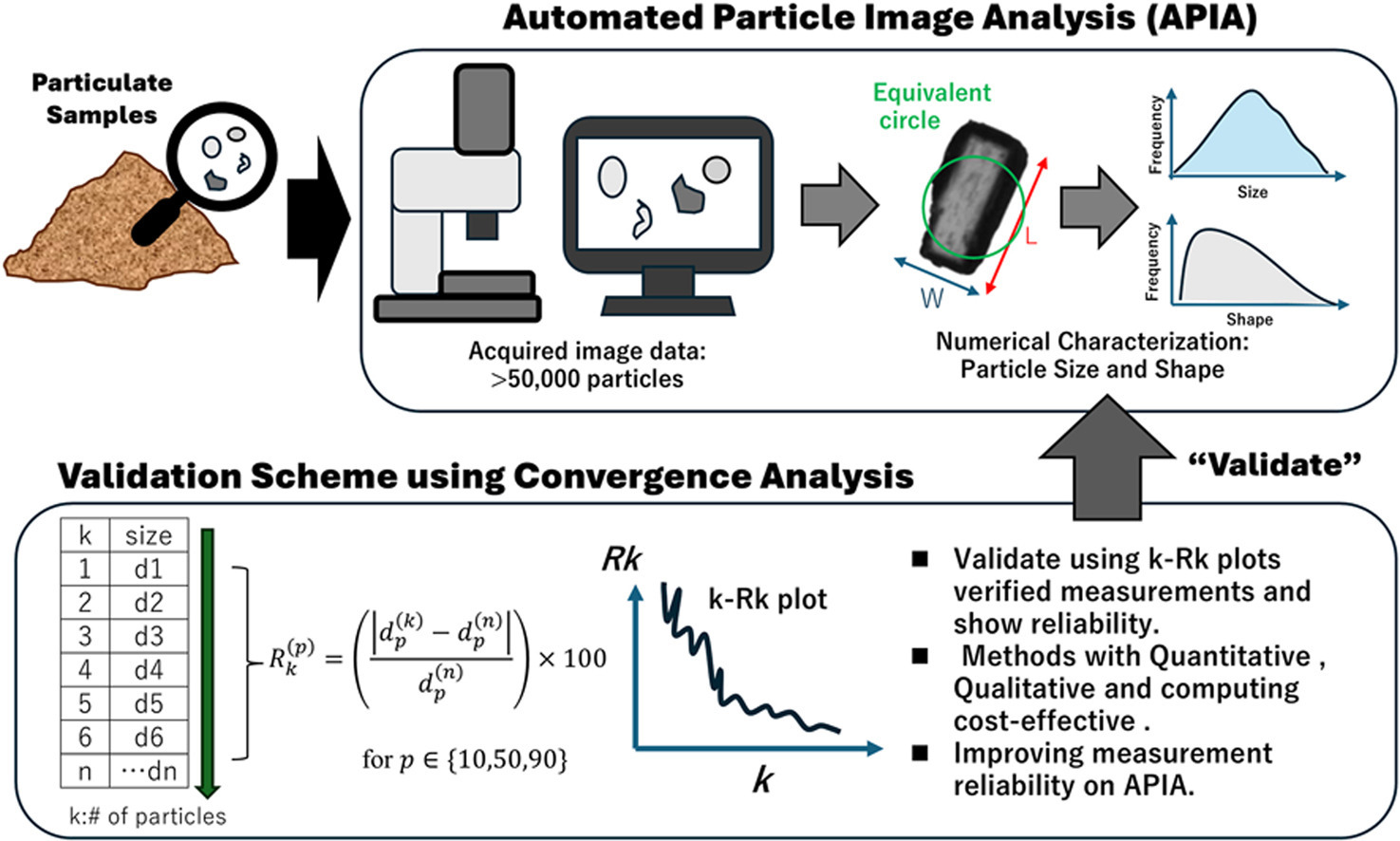
Evaluating soil particle morphology (i.e. shape and size) is vital in geology and geophysics, as the morphology controls properties such as shear strength, permeability, density, and friction. In coarse-grained soils, force chains affect the loading capacity and deformation, whereas particle orientation in silty soils influences their mechanical behaviour. Particle size and shape measurements typically combine laser diffraction (LD) and image analysis (IA). LD is fast but does not obtain shape data, whereas IA produces detailed results but is labour-intensive. Automated particle IA (APIA) can rapidly acquire diverse shape information; however, determining particle counts for statistical reliability and verifying their validity are challenging, as particle size and shape are multivariate. Although conventional simulation-based approaches can be used to evaluate these characteristics, such methods are often computationally intensive and may produce results the deviate from those of real samples. In this study, we propose a convergence parameter-based method to validate the particle counts obtained using APIA directly from physical measurements. This method is sample-independent, inexpensive, and uses intuitive calculations. The degree of convergence allows for comparisons across and within samples, thereby providing quantitative and qualitative verification without large-scale computation. This approach leverages the strengths of APIA to improve the reliability and performance of particle morphology characterisation in the broader fields of material and soil sciences.
Graphical abstract
Keywords
Particle size; Particle shape; Particle image analysis; Particle morphology
文章导读