
期刊文章
过刊浏览
- Volumes 108-119 (2025)
-
Volumes 96-107 (2025)
-
Volume 107
Pages 1-376 (December 2025)
-
Volume 106
Pages 1-336 (November 2025)
-
Volume 105
Pages 1-356 (October 2025)
-
Volume 104
Pages 1-332 (September 2025)
-
Volume 103
Pages 1-314 (August 2025)
-
Volume 102
Pages 1-276 (July 2025)
-
Volume 101
Pages 1-166 (June 2025)
-
Volume 100
Pages 1-256 (May 2025)
-
Volume 99
Pages 1-242 (April 2025)
-
Volume 98
Pages 1-288 (March 2025)
-
Volume 97
Pages 1-256 (February 2025)
-
Volume 96
Pages 1-340 (January 2025)
-
Volume 107
-
Volumes 84-95 (2024)
-
Volume 95
Pages 1-392 (December 2024)
-
Volume 94
Pages 1-400 (November 2024)
-
Volume 93
Pages 1-376 (October 2024)
-
Volume 92
Pages 1-316 (September 2024)
-
Volume 91
Pages 1-378 (August 2024)
-
Volume 90
Pages 1-580 (July 2024)
-
Volume 89
Pages 1-278 (June 2024)
-
Volume 88
Pages 1-350 (May 2024)
-
Volume 87
Pages 1-338 (April 2024)
-
Volume 86
Pages 1-312 (March 2024)
-
Volume 85
Pages 1-334 (February 2024)
-
Volume 84
Pages 1-308 (January 2024)
-
Volume 95
-
Volumes 72-83 (2023)
-
Volume 83
Pages 1-258 (December 2023)
-
Volume 82
Pages 1-204 (November 2023)
-
Volume 81
Pages 1-188 (October 2023)
-
Volume 80
Pages 1-202 (September 2023)
-
Volume 79
Pages 1-172 (August 2023)
-
Volume 78
Pages 1-146 (July 2023)
-
Volume 77
Pages 1-152 (June 2023)
-
Volume 76
Pages 1-176 (May 2023)
-
Volume 75
Pages 1-228 (April 2023)
-
Volume 74
Pages 1-200 (March 2023)
-
Volume 73
Pages 1-138 (February 2023)
-
Volume 72
Pages 1-144 (January 2023)
-
Volume 83
-
Volumes 60-71 (2022)
-
Volume 71
Pages 1-108 (December 2022)
-
Volume 70
Pages 1-106 (November 2022)
-
Volume 69
Pages 1-122 (October 2022)
-
Volume 68
Pages 1-124 (September 2022)
-
Volume 67
Pages 1-102 (August 2022)
-
Volume 66
Pages 1-112 (July 2022)
-
Volume 65
Pages 1-138 (June 2022)
-
Volume 64
Pages 1-186 (May 2022)
-
Volume 63
Pages 1-124 (April 2022)
-
Volume 62
Pages 1-104 (March 2022)
-
Volume 61
Pages 1-120 (February 2022)
-
Volume 60
Pages 1-124 (January 2022)
-
Volume 71
- Volumes 54-59 (2021)
- Volumes 48-53 (2020)
- Volumes 42-47 (2019)
- Volumes 36-41 (2018)
- Volumes 30-35 (2017)
- Volumes 24-29 (2016)
- Volumes 18-23 (2015)
- Volumes 12-17 (2014)
- Volume 11 (2013)
- Volume 10 (2012)
- Volume 9 (2011)
- Volume 8 (2010)
- Volume 7 (2009)
- Volume 6 (2008)
- Volume 5 (2007)
- Volume 4 (2006)
- Volume 3 (2005)
- Volume 2 (2004)
- Volume 1 (2003)
Volume 114
Zhou, Y., Ji, Y., Xu, Y., Zhou, J., Cai, X., & Yu, C. (2026). Non-spherical coarse coal breakage in single bend pneumatic conveying under idealized oscillatory flow. Particuology, 114, 270-282. https://doi.org/10.1016/j.partic.2026.04.017
Non-spherical coarse coal breakage in single bend pneumatic conveying under idealized oscillatory flow
Yuxuan Zhou a, Yun Ji a *, Yubo Xu a, Jiawei Zhou b, Xingzhou Cai a, Chong Yu c
a School of Mechanical Engineering, Yanshan University, Qinhuangdao, 066004, China
b School of Mechanical Engineering, North China University of Water Resources and Electric Power, Zhengzhou, 450046, China
c Tangshan Jidong Equipment and Engineering Co., Ltd., Tangshan, 063200, China
10.1016/j.partic.2026.04.017
b School of Mechanical Engineering, North China University of Water Resources and Electric Power, Zhengzhou, 450046, China
c Tangshan Jidong Equipment and Engineering Co., Ltd., Tangshan, 063200, China
Volume 114,
July 2026,
Pages 270-282
Received 14 March 2026, Revised 16 April 2026, Accepted 27 April 2026, Available online 4 May 2026, Version of Record 11 May 2026.
E-mail:
jiyun@ysu.edu.cn
Highlights
• Rectangular-wave oscillatory airflow was introduced for low-breakage transport.
• CFD–DEM with Tavares model predicted coarse coal breakage behavior.
• Optimal oscillation parameters reduced collision frequency and power loss.
• Particle sphericity significantly altered impact energy and breakage behavior.
Abstract
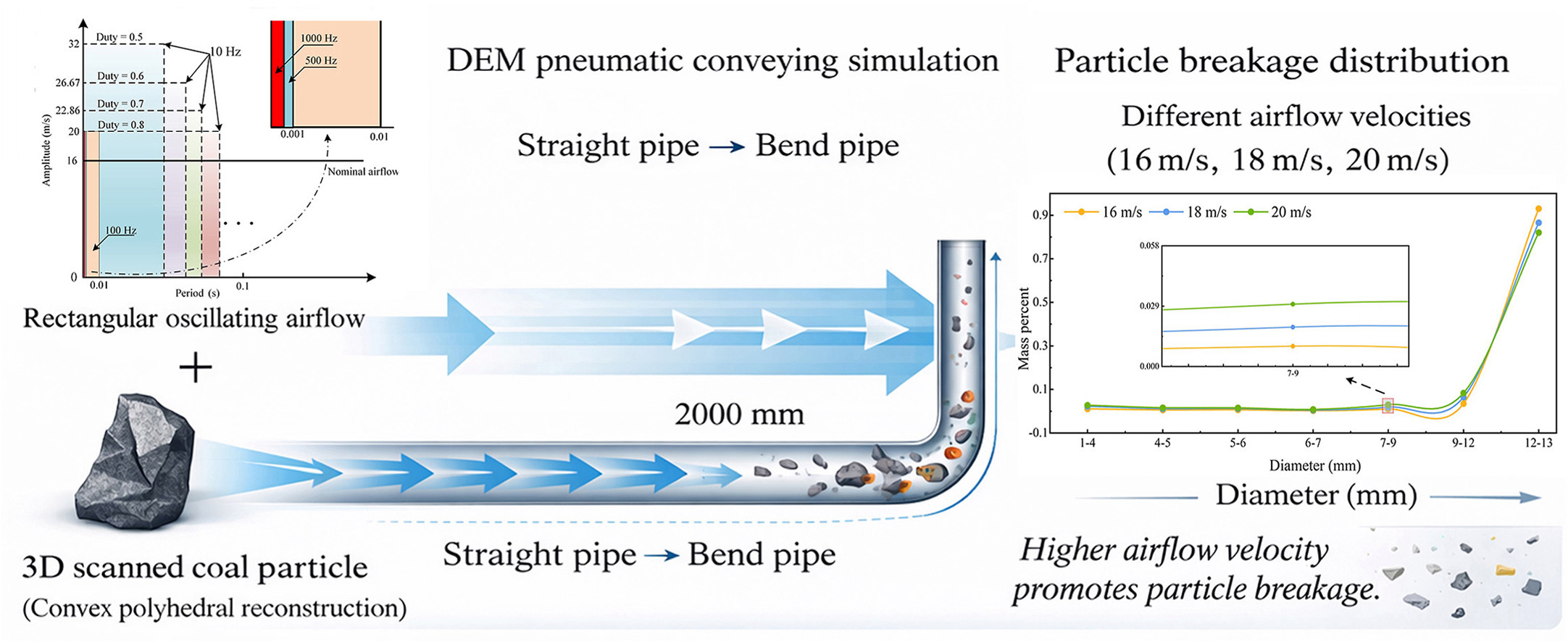
Coal breakage during pneumatic conveying reduces the economic value of lump coal and generates dust, thereby increasing explosion risk. Therefore, understanding and controlling particle breakage is important for improving conveying efficiency and safety. In this study, the breakage characteristics of non-spherical coarse coal were investigated using a CFD-DEM coupling method combined with the Tavares UFRJ breakage model, in which a rectangular wave oscillatory airflow was imposed as an idealized inlet air condition. The oscillatory airflow was implemented through a Fluent user defined function, enabling systematic control of frequency, amplitude, and Duty (the ratio of the pulse duration of the rectangular wave to its period). Compared with previous studies focused mainly on steady inlet conditions or simplified particle shapes, the present work considers both controlled inlet-flow modulation and reconstructed non-spherical particle geometry within the same framework. The results show that the breakage rate first decreases and then increases with increasing frequency and Duty, and the best-performing condition within the tested range was 100 Hz, Duty is 0.5, and nominal air flow velocity is 16 m/s. Compared with the steady inlet condition in the same bend scale model, the idealized rectangular wave inlet modulation reduced particle-wall collisions and improved particle integrity. In addition, 3D scanned coal particles were modeled as convex polyhedral particles to examine the effect of shape. The results indicate that particle sphericity significantly affects particle dynamics and impact behavior, and both the particle impact power at the bend and the breakage rate increase with increasing sphericity. These findings provide numerical insight into coarse-particle breakage behavior in bend scale pneumatic conveying under an idealized periodically modulated inlet condition.
Graphical abstract
Keywords
Non-spherical; Oscillatory airflow; Breakage; Pneumatic transport; Coarse coal
文章导读