
期刊文章
过刊浏览
- Volumes 108-119 (2025)
-
Volumes 96-107 (2025)
-
Volume 107
Pages 1-376 (December 2025)
-
Volume 106
Pages 1-336 (November 2025)
-
Volume 105
Pages 1-356 (October 2025)
-
Volume 104
Pages 1-332 (September 2025)
-
Volume 103
Pages 1-314 (August 2025)
-
Volume 102
Pages 1-276 (July 2025)
-
Volume 101
Pages 1-166 (June 2025)
-
Volume 100
Pages 1-256 (May 2025)
-
Volume 99
Pages 1-242 (April 2025)
-
Volume 98
Pages 1-288 (March 2025)
-
Volume 97
Pages 1-256 (February 2025)
-
Volume 96
Pages 1-340 (January 2025)
-
Volume 107
-
Volumes 84-95 (2024)
-
Volume 95
Pages 1-392 (December 2024)
-
Volume 94
Pages 1-400 (November 2024)
-
Volume 93
Pages 1-376 (October 2024)
-
Volume 92
Pages 1-316 (September 2024)
-
Volume 91
Pages 1-378 (August 2024)
-
Volume 90
Pages 1-580 (July 2024)
-
Volume 89
Pages 1-278 (June 2024)
-
Volume 88
Pages 1-350 (May 2024)
-
Volume 87
Pages 1-338 (April 2024)
-
Volume 86
Pages 1-312 (March 2024)
-
Volume 85
Pages 1-334 (February 2024)
-
Volume 84
Pages 1-308 (January 2024)
-
Volume 95
-
Volumes 72-83 (2023)
-
Volume 83
Pages 1-258 (December 2023)
-
Volume 82
Pages 1-204 (November 2023)
-
Volume 81
Pages 1-188 (October 2023)
-
Volume 80
Pages 1-202 (September 2023)
-
Volume 79
Pages 1-172 (August 2023)
-
Volume 78
Pages 1-146 (July 2023)
-
Volume 77
Pages 1-152 (June 2023)
-
Volume 76
Pages 1-176 (May 2023)
-
Volume 75
Pages 1-228 (April 2023)
-
Volume 74
Pages 1-200 (March 2023)
-
Volume 73
Pages 1-138 (February 2023)
-
Volume 72
Pages 1-144 (January 2023)
-
Volume 83
-
Volumes 60-71 (2022)
-
Volume 71
Pages 1-108 (December 2022)
-
Volume 70
Pages 1-106 (November 2022)
-
Volume 69
Pages 1-122 (October 2022)
-
Volume 68
Pages 1-124 (September 2022)
-
Volume 67
Pages 1-102 (August 2022)
-
Volume 66
Pages 1-112 (July 2022)
-
Volume 65
Pages 1-138 (June 2022)
-
Volume 64
Pages 1-186 (May 2022)
-
Volume 63
Pages 1-124 (April 2022)
-
Volume 62
Pages 1-104 (March 2022)
-
Volume 61
Pages 1-120 (February 2022)
-
Volume 60
Pages 1-124 (January 2022)
-
Volume 71
- Volumes 54-59 (2021)
- Volumes 48-53 (2020)
- Volumes 42-47 (2019)
- Volumes 36-41 (2018)
- Volumes 30-35 (2017)
- Volumes 24-29 (2016)
- Volumes 18-23 (2015)
- Volumes 12-17 (2014)
- Volume 11 (2013)
- Volume 10 (2012)
- Volume 9 (2011)
- Volume 8 (2010)
- Volume 7 (2009)
- Volume 6 (2008)
- Volume 5 (2007)
- Volume 4 (2006)
- Volume 3 (2005)
- Volume 2 (2004)
- Volume 1 (2003)
Volume 114
ing, W., Wang, T., Zhao, S., Yan, X., & Zhang, H. (2026). Screening efficiency and energy consumption collaborative optimization of linear vibrating screen using coupled DEM-MBK method. Particuology, 114, 283-292. https://doi.org/10.1016/j.partic.2026.04.016
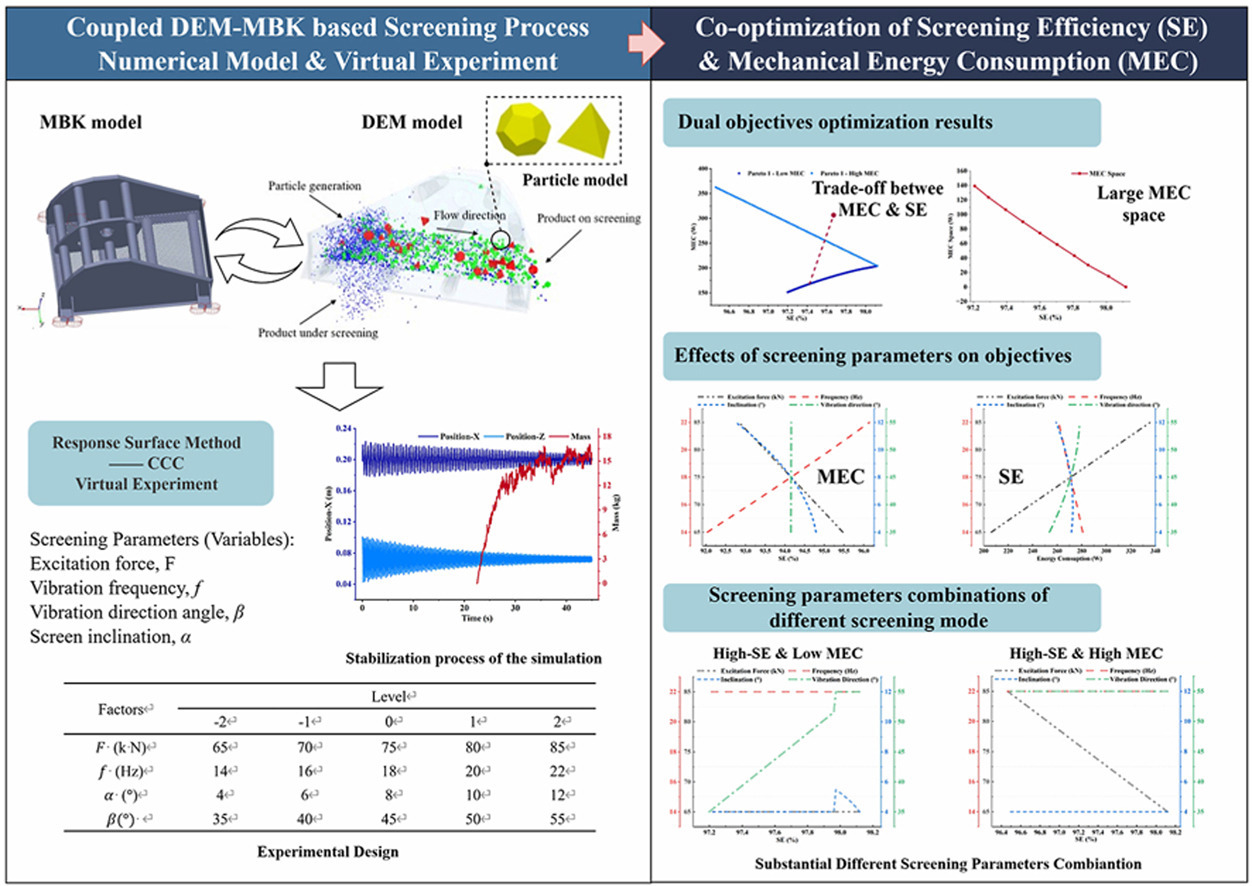
Screening efficiency and energy consumption collaborative optimization of linear vibrating screen using coupled DEM-MBK method
Weimin Jing a b 1, Tong Wang c d 1, Shida Zhao b, Xuguo Yan b, Huan Zhang b *
a College of Mechanical and Vehicle Engineering, Chongqing University, Chongqing, 400044, China
b Key Laboratory of Metallurgical Equipment and Control Technology, Ministry of Education, Wuhan University of Science and Technology, Wuhan, 430081, China
c School of Mechanical Engineering, Wuhan Vocational College of Software and Engineering, Wuhan, 430205, China
d Hubei Engineering Research Center for Intelligent Detection and Identification of Complex Parts, Wuhan, 430205, China
10.1016/j.partic.2026.04.016
Volume 114,
July 2026,
Pages 283-292
Received 27 January 2026, Revised 10 April 2026, Accepted 21 April 2026, Available online 2 May 2026, Version of Record 12 May 2026.
E-mail:
zhanghuan@wust.edu.cn
Highlights
• A bidirectional DEM–MBK coupled model is developed for a linear vibrating screen.
• Mechanical Energy Consumption (MEC) and Screening Efficiency (SE) are evaluated.
• Effects of four key screening parameters on SE and MEC are analyzed.
• Dual-objective optimizations of SE and MEC are performed to identify the MEC space.
• High SE & low MEC can be achieved through appropriate parameter combinations.
Abstract
Vibrating screens are essential in mineral processing, operating continuously under heavy loads and consuming considerable energy. Reducing mechanical energy consumption (MEC) while maintaining high screening efficiency (SE) is an important engineering challenge. This study develops a collaborative optimization framework for SE and MEC using bidirectional Discrete Element Method–Multi-Body Kinematics (DEM–MBK) simulations and virtual experiments. A DEM–MBK model of a CWKS1218 linear vibrating screen is established to capture the interaction between particle motion and screen dynamics driven by the excitation source. MEC is quantified as the time-averaged input power of the exciter at steady state. A Central Composite Circumscribed (CCC) design is used to construct response surface models and analyze the effects of excitation force, screen inclination, vibration frequency, and vibration direction angle on SE and MEC. Based on the fitted models, Non-dominated Sorting Genetic Algorithm II performs dual-objective optimization. The results reveal a clear trade-off between SE and MEC: in the low-MEC regime, improving SE requires increased energy input. Below 98.12% SE, different parameter combinations produce a wide energy-consumption range, whereas at 98.12% SE, Pareto-optimal solutions converge to a unique parameter setting. Additional simulations validate the optimization results, demonstrating acceptable prediction accuracy.
Graphical abstract
Keywords
DEM–MBK; Screening efficiency; Mechanical energy consumption; Collaborative optimization; Screening parameters combination
文章导读