
期刊文章
过刊浏览
- Volumes 108-119 (2025)
-
Volumes 96-107 (2025)
-
Volume 107
Pages 1-376 (December 2025)
-
Volume 106
Pages 1-336 (November 2025)
-
Volume 105
Pages 1-356 (October 2025)
-
Volume 104
Pages 1-332 (September 2025)
-
Volume 103
Pages 1-314 (August 2025)
-
Volume 102
Pages 1-276 (July 2025)
-
Volume 101
Pages 1-166 (June 2025)
-
Volume 100
Pages 1-256 (May 2025)
-
Volume 99
Pages 1-242 (April 2025)
-
Volume 98
Pages 1-288 (March 2025)
-
Volume 97
Pages 1-256 (February 2025)
-
Volume 96
Pages 1-340 (January 2025)
-
Volume 107
-
Volumes 84-95 (2024)
-
Volume 95
Pages 1-392 (December 2024)
-
Volume 94
Pages 1-400 (November 2024)
-
Volume 93
Pages 1-376 (October 2024)
-
Volume 92
Pages 1-316 (September 2024)
-
Volume 91
Pages 1-378 (August 2024)
-
Volume 90
Pages 1-580 (July 2024)
-
Volume 89
Pages 1-278 (June 2024)
-
Volume 88
Pages 1-350 (May 2024)
-
Volume 87
Pages 1-338 (April 2024)
-
Volume 86
Pages 1-312 (March 2024)
-
Volume 85
Pages 1-334 (February 2024)
-
Volume 84
Pages 1-308 (January 2024)
-
Volume 95
-
Volumes 72-83 (2023)
-
Volume 83
Pages 1-258 (December 2023)
-
Volume 82
Pages 1-204 (November 2023)
-
Volume 81
Pages 1-188 (October 2023)
-
Volume 80
Pages 1-202 (September 2023)
-
Volume 79
Pages 1-172 (August 2023)
-
Volume 78
Pages 1-146 (July 2023)
-
Volume 77
Pages 1-152 (June 2023)
-
Volume 76
Pages 1-176 (May 2023)
-
Volume 75
Pages 1-228 (April 2023)
-
Volume 74
Pages 1-200 (March 2023)
-
Volume 73
Pages 1-138 (February 2023)
-
Volume 72
Pages 1-144 (January 2023)
-
Volume 83
-
Volumes 60-71 (2022)
-
Volume 71
Pages 1-108 (December 2022)
-
Volume 70
Pages 1-106 (November 2022)
-
Volume 69
Pages 1-122 (October 2022)
-
Volume 68
Pages 1-124 (September 2022)
-
Volume 67
Pages 1-102 (August 2022)
-
Volume 66
Pages 1-112 (July 2022)
-
Volume 65
Pages 1-138 (June 2022)
-
Volume 64
Pages 1-186 (May 2022)
-
Volume 63
Pages 1-124 (April 2022)
-
Volume 62
Pages 1-104 (March 2022)
-
Volume 61
Pages 1-120 (February 2022)
-
Volume 60
Pages 1-124 (January 2022)
-
Volume 71
- Volumes 54-59 (2021)
- Volumes 48-53 (2020)
- Volumes 42-47 (2019)
- Volumes 36-41 (2018)
- Volumes 30-35 (2017)
- Volumes 24-29 (2016)
- Volumes 18-23 (2015)
- Volumes 12-17 (2014)
- Volume 11 (2013)
- Volume 10 (2012)
- Volume 9 (2011)
- Volume 8 (2010)
- Volume 7 (2009)
- Volume 6 (2008)
- Volume 5 (2007)
- Volume 4 (2006)
- Volume 3 (2005)
- Volume 2 (2004)
- Volume 1 (2003)
Volume 114
Meng, L., Liu, T., Kuang, J., Wang, J., Qiu, T., Yan, H., . . . Zhou, S. (2026). Effect of classifier on flow field characteristic and grinding media collision behaviour in horizontal stirred mill. Particuology, 114, 293-306. https://doi.org/10.1016/j.partic.2026.04.009
Effect of classifier on flow field characteristic and grinding media collision behaviour in horizontal stirred mill
Lingguo Meng a c *, Tianlin Liu a c, Jingzhong Kuang a c, Jingyu Wang a c, Tingsheng Qiu a c, Huashan Yan a c, Guoqiang Wang b, Shaobing Zhou d
a Jiangxi Provincial Key Laboratory of Low-Carbon Processing and Utilization of Strategic Metal Mineral Resources, Ganzhou, 341099, China
b State Key Laboratory of Mineral Processing, Beijing General Research Institute of Mining & Metallurgy, Beijing, 102628, China
c School of Mining Engineering, Jiangxi University of Science and Technology, Ganzhou, 341099, China
d Jiangxi Copper Company Limited, Nanchang, 330002, China
10.1016/j.partic.2026.04.009
Volume 114,
July 2026,
Pages: 293-306
Received 20 January 2026, Revised 7 April 2026, Accepted 13 April 2026, Available online 26 April 2026, Version of Record 12 May 2026.
E-mail:
menglingguo1994@163.com
Highlights
• Classifier size increase boosts fluid tangential velocity and collision energy.
• Larger classifiers intensify reverse flow and disrupt vortex structures at d/D = 1.2.
• Total collision frequency drops at d/D = 1.2, but high-energy collision proportion rises.
• Peak energy utilization (74%) achieved at d/D = 1.1, efficiency declines beyond.
Abstract
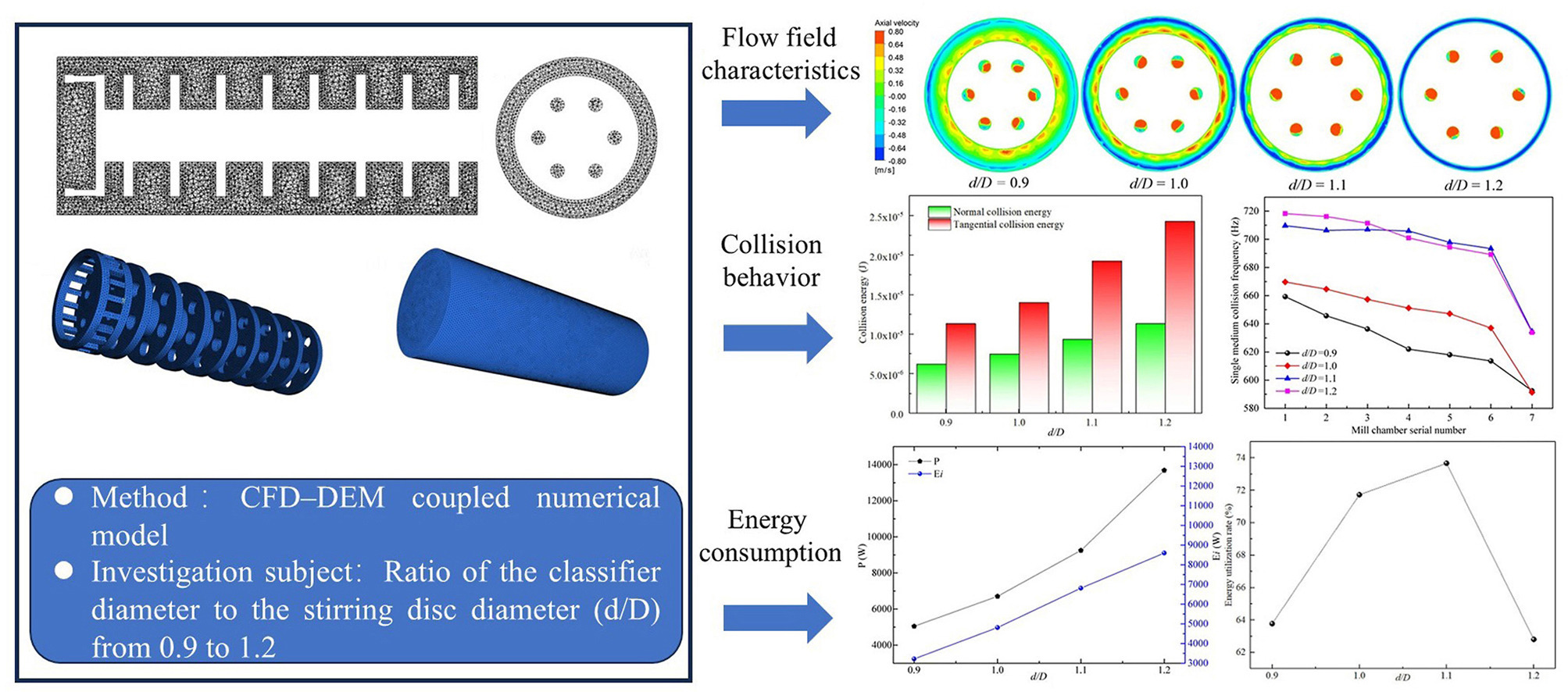
As a critical component of horizontal stirred mills, the classifier plays a key role in precisely controlling the particle size distribution and energy efficiency. Adjusting its structural parameters is essential for addressing the challenge of efficient mineral resource liberation. In this study, numerical simulations were conducted to systematically elucidate the influence of classifier diameter on flow field characteristics and grinding media collision behaviour. Results show that increasing the diameter ratio of classifier to stirring disc (d/D) enhances tangential flow and collision energy, thereby creating a more intense stress environment conducive to particle breakage, but also intensifies axial backflow, which can impair classification and increase component wear. While collision frequency and energy generally rise with classifier diameter, an excessive ratio (d/D = 1.2) disrupts local flow, reducing collision frequency near the classifier and highlighting axial heterogeneity in media behavior. The collision energy spectrum is normally distributed, dominated by low-energy, high-frequency events. A d/D ratio of 1.1 yields the most concentrated energy distribution and highest density, which is hypothesized to optimize grind efficiency and product size control by providing a uniform and intense stress field. Although power and impact energy increase monotonically with diameter, energy utilization peaks (∼74%) at d/D = 1.1 before declining due to reduced flow stability. These findings provide a theoretical basis for parameter optimisation and performance regulation of horizontal stirred mills.
Graphical abstract
Keywords
Horizontal stirred mills; Classifier; Computational fluid dynamics-discrete element method (CFD-DEM); Flow field characteristics; Collision behaviour
文章导读