
期刊文章
过刊浏览
- Volumes 108-119 (2025)
-
Volumes 96-107 (2025)
-
Volume 107
Pages 1-376 (December 2025)
-
Volume 106
Pages 1-336 (November 2025)
-
Volume 105
Pages 1-356 (October 2025)
-
Volume 104
Pages 1-332 (September 2025)
-
Volume 103
Pages 1-314 (August 2025)
-
Volume 102
Pages 1-276 (July 2025)
-
Volume 101
Pages 1-166 (June 2025)
-
Volume 100
Pages 1-256 (May 2025)
-
Volume 99
Pages 1-242 (April 2025)
-
Volume 98
Pages 1-288 (March 2025)
-
Volume 97
Pages 1-256 (February 2025)
-
Volume 96
Pages 1-340 (January 2025)
-
Volume 107
-
Volumes 84-95 (2024)
-
Volume 95
Pages 1-392 (December 2024)
-
Volume 94
Pages 1-400 (November 2024)
-
Volume 93
Pages 1-376 (October 2024)
-
Volume 92
Pages 1-316 (September 2024)
-
Volume 91
Pages 1-378 (August 2024)
-
Volume 90
Pages 1-580 (July 2024)
-
Volume 89
Pages 1-278 (June 2024)
-
Volume 88
Pages 1-350 (May 2024)
-
Volume 87
Pages 1-338 (April 2024)
-
Volume 86
Pages 1-312 (March 2024)
-
Volume 85
Pages 1-334 (February 2024)
-
Volume 84
Pages 1-308 (January 2024)
-
Volume 95
-
Volumes 72-83 (2023)
-
Volume 83
Pages 1-258 (December 2023)
-
Volume 82
Pages 1-204 (November 2023)
-
Volume 81
Pages 1-188 (October 2023)
-
Volume 80
Pages 1-202 (September 2023)
-
Volume 79
Pages 1-172 (August 2023)
-
Volume 78
Pages 1-146 (July 2023)
-
Volume 77
Pages 1-152 (June 2023)
-
Volume 76
Pages 1-176 (May 2023)
-
Volume 75
Pages 1-228 (April 2023)
-
Volume 74
Pages 1-200 (March 2023)
-
Volume 73
Pages 1-138 (February 2023)
-
Volume 72
Pages 1-144 (January 2023)
-
Volume 83
-
Volumes 60-71 (2022)
-
Volume 71
Pages 1-108 (December 2022)
-
Volume 70
Pages 1-106 (November 2022)
-
Volume 69
Pages 1-122 (October 2022)
-
Volume 68
Pages 1-124 (September 2022)
-
Volume 67
Pages 1-102 (August 2022)
-
Volume 66
Pages 1-112 (July 2022)
-
Volume 65
Pages 1-138 (June 2022)
-
Volume 64
Pages 1-186 (May 2022)
-
Volume 63
Pages 1-124 (April 2022)
-
Volume 62
Pages 1-104 (March 2022)
-
Volume 61
Pages 1-120 (February 2022)
-
Volume 60
Pages 1-124 (January 2022)
-
Volume 71
- Volumes 54-59 (2021)
- Volumes 48-53 (2020)
- Volumes 42-47 (2019)
- Volumes 36-41 (2018)
- Volumes 30-35 (2017)
- Volumes 24-29 (2016)
- Volumes 18-23 (2015)
- Volumes 12-17 (2014)
- Volume 11 (2013)
- Volume 10 (2012)
- Volume 9 (2011)
- Volume 8 (2010)
- Volume 7 (2009)
- Volume 6 (2008)
- Volume 5 (2007)
- Volume 4 (2006)
- Volume 3 (2005)
- Volume 2 (2004)
- Volume 1 (2003)
Volume 114
Guo, N., Xu, Z., & Yu, T. (2026). A DEM–FEM coupling framework for particle–membrane interaction. Particuology, 114, 307-319. https://doi.org/10.1016/j.partic.2026.04.023
A DEM–FEM coupling framework for particle–membrane interaction
Ning Guo, Zhangbin Xu, Tao Yu *
Computing Center for Geotechnical Engineering, Zhejiang Key Laboratory of the Development and Utilization of Underground Space, Department of Civil Engineering, Zhejiang University, Hangzhou, 310058, China
10.1016/j.partic.2026.04.023
Volume 114,
July 2026,
Pages 307-319
Received 13 March 2026, Revised 16 April 2026, Accepted 29 April 2026, Available online 9 May 2026, Version of Record 14 May 2026.
E-mail:
tyu_civil@zju.edu.cn
Highlights
• A GPU-parallelized DEM–FEM framework for particle–membrane interaction.
• A total Lagrangian membrane element capturing geometric nonlinearity.
• Dynamic membrane roughness evolution induced by granular penetration.
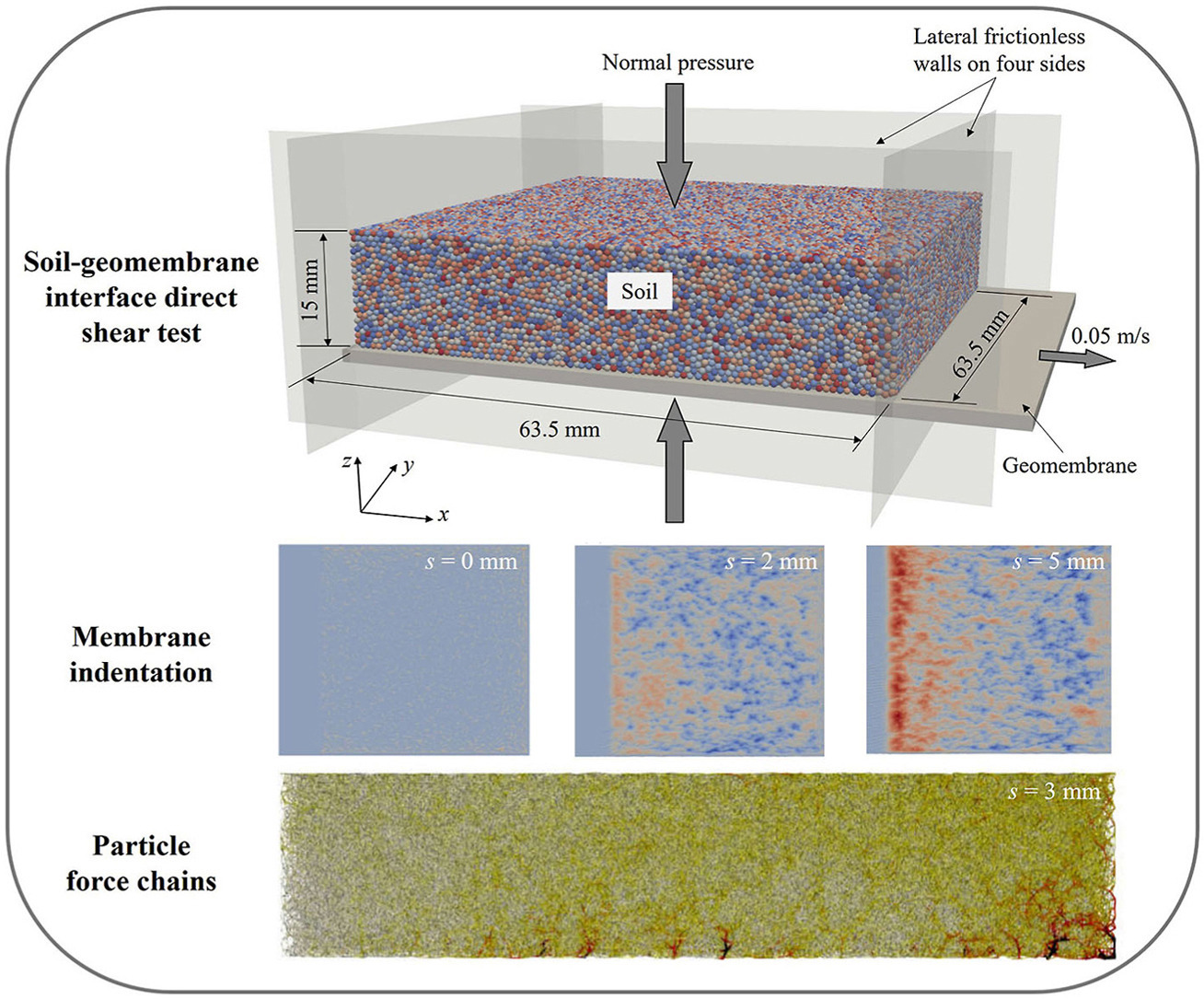
• Full-scale 3D soil–geomembrane interface direct shear test.
Abstract
The interaction between granular materials and highly flexible membranes involves complex micromechanical contact and severe localized deformations, posing significant challenges for numerical modeling. Traditional pure discrete element method (DEM) approaches that employ bonded particle model (BPM) fail to capture the dynamic changes in surface roughness arising from membrane penetration into granular voids. This paper presents a GPU-parallelized explicit dynamic framework that couples DEM and the finite element method (FEM) to address this limitation. A total Lagrangian membrane element is implemented to capture geometric nonlinearity and follower loads, and is coupled with DEM through a penalty-based contact algorithm. The accuracy and robustness of the DEM–FEM coupling framework are validated against classical benchmarks for membrane inflation, penetration, and particle–membrane interaction. Finally, a 3D soil–geomembrane interface direct shear test, comprising over 170,000 particles at true physical scale, is simulated without artificial upscaling. The results successfully reproduce macroscopic strain-softening behavior and capture the underlying micromechanical interface mechanisms. By enabling the membrane topography to dynamically adapt to varying normal stresses, the proposed framework overcomes the static roughness limitations of BPM, providing a highly efficient computational tool for large-scale particle–membrane interaction problems.
Graphical abstract
Keywords
DEM–FEM; Membrane element; GPU parallelization; Particle–membrane interaction
文章导读