
期刊文章
过刊浏览
- Volumes 108-119 (2025)
-
Volumes 96-107 (2025)
-
Volume 107
Pages 1-376 (December 2025)
-
Volume 106
Pages 1-336 (November 2025)
-
Volume 105
Pages 1-356 (October 2025)
-
Volume 104
Pages 1-332 (September 2025)
-
Volume 103
Pages 1-314 (August 2025)
-
Volume 102
Pages 1-276 (July 2025)
-
Volume 101
Pages 1-166 (June 2025)
-
Volume 100
Pages 1-256 (May 2025)
-
Volume 99
Pages 1-242 (April 2025)
-
Volume 98
Pages 1-288 (March 2025)
-
Volume 97
Pages 1-256 (February 2025)
-
Volume 96
Pages 1-340 (January 2025)
-
Volume 107
-
Volumes 84-95 (2024)
-
Volume 95
Pages 1-392 (December 2024)
-
Volume 94
Pages 1-400 (November 2024)
-
Volume 93
Pages 1-376 (October 2024)
-
Volume 92
Pages 1-316 (September 2024)
-
Volume 91
Pages 1-378 (August 2024)
-
Volume 90
Pages 1-580 (July 2024)
-
Volume 89
Pages 1-278 (June 2024)
-
Volume 88
Pages 1-350 (May 2024)
-
Volume 87
Pages 1-338 (April 2024)
-
Volume 86
Pages 1-312 (March 2024)
-
Volume 85
Pages 1-334 (February 2024)
-
Volume 84
Pages 1-308 (January 2024)
-
Volume 95
-
Volumes 72-83 (2023)
-
Volume 83
Pages 1-258 (December 2023)
-
Volume 82
Pages 1-204 (November 2023)
-
Volume 81
Pages 1-188 (October 2023)
-
Volume 80
Pages 1-202 (September 2023)
-
Volume 79
Pages 1-172 (August 2023)
-
Volume 78
Pages 1-146 (July 2023)
-
Volume 77
Pages 1-152 (June 2023)
-
Volume 76
Pages 1-176 (May 2023)
-
Volume 75
Pages 1-228 (April 2023)
-
Volume 74
Pages 1-200 (March 2023)
-
Volume 73
Pages 1-138 (February 2023)
-
Volume 72
Pages 1-144 (January 2023)
-
Volume 83
-
Volumes 60-71 (2022)
-
Volume 71
Pages 1-108 (December 2022)
-
Volume 70
Pages 1-106 (November 2022)
-
Volume 69
Pages 1-122 (October 2022)
-
Volume 68
Pages 1-124 (September 2022)
-
Volume 67
Pages 1-102 (August 2022)
-
Volume 66
Pages 1-112 (July 2022)
-
Volume 65
Pages 1-138 (June 2022)
-
Volume 64
Pages 1-186 (May 2022)
-
Volume 63
Pages 1-124 (April 2022)
-
Volume 62
Pages 1-104 (March 2022)
-
Volume 61
Pages 1-120 (February 2022)
-
Volume 60
Pages 1-124 (January 2022)
-
Volume 71
- Volumes 54-59 (2021)
- Volumes 48-53 (2020)
- Volumes 42-47 (2019)
- Volumes 36-41 (2018)
- Volumes 30-35 (2017)
- Volumes 24-29 (2016)
- Volumes 18-23 (2015)
- Volumes 12-17 (2014)
- Volume 11 (2013)
- Volume 10 (2012)
- Volume 9 (2011)
- Volume 8 (2010)
- Volume 7 (2009)
- Volume 6 (2008)
- Volume 5 (2007)
- Volume 4 (2006)
- Volume 3 (2005)
- Volume 2 (2004)
- Volume 1 (2003)
Volume 114
Ugwuodo, U. M., Li, X., Wang, C., & Liu, G. (2026). Effects of particle shape and density ratio on energy dissipation pathways in drafting, kissing and tumbling. Particuology, 114, 320-336. https://doi.org/10.1016/j.partic.2026.04.020
Effects of particle shape and density ratio on energy dissipation pathways in drafting, kissing and tumbling
Ugochukwu Marcellus Ugwuodo, Xiaohui Li, Chunlei Wang, Guodong Liu *
School of Energy Science and Engineering, Harbin Institute of Technology, Harbin, 150001, China
10.1016/j.partic.2026.04.020
Volume 114,
July 2026,
Pages 320-336
Received 24 February 2026, Revised 13 April 2026, Accepted 23 April 2026, Available online 6 May 2026, Version of Record 14 May 2026.
E-mail:
gdliu@hit.edu.cn
Highlights
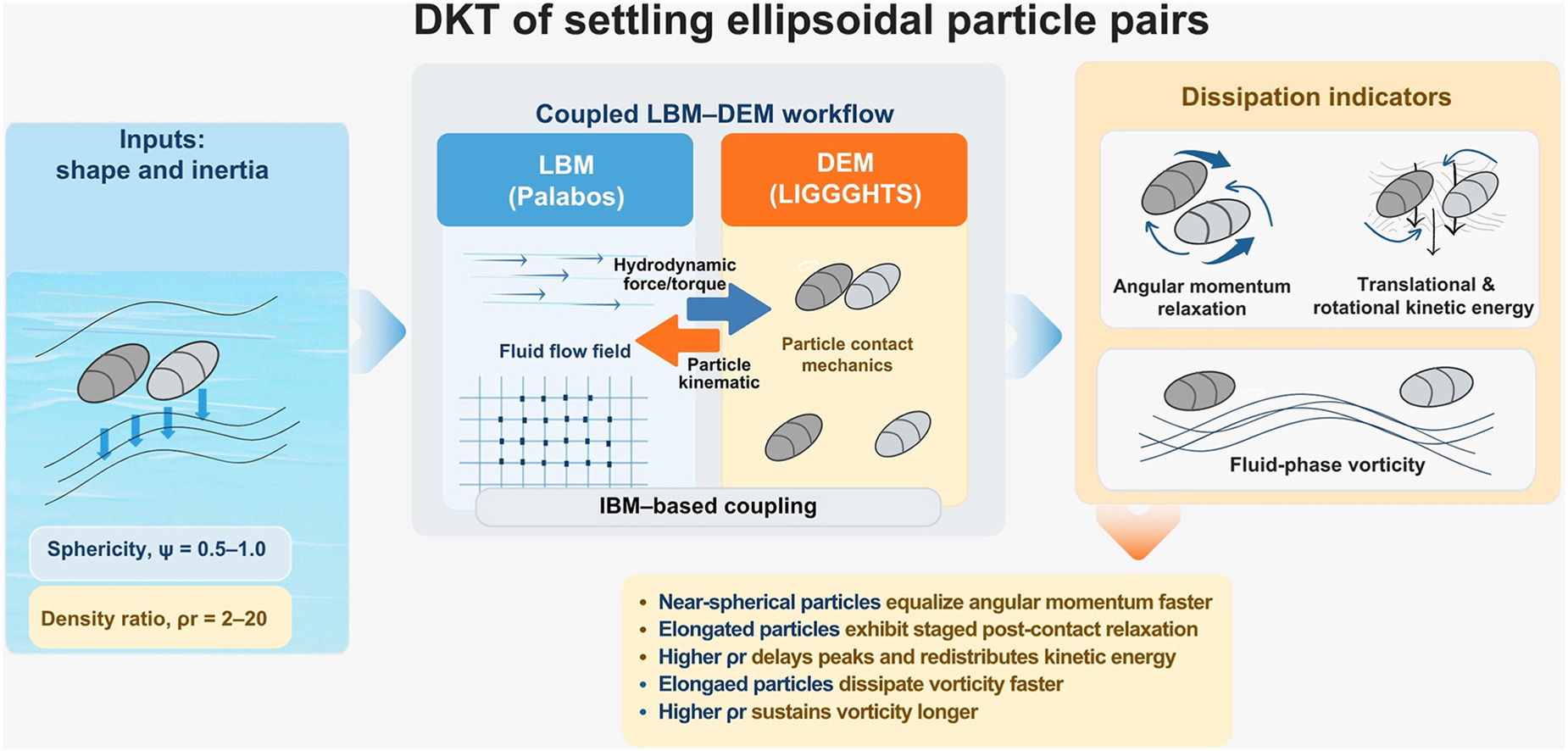
• Coupled LBM–DEM PR-DNS was used to study DKT of settling volume-equivalent ellipsoidal particle pairs.
• Particle sphericity modulates post-contact relaxation, with elongated particles showing staged angular-momentum decay and faster vorticity collapse.
• Near-spherical particles retain higher kinetic energy and sustain fluid disturbance for longer durations.
• Increasing particle–fluid density ratio delays response peaks and shifts kinetic-energy redistribution to later DKT stages.
Abstract
The Drafting, Kissing, and Tumbling (DKT) process reveals key features of particle–fluid–particle interactions in suspensions, but how particle shape and density regulate energy dissipation remains unclear. Using a coupled LBM-DEM-based Particle Resolved-Direct Numerical Simulation (PR-DNS) framework, we quantify the roles of sphericity (0.5–1.0) and particle–fluid density ratio (2–20) on dissipation pathways and rates of two interacting volume-equivalent ellipsoids. We show that shape modulates dissipation modes: elongated particles (sphericity ≈ 0.5–0.8) undergo staged angular momentum relaxation and abrupt vorticity decay, whereas near-spherical ones (sphericity ≈ 0.9–1.0) maintain higher kinetic energy and slower vorticity decay, consistent with persistent compact wakes. Density ratio modulates dynamics: low density ratio (2–5) enhances angular momentum equalization and accelerates vorticity decay, while high density ratio (10–20) delays response and prolongs vorticity plateaus. Sphericity and density ratio shift kinetic energy dominance during DKT, with near-spherical particles favoring stronger post-tumbling rotational energy, while increasing density ratio delays and redistributes energy toward later interaction stages. These results establish that elongated particles accelerate flow stabilization via rapid vorticity collapse, while spherical shapes and high density ratios prolong agitation. The findings provide predictive guidelines for tailoring dissipation in dense and dilute particulate systems.
Graphical abstract
Keywords
Drafting kissing and tumbling; Particle sphericity; Particle–fluid density ratio; Energy dissipation; Direct numerical simulation
文章导读