
期刊文章
过刊浏览
- Volumes 108-119 (2025)
-
Volumes 96-107 (2025)
-
Volume 107
Pages 1-376 (December 2025)
-
Volume 106
Pages 1-336 (November 2025)
-
Volume 105
Pages 1-356 (October 2025)
-
Volume 104
Pages 1-332 (September 2025)
-
Volume 103
Pages 1-314 (August 2025)
-
Volume 102
Pages 1-276 (July 2025)
-
Volume 101
Pages 1-166 (June 2025)
-
Volume 100
Pages 1-256 (May 2025)
-
Volume 99
Pages 1-242 (April 2025)
-
Volume 98
Pages 1-288 (March 2025)
-
Volume 97
Pages 1-256 (February 2025)
-
Volume 96
Pages 1-340 (January 2025)
-
Volume 107
-
Volumes 84-95 (2024)
-
Volume 95
Pages 1-392 (December 2024)
-
Volume 94
Pages 1-400 (November 2024)
-
Volume 93
Pages 1-376 (October 2024)
-
Volume 92
Pages 1-316 (September 2024)
-
Volume 91
Pages 1-378 (August 2024)
-
Volume 90
Pages 1-580 (July 2024)
-
Volume 89
Pages 1-278 (June 2024)
-
Volume 88
Pages 1-350 (May 2024)
-
Volume 87
Pages 1-338 (April 2024)
-
Volume 86
Pages 1-312 (March 2024)
-
Volume 85
Pages 1-334 (February 2024)
-
Volume 84
Pages 1-308 (January 2024)
-
Volume 95
-
Volumes 72-83 (2023)
-
Volume 83
Pages 1-258 (December 2023)
-
Volume 82
Pages 1-204 (November 2023)
-
Volume 81
Pages 1-188 (October 2023)
-
Volume 80
Pages 1-202 (September 2023)
-
Volume 79
Pages 1-172 (August 2023)
-
Volume 78
Pages 1-146 (July 2023)
-
Volume 77
Pages 1-152 (June 2023)
-
Volume 76
Pages 1-176 (May 2023)
-
Volume 75
Pages 1-228 (April 2023)
-
Volume 74
Pages 1-200 (March 2023)
-
Volume 73
Pages 1-138 (February 2023)
-
Volume 72
Pages 1-144 (January 2023)
-
Volume 83
-
Volumes 60-71 (2022)
-
Volume 71
Pages 1-108 (December 2022)
-
Volume 70
Pages 1-106 (November 2022)
-
Volume 69
Pages 1-122 (October 2022)
-
Volume 68
Pages 1-124 (September 2022)
-
Volume 67
Pages 1-102 (August 2022)
-
Volume 66
Pages 1-112 (July 2022)
-
Volume 65
Pages 1-138 (June 2022)
-
Volume 64
Pages 1-186 (May 2022)
-
Volume 63
Pages 1-124 (April 2022)
-
Volume 62
Pages 1-104 (March 2022)
-
Volume 61
Pages 1-120 (February 2022)
-
Volume 60
Pages 1-124 (January 2022)
-
Volume 71
- Volumes 54-59 (2021)
- Volumes 48-53 (2020)
- Volumes 42-47 (2019)
- Volumes 36-41 (2018)
- Volumes 30-35 (2017)
- Volumes 24-29 (2016)
- Volumes 18-23 (2015)
- Volumes 12-17 (2014)
- Volume 11 (2013)
- Volume 10 (2012)
- Volume 9 (2011)
- Volume 8 (2010)
- Volume 7 (2009)
- Volume 6 (2008)
- Volume 5 (2007)
- Volume 4 (2006)
- Volume 3 (2005)
- Volume 2 (2004)
- Volume 1 (2003)
Volume 114
Song, Y., Li, X., Ye, M., & Liu, Z. (2026). Particle-resolved direct numerical simulation of reacting particulate two-phase flows. Particuology, 114, 337-352. https://doi.org/10.1016/j.partic.2026.04.021
Particle-resolved direct numerical simulation of reacting particulate two-phase flows
Yiqi Song a b, Xue Li a *, Mao Ye a *, Zhongmin Liu a b
a National Engineering Research Center of Lower-Carbon Catalysis Technology, Dalian Institute of Chemical Physics, Chinese Academy of Sciences, Dalian, 116023, China
b University of Chinese Academy of Sciences, Beijing, 100049, China
10.1016/j.partic.2026.04.021
Volume 114,
July 2026,
Pages 337-352
Received 2 February 2026, Revised 15 April 2026, Accepted 27 April 2026, Available online 7 May 2026, Version of Record 15 May 2026.
E-mail:
lixue@dicp.ac.cn; maoye@dicp.ac.cn
Highlights
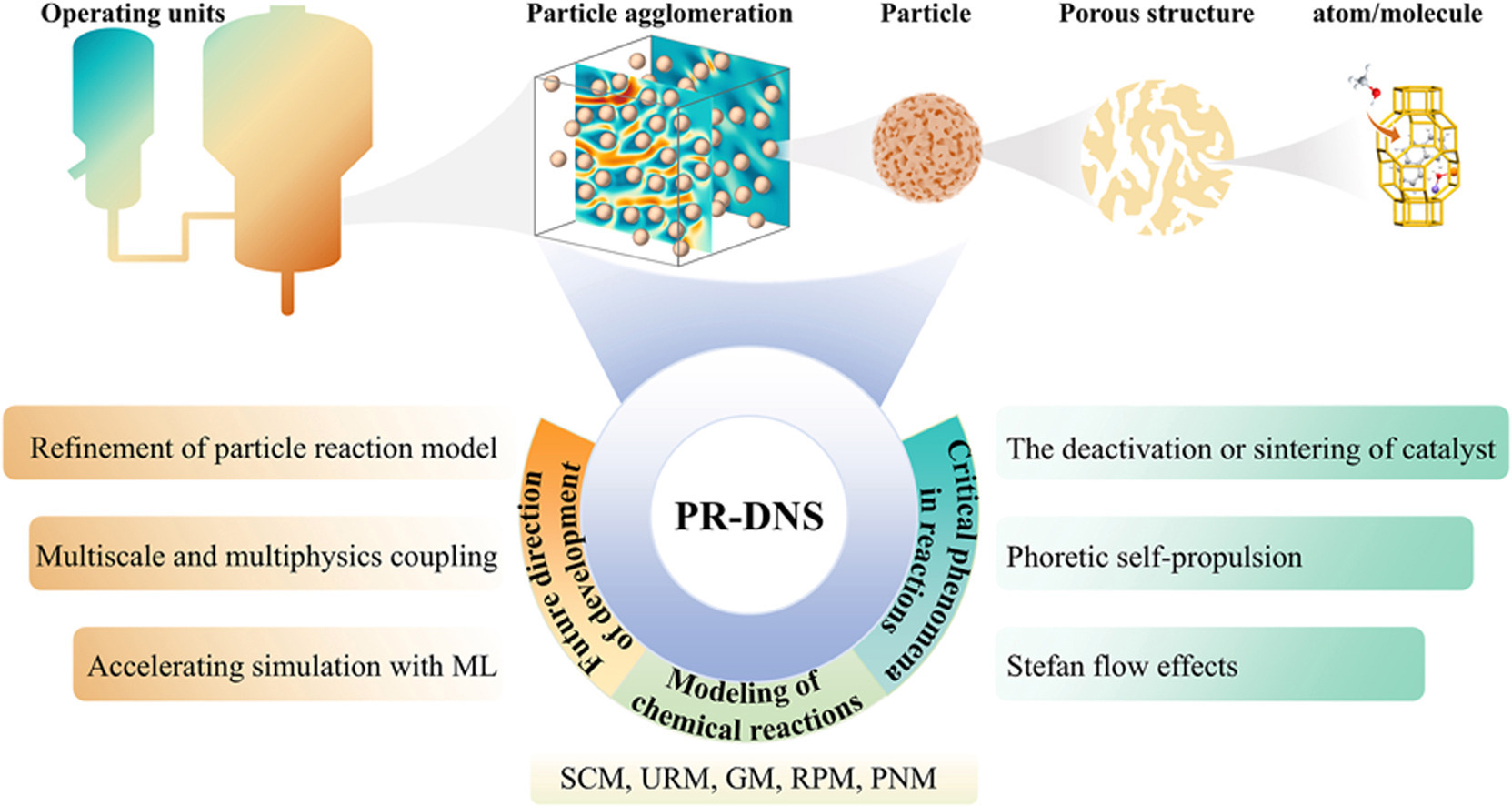
• PR-DNS accurately resolves flow fields around particles, revealing key reaction phenomena, such as Stefan flow, phoretic self-propulsion, catalyst deactivation/sintering.
• This review systematically summarizes the characteristics, applicable reaction systems, advantages, and limitations of common reaction models.
• This review outlines PR-DNS application progress in reactive and catalyst particles, clarifying how particle geometry, pore structure, reaction conditions regulate process efficiency.
Abstract
Particulate two-phase flows are characterized by multiscale and nonlinear interactions. The coupling simulation of the reaction and transfer process is a critical problem in many industrial applications. Innovations in modeling techniques, including the treatments of complicated boundary conditions and improved chemical reaction models, have greatly enhanced computational accuracy and feasibility. This review provides a comprehensive overview of the progress made in particle-resolved direct numerical simulation (PR-DNS) for investigating the complex phenomena in reacting particulate two-phase flows, with a focus on insights into reaction models, interphase heat and mass transfer, and hydrodynamic forces. PR-DNS has been applied to a range of reaction processes, such as combustion, gasification, and catalytic reactions, revealing critical phenomena such as Stefan flow effects and particle-scale interactions by resolving detailed flow fields around particles. Despite promising prospects, PR-DNS still presents challenges in terms of computational cost, model refinement, and multiscale integration. Recent advancements in emerging computational methodologies, particularly machine learning frameworks and hybrid multiscale modeling approaches, are expected to offer viable pathways to address these technical limitations.
Graphical abstract
Keywords
Particle-resolved; Particulate two-phase flow; Multiscale; Chemical reaction models
文章导读