
期刊文章
过刊浏览
- Volumes 108-119 (2025)
-
Volumes 96-107 (2025)
-
Volume 107
Pages 1-376 (December 2025)
-
Volume 106
Pages 1-336 (November 2025)
-
Volume 105
Pages 1-356 (October 2025)
-
Volume 104
Pages 1-332 (September 2025)
-
Volume 103
Pages 1-314 (August 2025)
-
Volume 102
Pages 1-276 (July 2025)
-
Volume 101
Pages 1-166 (June 2025)
-
Volume 100
Pages 1-256 (May 2025)
-
Volume 99
Pages 1-242 (April 2025)
-
Volume 98
Pages 1-288 (March 2025)
-
Volume 97
Pages 1-256 (February 2025)
-
Volume 96
Pages 1-340 (January 2025)
-
Volume 107
-
Volumes 84-95 (2024)
-
Volume 95
Pages 1-392 (December 2024)
-
Volume 94
Pages 1-400 (November 2024)
-
Volume 93
Pages 1-376 (October 2024)
-
Volume 92
Pages 1-316 (September 2024)
-
Volume 91
Pages 1-378 (August 2024)
-
Volume 90
Pages 1-580 (July 2024)
-
Volume 89
Pages 1-278 (June 2024)
-
Volume 88
Pages 1-350 (May 2024)
-
Volume 87
Pages 1-338 (April 2024)
-
Volume 86
Pages 1-312 (March 2024)
-
Volume 85
Pages 1-334 (February 2024)
-
Volume 84
Pages 1-308 (January 2024)
-
Volume 95
-
Volumes 72-83 (2023)
-
Volume 83
Pages 1-258 (December 2023)
-
Volume 82
Pages 1-204 (November 2023)
-
Volume 81
Pages 1-188 (October 2023)
-
Volume 80
Pages 1-202 (September 2023)
-
Volume 79
Pages 1-172 (August 2023)
-
Volume 78
Pages 1-146 (July 2023)
-
Volume 77
Pages 1-152 (June 2023)
-
Volume 76
Pages 1-176 (May 2023)
-
Volume 75
Pages 1-228 (April 2023)
-
Volume 74
Pages 1-200 (March 2023)
-
Volume 73
Pages 1-138 (February 2023)
-
Volume 72
Pages 1-144 (January 2023)
-
Volume 83
-
Volumes 60-71 (2022)
-
Volume 71
Pages 1-108 (December 2022)
-
Volume 70
Pages 1-106 (November 2022)
-
Volume 69
Pages 1-122 (October 2022)
-
Volume 68
Pages 1-124 (September 2022)
-
Volume 67
Pages 1-102 (August 2022)
-
Volume 66
Pages 1-112 (July 2022)
-
Volume 65
Pages 1-138 (June 2022)
-
Volume 64
Pages 1-186 (May 2022)
-
Volume 63
Pages 1-124 (April 2022)
-
Volume 62
Pages 1-104 (March 2022)
-
Volume 61
Pages 1-120 (February 2022)
-
Volume 60
Pages 1-124 (January 2022)
-
Volume 71
- Volumes 54-59 (2021)
- Volumes 48-53 (2020)
- Volumes 42-47 (2019)
- Volumes 36-41 (2018)
- Volumes 30-35 (2017)
- Volumes 24-29 (2016)
- Volumes 18-23 (2015)
- Volumes 12-17 (2014)
- Volume 11 (2013)
- Volume 10 (2012)
- Volume 9 (2011)
- Volume 8 (2010)
- Volume 7 (2009)
- Volume 6 (2008)
- Volume 5 (2007)
- Volume 4 (2006)
- Volume 3 (2005)
- Volume 2 (2004)
- Volume 1 (2003)
Volume 114
Bourisli, R. I., Ebrahim, A. S., Patil, M., Agarwal, J., & Vedapuri, D. (2026). Efficient sand transport in wellbores: Exploring optimal superficial liquid and gas velocity configurations through multiphase flow analysis. Particuology, 114, 353-364. https://doi.org/10.1016/j.partic.2026.04.019
Efficient sand transport in wellbores: Exploring optimal superficial liquid and gas velocity configurations through multiphase flow analysis
Raed I. Bourisli a *, Abdullah S. Ebrahim b, Makarand Patil c, Jatin Agarwal c, Damodaran Vedapuri c
a Mechanical Engineering Department, Kuwait University, PO Box 5969, Safat, 13060, Kuwait
b Petroleum Engineering Department, Kuwait University, PO Box 5969, Safat, 13060, Kuwait
c EFD group, Tridiagonal Solutions Pvt. Ltd., Pune, Maharashtra, India
10.1016/j.partic.2026.04.019
Volume 114,
July 2026,
Pages 353-364
Received 30 November 2025, Revised 12 April 2026, Accepted 27 April 2026, Available online 5 May 2026, Version of Record 14 May 2026.
E-mail:
raed.bourisli@ku.edu.kw
Highlights
• Identified particle-transport thresholds via critical superficial gas velocity.
• Experiments and OLGA modeling reveal conditions preventing particle bed formation.
• Gas breakout enhances particle entrainment and stabilizes churn-flow transport.
• Particle–wall shear and multiphase interactions mapped across production regimes.
Abstract
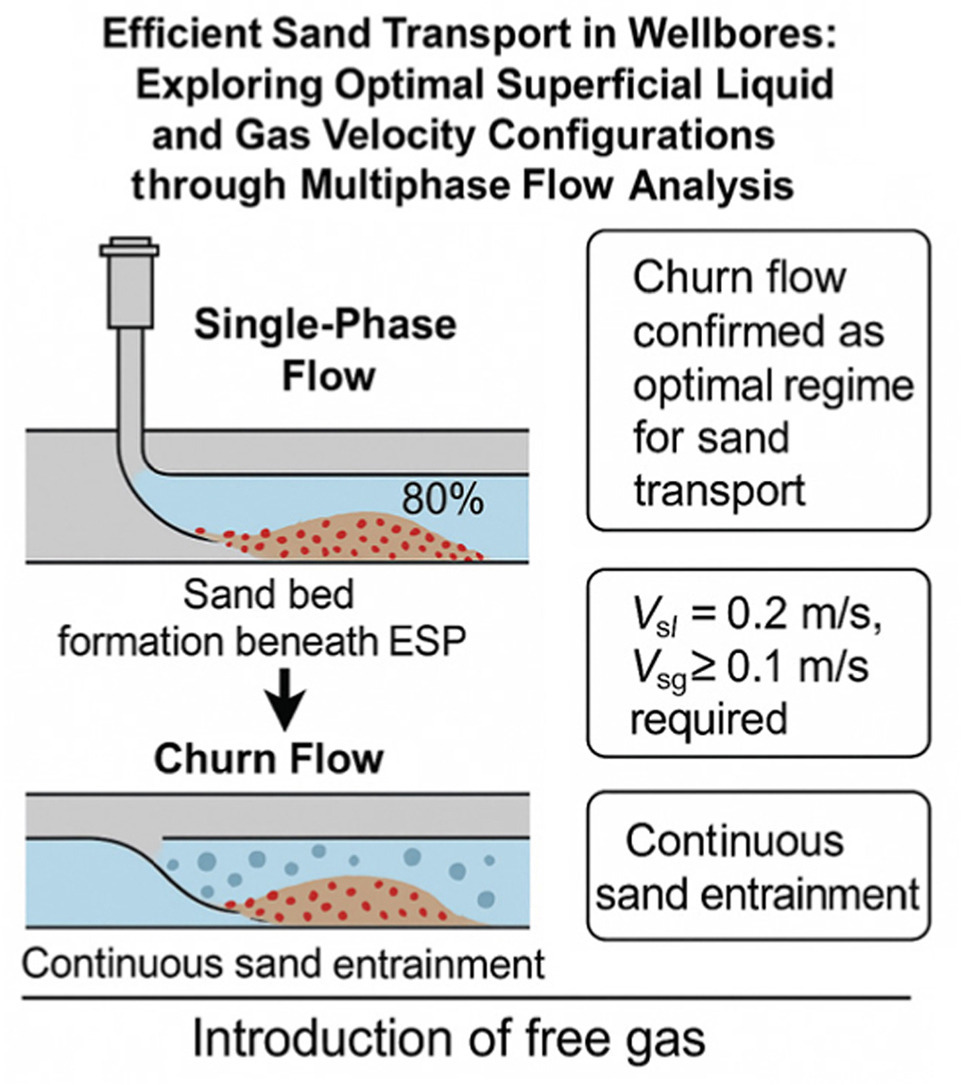
This study investigates the influence of superficial liquid and gas velocity configurations on flow regimes and sand transport dynamics in a 4.276″ production tubing of a Kuwait Oil Company (KOC) well. Using OLGA simulations, the minimum superficial gas velocity (Vsg) required to avoid sand accumulation at varying superficial liquid velocities (Vsl) was identified. For higher production rates (Vsl = 0.2 m/s, ∼1000 bpd), a minimum Vsg of 0.1 m/s is necessary to achieve a churn flow regime conducive to effective sand transport. At lower production rates (Vsl = 0.04 m/s, ∼200 bpd), churn flow and adequate sand mobilization occur at Vsg values above 0.02 m/s. Under single-phase conditions (Vsg = 0 m/s), simulations revealed sand deposition near the toe of the well, resulting in stationary bed formation. The findings emphasize the importance of maintaining multiphase flow—particularly, churn flow—at the bottom hole to enhance sand transport efficiency and prevent deposition beneath the Electric Submersible Pump (ESP). The work provides a field-scale identification of superficial gas velocity thresholds governing sand transport below electric submersible pumps, based on the combined interpretation of full-scale experiments and OLGA-based multiphase modeling.
Graphical abstract
Keywords
Sand transport; Superficial velocity; Multiphase flow modeling; Electric submersible pumps (ESP); OLGA simulation
文章导读