
期刊文章
过刊浏览
- Volumes 108-119 (2025)
-
Volumes 96-107 (2025)
-
Volume 107
Pages 1-376 (December 2025)
-
Volume 106
Pages 1-336 (November 2025)
-
Volume 105
Pages 1-356 (October 2025)
-
Volume 104
Pages 1-332 (September 2025)
-
Volume 103
Pages 1-314 (August 2025)
-
Volume 102
Pages 1-276 (July 2025)
-
Volume 101
Pages 1-166 (June 2025)
-
Volume 100
Pages 1-256 (May 2025)
-
Volume 99
Pages 1-242 (April 2025)
-
Volume 98
Pages 1-288 (March 2025)
-
Volume 97
Pages 1-256 (February 2025)
-
Volume 96
Pages 1-340 (January 2025)
-
Volume 107
-
Volumes 84-95 (2024)
-
Volume 95
Pages 1-392 (December 2024)
-
Volume 94
Pages 1-400 (November 2024)
-
Volume 93
Pages 1-376 (October 2024)
-
Volume 92
Pages 1-316 (September 2024)
-
Volume 91
Pages 1-378 (August 2024)
-
Volume 90
Pages 1-580 (July 2024)
-
Volume 89
Pages 1-278 (June 2024)
-
Volume 88
Pages 1-350 (May 2024)
-
Volume 87
Pages 1-338 (April 2024)
-
Volume 86
Pages 1-312 (March 2024)
-
Volume 85
Pages 1-334 (February 2024)
-
Volume 84
Pages 1-308 (January 2024)
-
Volume 95
-
Volumes 72-83 (2023)
-
Volume 83
Pages 1-258 (December 2023)
-
Volume 82
Pages 1-204 (November 2023)
-
Volume 81
Pages 1-188 (October 2023)
-
Volume 80
Pages 1-202 (September 2023)
-
Volume 79
Pages 1-172 (August 2023)
-
Volume 78
Pages 1-146 (July 2023)
-
Volume 77
Pages 1-152 (June 2023)
-
Volume 76
Pages 1-176 (May 2023)
-
Volume 75
Pages 1-228 (April 2023)
-
Volume 74
Pages 1-200 (March 2023)
-
Volume 73
Pages 1-138 (February 2023)
-
Volume 72
Pages 1-144 (January 2023)
-
Volume 83
-
Volumes 60-71 (2022)
-
Volume 71
Pages 1-108 (December 2022)
-
Volume 70
Pages 1-106 (November 2022)
-
Volume 69
Pages 1-122 (October 2022)
-
Volume 68
Pages 1-124 (September 2022)
-
Volume 67
Pages 1-102 (August 2022)
-
Volume 66
Pages 1-112 (July 2022)
-
Volume 65
Pages 1-138 (June 2022)
-
Volume 64
Pages 1-186 (May 2022)
-
Volume 63
Pages 1-124 (April 2022)
-
Volume 62
Pages 1-104 (March 2022)
-
Volume 61
Pages 1-120 (February 2022)
-
Volume 60
Pages 1-124 (January 2022)
-
Volume 71
- Volumes 54-59 (2021)
- Volumes 48-53 (2020)
- Volumes 42-47 (2019)
- Volumes 36-41 (2018)
- Volumes 30-35 (2017)
- Volumes 24-29 (2016)
- Volumes 18-23 (2015)
- Volumes 12-17 (2014)
- Volume 11 (2013)
- Volume 10 (2012)
- Volume 9 (2011)
- Volume 8 (2010)
- Volume 7 (2009)
- Volume 6 (2008)
- Volume 5 (2007)
- Volume 4 (2006)
- Volume 3 (2005)
- Volume 2 (2004)
- Volume 1 (2003)
Volume 114
Jiang, T., Jiang, X., Liu, X., Song, S., Pan, B., Li, C., & Yao, S. (2026). Breakage characteristics of columnar catalyst in a vertical-to-horizontal bend during dilute-phase pneumatic conveying. Particuology, 114, 365-383. https://doi.org/10.1016/j.partic.2026.04.018
Breakage characteristics of columnar catalyst in a vertical-to-horizontal bend during dilute-phase pneumatic conveying
Tao Jiang a, Xiao Jiang a e, Xuedong Liu a *, Siduo Song b, Bing Pan a, Chengze Li c, Sheng Yao d
a School of Mechanical Engineering and Railway Transit, Changzhou University, Changzhou, 213164, China
b School of Mechanical and Power Engineering, East China University of Science and Technology, Shanghai, 200237, China
c Department of Mathematics, University of Toronto, Toronto, ON, M5S 1A1, Canada
d Jiangsu Tianpeng Petrochemical Technology Co., Ltd, Nanjing, 211100, China
e Jiangsu Meilan Chemical Co., Ltd., Taizhou, 225300, China
10.1016/j.partic.2026.04.018
Volume 114,
July 2026,
Pages 365-383
Received 9 February 2026, Revised 15 April 2026, Accepted 27 April 2026, Available online 3 May 2026, Version of Record 15 May 2026.
E-mail:
xdliu_65@126.com
Highlights
• CFD-DEM coupled with Ab-t10 breakage model is used to simulate catalyst breakage.
• Effect of operating conditions and bend curvature ratio on particle breakage.
• Investigation on impact energy distribution and fragment formation.
• Response surface models for prediction of breakage and pressure drop.
Abstract
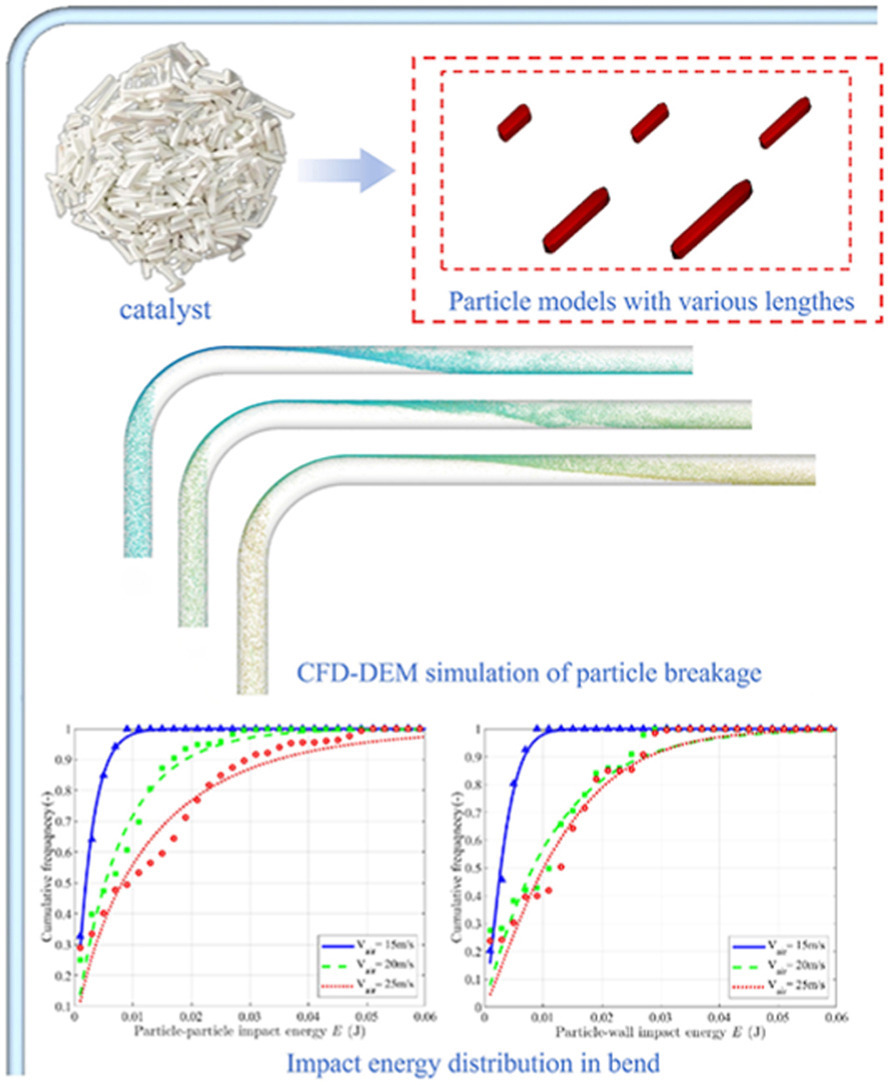
Particle breakage during pneumatic conveying remains a critical issue in catalyst handling, particularly in pipelines where intensive particle-particle and particle-wall collisions occur. In this study, the breakage and flow characteristics of brittle columnar catalyst in a single bend were systematically investigated using a coupled CFD-DEM approach. The breakage model was experimentally calibrated based on single-particle impact tests and was implemented to account for impact-induced fragmentation under conveying conditions. Effects of airflow velocity (15–25 m/s), feeding rate (0.4–0.8 kg/s), and bend curvature ratio (R/D = 1–5) on particle motion, impact energy distributions, and breakage extent were analyzed. The results show that increasing airflow velocity significantly intensifies particle breakage as it shifts the impact energy distributions toward higher-energy collisions and enhances the high-energy fragmentation. In contrast, feeding rate exhibits a comparatively weaker influence on collision intensity and breakage extent. A smaller bend curvature ratio (R/D) leads to increased particle impact severity, leading to enhanced breakage. A response surface analysis based on the Box-Behnken design was employed to evaluate the combined influence of these parameters and to establish predictive models for median particle size and bend pressure drop, providing a reference for the system optimization.
Graphical abstract
Keywords
Catalyst; Non-spherical particle; Particle breakage; CFD-DEM; Pneumatic conveying
文章导读