
期刊文章
过刊浏览
- Volumes 108-119 (2025)
-
Volumes 96-107 (2025)
-
Volume 107
Pages 1-376 (December 2025)
-
Volume 106
Pages 1-336 (November 2025)
-
Volume 105
Pages 1-356 (October 2025)
-
Volume 104
Pages 1-332 (September 2025)
-
Volume 103
Pages 1-314 (August 2025)
-
Volume 102
Pages 1-276 (July 2025)
-
Volume 101
Pages 1-166 (June 2025)
-
Volume 100
Pages 1-256 (May 2025)
-
Volume 99
Pages 1-242 (April 2025)
-
Volume 98
Pages 1-288 (March 2025)
-
Volume 97
Pages 1-256 (February 2025)
-
Volume 96
Pages 1-340 (January 2025)
-
Volume 107
-
Volumes 84-95 (2024)
-
Volume 95
Pages 1-392 (December 2024)
-
Volume 94
Pages 1-400 (November 2024)
-
Volume 93
Pages 1-376 (October 2024)
-
Volume 92
Pages 1-316 (September 2024)
-
Volume 91
Pages 1-378 (August 2024)
-
Volume 90
Pages 1-580 (July 2024)
-
Volume 89
Pages 1-278 (June 2024)
-
Volume 88
Pages 1-350 (May 2024)
-
Volume 87
Pages 1-338 (April 2024)
-
Volume 86
Pages 1-312 (March 2024)
-
Volume 85
Pages 1-334 (February 2024)
-
Volume 84
Pages 1-308 (January 2024)
-
Volume 95
-
Volumes 72-83 (2023)
-
Volume 83
Pages 1-258 (December 2023)
-
Volume 82
Pages 1-204 (November 2023)
-
Volume 81
Pages 1-188 (October 2023)
-
Volume 80
Pages 1-202 (September 2023)
-
Volume 79
Pages 1-172 (August 2023)
-
Volume 78
Pages 1-146 (July 2023)
-
Volume 77
Pages 1-152 (June 2023)
-
Volume 76
Pages 1-176 (May 2023)
-
Volume 75
Pages 1-228 (April 2023)
-
Volume 74
Pages 1-200 (March 2023)
-
Volume 73
Pages 1-138 (February 2023)
-
Volume 72
Pages 1-144 (January 2023)
-
Volume 83
-
Volumes 60-71 (2022)
-
Volume 71
Pages 1-108 (December 2022)
-
Volume 70
Pages 1-106 (November 2022)
-
Volume 69
Pages 1-122 (October 2022)
-
Volume 68
Pages 1-124 (September 2022)
-
Volume 67
Pages 1-102 (August 2022)
-
Volume 66
Pages 1-112 (July 2022)
-
Volume 65
Pages 1-138 (June 2022)
-
Volume 64
Pages 1-186 (May 2022)
-
Volume 63
Pages 1-124 (April 2022)
-
Volume 62
Pages 1-104 (March 2022)
-
Volume 61
Pages 1-120 (February 2022)
-
Volume 60
Pages 1-124 (January 2022)
-
Volume 71
- Volumes 54-59 (2021)
- Volumes 48-53 (2020)
- Volumes 42-47 (2019)
- Volumes 36-41 (2018)
- Volumes 30-35 (2017)
- Volumes 24-29 (2016)
- Volumes 18-23 (2015)
- Volumes 12-17 (2014)
- Volume 11 (2013)
- Volume 10 (2012)
- Volume 9 (2011)
- Volume 8 (2010)
- Volume 7 (2009)
- Volume 6 (2008)
- Volume 5 (2007)
- Volume 4 (2006)
- Volume 3 (2005)
- Volume 2 (2004)
- Volume 1 (2003)
Volume 114
Nikitin, M., & Pashchenko, D. (2026). Pathway analogy for computational fluid dynamics simulations of fluid flow through structured packed beds. Particuology, 114, 384-393. https://doi.org/10.1016/j.partic.2026.04.012
Pathway analogy for computational fluid dynamics simulations of fluid flow through structured packed beds (Open Access)
Maxim Nikitin b, Dmitry Pashchenko a b *
a Faculty of Mechanical Engineering, Technion — Israel Institute of Technology, Technion City, Haifa, 3200003, Israel
b Department of Mechanical Engineering (Robotics) and MATEC, Guangdong Technion — Israel Institute of Technology, Guangdong, Shantou, 515063, China
10.1016/j.partic.2026.04.012
Volume 114,
July 2026,
Pages 384-393
Received 14 February 2026, Revised 8 April 2026, Accepted 14 April 2026, Available online 27 April 2026, Version of Record 14 May 2026.
E-mail:
dmitry.pa@technion.ac.il; dmitry.pashchenko@gtiit.edu.cn
Highlights
• Novel pathway analogy decomposes structured packed bed flow.
• Cross-flow between pathways is negligible (<1%).
• Universal friction factor correlations independent of particle size.
• Mechanistic model sums weighted pathway contributions.
• Validated against experimental data across wide Re range.
Abstract
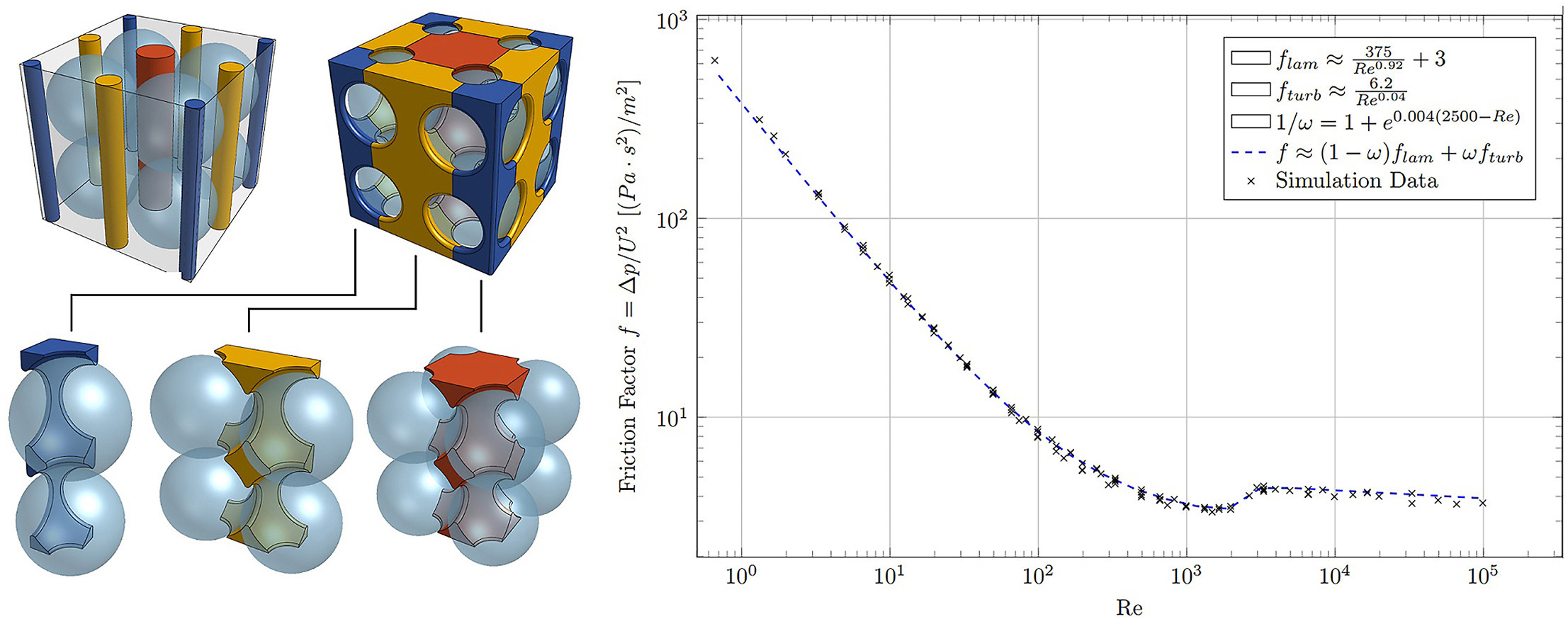
Predicting pressure drop in structured packed beds is critical for the design of industrial chemical reactors and heat exchangers. While particle-resolved Computational Fluid Dynamics (CFD) offers high fidelity, its prohibitive computational cost for large-scale systems necessitates efficient modeling strategies. This study introduces a novel pathway analogy for fluid flow through structured packed beds in a simple cubic arrangement. The approach deconstructs the complex interstitial flow field into a finite set of discrete, hydraulically independent pathways—classified as full, half, or quarter based on their proximity to the container walls. High-fidelity CFD simulations confirm that cross-flow between these pathways is negligible ( < 1%) both in laminar and turbulent regimes, justifying their treatment as independent flow units. Universal correlations for the friction factor and a normalized pressure drop are derived for each pathway type as a function of Reynolds number, demonstrating negligible dependence on particle diameter. These foundational correlations are synthesized into a mechanistic engineering model that reconstructs the total pressure drop for a bed of any dimension by summing the weighted contributions of all individual pathways. The model is rigorously validated against experimental data from the literature, showing strong agreement across a wide range of Reynolds numbers and bed configurations. This pathway analogy provides a robust, physics-based framework for drastic computational domain reduction, offering a valuable tool for the efficient design and scaling of structured packed bed systems.
Graphical abstract
Keywords
Packed beds; Computational fluid dynamics; Pressure drop; Structured packings; Pathway analogy
文章导读