
期刊文章
过刊浏览
- Volumes 108-119 (2025)
-
Volumes 96-107 (2025)
-
Volume 107
Pages 1-376 (December 2025)
-
Volume 106
Pages 1-336 (November 2025)
-
Volume 105
Pages 1-356 (October 2025)
-
Volume 104
Pages 1-332 (September 2025)
-
Volume 103
Pages 1-314 (August 2025)
-
Volume 102
Pages 1-276 (July 2025)
-
Volume 101
Pages 1-166 (June 2025)
-
Volume 100
Pages 1-256 (May 2025)
-
Volume 99
Pages 1-242 (April 2025)
-
Volume 98
Pages 1-288 (March 2025)
-
Volume 97
Pages 1-256 (February 2025)
-
Volume 96
Pages 1-340 (January 2025)
-
Volume 107
-
Volumes 84-95 (2024)
-
Volume 95
Pages 1-392 (December 2024)
-
Volume 94
Pages 1-400 (November 2024)
-
Volume 93
Pages 1-376 (October 2024)
-
Volume 92
Pages 1-316 (September 2024)
-
Volume 91
Pages 1-378 (August 2024)
-
Volume 90
Pages 1-580 (July 2024)
-
Volume 89
Pages 1-278 (June 2024)
-
Volume 88
Pages 1-350 (May 2024)
-
Volume 87
Pages 1-338 (April 2024)
-
Volume 86
Pages 1-312 (March 2024)
-
Volume 85
Pages 1-334 (February 2024)
-
Volume 84
Pages 1-308 (January 2024)
-
Volume 95
-
Volumes 72-83 (2023)
-
Volume 83
Pages 1-258 (December 2023)
-
Volume 82
Pages 1-204 (November 2023)
-
Volume 81
Pages 1-188 (October 2023)
-
Volume 80
Pages 1-202 (September 2023)
-
Volume 79
Pages 1-172 (August 2023)
-
Volume 78
Pages 1-146 (July 2023)
-
Volume 77
Pages 1-152 (June 2023)
-
Volume 76
Pages 1-176 (May 2023)
-
Volume 75
Pages 1-228 (April 2023)
-
Volume 74
Pages 1-200 (March 2023)
-
Volume 73
Pages 1-138 (February 2023)
-
Volume 72
Pages 1-144 (January 2023)
-
Volume 83
-
Volumes 60-71 (2022)
-
Volume 71
Pages 1-108 (December 2022)
-
Volume 70
Pages 1-106 (November 2022)
-
Volume 69
Pages 1-122 (October 2022)
-
Volume 68
Pages 1-124 (September 2022)
-
Volume 67
Pages 1-102 (August 2022)
-
Volume 66
Pages 1-112 (July 2022)
-
Volume 65
Pages 1-138 (June 2022)
-
Volume 64
Pages 1-186 (May 2022)
-
Volume 63
Pages 1-124 (April 2022)
-
Volume 62
Pages 1-104 (March 2022)
-
Volume 61
Pages 1-120 (February 2022)
-
Volume 60
Pages 1-124 (January 2022)
-
Volume 71
- Volumes 54-59 (2021)
- Volumes 48-53 (2020)
- Volumes 42-47 (2019)
- Volumes 36-41 (2018)
- Volumes 30-35 (2017)
- Volumes 24-29 (2016)
- Volumes 18-23 (2015)
- Volumes 12-17 (2014)
- Volume 11 (2013)
- Volume 10 (2012)
- Volume 9 (2011)
- Volume 8 (2010)
- Volume 7 (2009)
- Volume 6 (2008)
- Volume 5 (2007)
- Volume 4 (2006)
- Volume 3 (2005)
- Volume 2 (2004)
- Volume 1 (2003)
Volume 114
Chen, J., Peng, B., Li, D., Zhu, Y., Cao, X., Zhuravkov, M., . . . Jiang, W. (2026). YOLOv8l-Voronoi ensemble learning for enhanced detection and segmentation of nanoparticle agglomerates in micro fluidized beds. Particuology, 114, 394-407. https://doi.org/10.1016/j.partic.2026.05.002
YOLOv8l-Voronoi ensemble learning for enhanced detection and segmentation of nanoparticle agglomerates in micro fluidized beds
Juhui Chen a b *, Buyang Peng a b, Dan Li a b, Yongxin Zhu a b, Xifeng Cao a b, Michael Zhuravkov c d, Siarhei Lapatsin c d, Wenrui Jiang d
a School of Mechanical and Power Engineering, Harbin University of Science and Technology, Harbin, 150080, China
b Key Laboratory of Advanced Manufacturing and Intelligent Technology, Ministry of Education, Harbin University of Science and Technology, Harbin, 150080, China
c Heilongjiang Key Laboratory for International Cooperation on Gear Transmission of Maritime and Air Equipment, Harbin, 150001, China
d School of Mechatronics Engineering, Harbin Institute of Technology, Harbin, 150001, China
10.1016/j.partic.2026.05.002
Volume 114,
July 2026,
Pages 394-407
Received 18 March 2026, Revised 23 April 2026, Accepted 6 May 2026, Available online 13 May 2026, Version of Record 19 May 2026.
E-mail:
chenjuhui@hrbust.edu.cn
Highlights
• YOLOv8l-Voronoi ensemble for nanoparticle agglomerate detection and segmentation.
• An adaptive overlapping tiling strategy reduces the agglomerate miss rate from 19.4% to 13.1%.
• A Voronoi-SVM module suppresses false alarms, increasing the mAP@0.5 to 90.1%.
• A cascaded U-Net model refines boundaries, achieving an MIoU of 0.876.
• Quantitative analysis reveals ZnO content reduces agglomerate size and improves sphericity.
Abstract
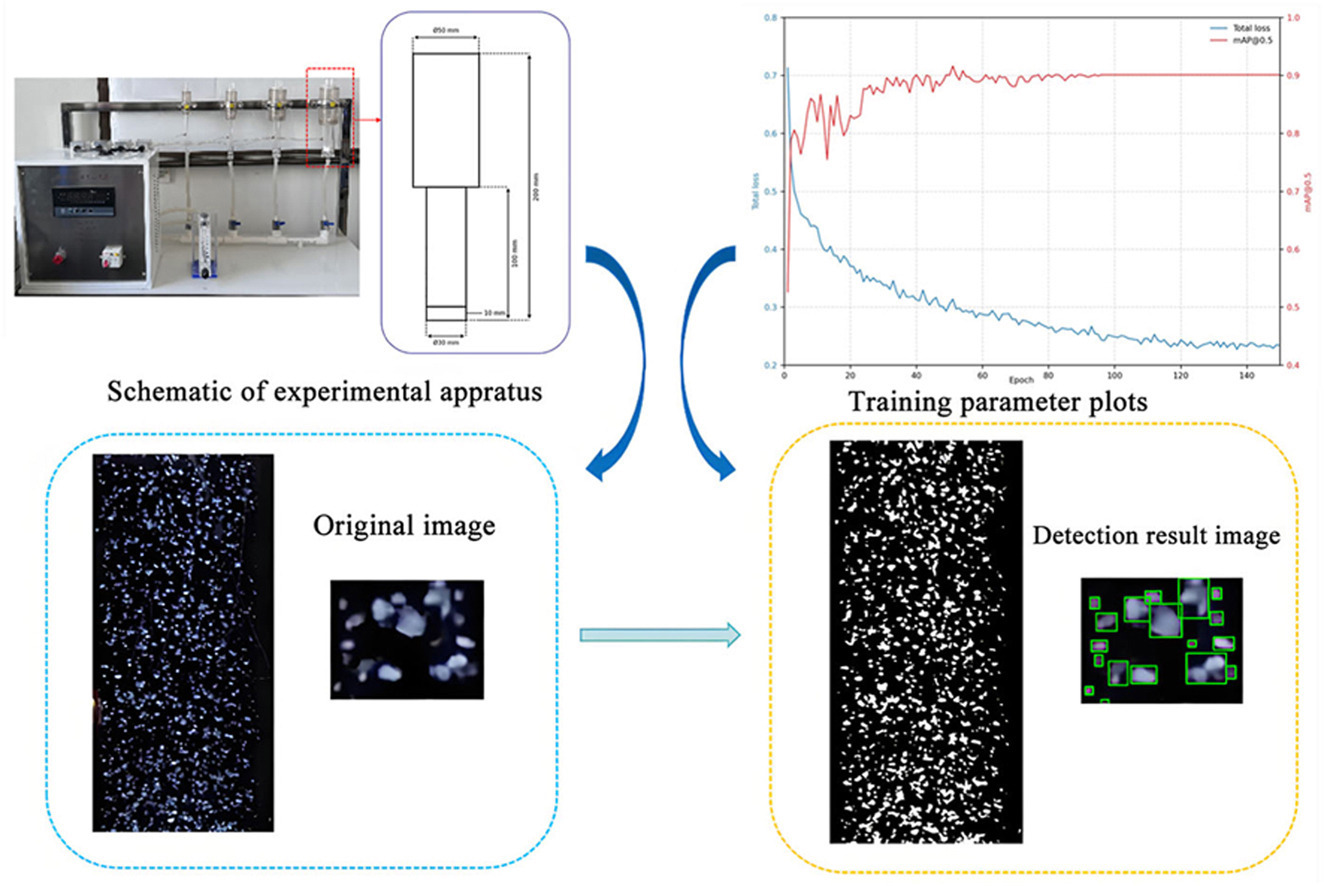
This study proposes an integrated YOLOv8l-Voronoi ensemble framework for accurate detection and segmentation of nanoparticle agglomerates in micro-fluidized beds. To address challenges posed by high density, small size, and complex morphologies of agglomerates, an adaptive overlapping tiling strategy is introduced, reducing the agglomerate miss rate from 19.4% to 13.1% compared to the baseline YOLOv8l model. A Voronoi polygon partitioning combined with a support vector machine (SVM) is further incorporated to suppress false alarms caused by illumination variations, and a cascaded U-Net model is employed for pixel-level boundary segmentation. Experimental results show that the proposed framework achieves an mAP@0.5 of 90.1% on a self-built dataset, representing an 8.4 percentage point improvement over the baseline, while maintaining a high segmentation accuracy (MIoU>0.87). The method provides a robust and precise solution for online monitoring and quantitative analysis of nanoparticle aggregation behavior.
Graphical abstract
Keywords
YOLOv8l; Nanoparticle agglomerates; Voronoi diagram; Support Vector Machine (SVM); Micro fluidized bed
文章导读