
期刊文章
过刊浏览
- Volumes 108-119 (2025)
-
Volumes 96-107 (2025)
-
Volume 107
Pages 1-376 (December 2025)
-
Volume 106
Pages 1-336 (November 2025)
-
Volume 105
Pages 1-356 (October 2025)
-
Volume 104
Pages 1-332 (September 2025)
-
Volume 103
Pages 1-314 (August 2025)
-
Volume 102
Pages 1-276 (July 2025)
-
Volume 101
Pages 1-166 (June 2025)
-
Volume 100
Pages 1-256 (May 2025)
-
Volume 99
Pages 1-242 (April 2025)
-
Volume 98
Pages 1-288 (March 2025)
-
Volume 97
Pages 1-256 (February 2025)
-
Volume 96
Pages 1-340 (January 2025)
-
Volume 107
-
Volumes 84-95 (2024)
-
Volume 95
Pages 1-392 (December 2024)
-
Volume 94
Pages 1-400 (November 2024)
-
Volume 93
Pages 1-376 (October 2024)
-
Volume 92
Pages 1-316 (September 2024)
-
Volume 91
Pages 1-378 (August 2024)
-
Volume 90
Pages 1-580 (July 2024)
-
Volume 89
Pages 1-278 (June 2024)
-
Volume 88
Pages 1-350 (May 2024)
-
Volume 87
Pages 1-338 (April 2024)
-
Volume 86
Pages 1-312 (March 2024)
-
Volume 85
Pages 1-334 (February 2024)
-
Volume 84
Pages 1-308 (January 2024)
-
Volume 95
-
Volumes 72-83 (2023)
-
Volume 83
Pages 1-258 (December 2023)
-
Volume 82
Pages 1-204 (November 2023)
-
Volume 81
Pages 1-188 (October 2023)
-
Volume 80
Pages 1-202 (September 2023)
-
Volume 79
Pages 1-172 (August 2023)
-
Volume 78
Pages 1-146 (July 2023)
-
Volume 77
Pages 1-152 (June 2023)
-
Volume 76
Pages 1-176 (May 2023)
-
Volume 75
Pages 1-228 (April 2023)
-
Volume 74
Pages 1-200 (March 2023)
-
Volume 73
Pages 1-138 (February 2023)
-
Volume 72
Pages 1-144 (January 2023)
-
Volume 83
-
Volumes 60-71 (2022)
-
Volume 71
Pages 1-108 (December 2022)
-
Volume 70
Pages 1-106 (November 2022)
-
Volume 69
Pages 1-122 (October 2022)
-
Volume 68
Pages 1-124 (September 2022)
-
Volume 67
Pages 1-102 (August 2022)
-
Volume 66
Pages 1-112 (July 2022)
-
Volume 65
Pages 1-138 (June 2022)
-
Volume 64
Pages 1-186 (May 2022)
-
Volume 63
Pages 1-124 (April 2022)
-
Volume 62
Pages 1-104 (March 2022)
-
Volume 61
Pages 1-120 (February 2022)
-
Volume 60
Pages 1-124 (January 2022)
-
Volume 71
- Volumes 54-59 (2021)
- Volumes 48-53 (2020)
- Volumes 42-47 (2019)
- Volumes 36-41 (2018)
- Volumes 30-35 (2017)
- Volumes 24-29 (2016)
- Volumes 18-23 (2015)
- Volumes 12-17 (2014)
- Volume 11 (2013)
- Volume 10 (2012)
- Volume 9 (2011)
- Volume 8 (2010)
- Volume 7 (2009)
- Volume 6 (2008)
- Volume 5 (2007)
- Volume 4 (2006)
- Volume 3 (2005)
- Volume 2 (2004)
- Volume 1 (2003)
Volume 114
Khalifa, A., Breuer, M., & Nguyen, H. H. (2026). Assessment of Euler–Lagrange models for fluid-induced cohesive particle deagglomeration using particle-resolved DNS. Particuology, 114, 408-430. https://doi.org/10.1016/j.partic.2026.04.022
Assessment of Euler–Lagrange models for fluid-induced cohesive particle deagglomeration using particle-resolved DNS (Open Access)
Ali Khalifa a b, Michael Breuer a *, Hoang Huy Nguyen a
a Helmut–Schmidt–Universität Hamburg, D–22043, Hamburg, Germany
b Technische Universität München, 85354, Freising, Germany
10.1016/j.partic.2026.04.022
July 2026,
Received 18 September 2025, Revised 13 April 2026, Accepted 29 April 2026, Available online 12 May 2026, Version of Record 19 May 2026.,
Pages 408-430
Volume 114
E-mail:
breuer@hsu-hh.de
Highlights
• Detailed assessment of breakup models developed for the Euler-Lagrange approach.
• Thorough analysis relying on particle-resolved direct numerical simulations.
• Cohesive particle agglomerates in homogeneous isotropic turbulence.
• Comparison based on 18 cases with varying Reynolds number, Hamaker constant and particle size.
• Analysis of fragmentation ratio, size distributions of fragments, breakup and reagglomeration rate.
Abstract
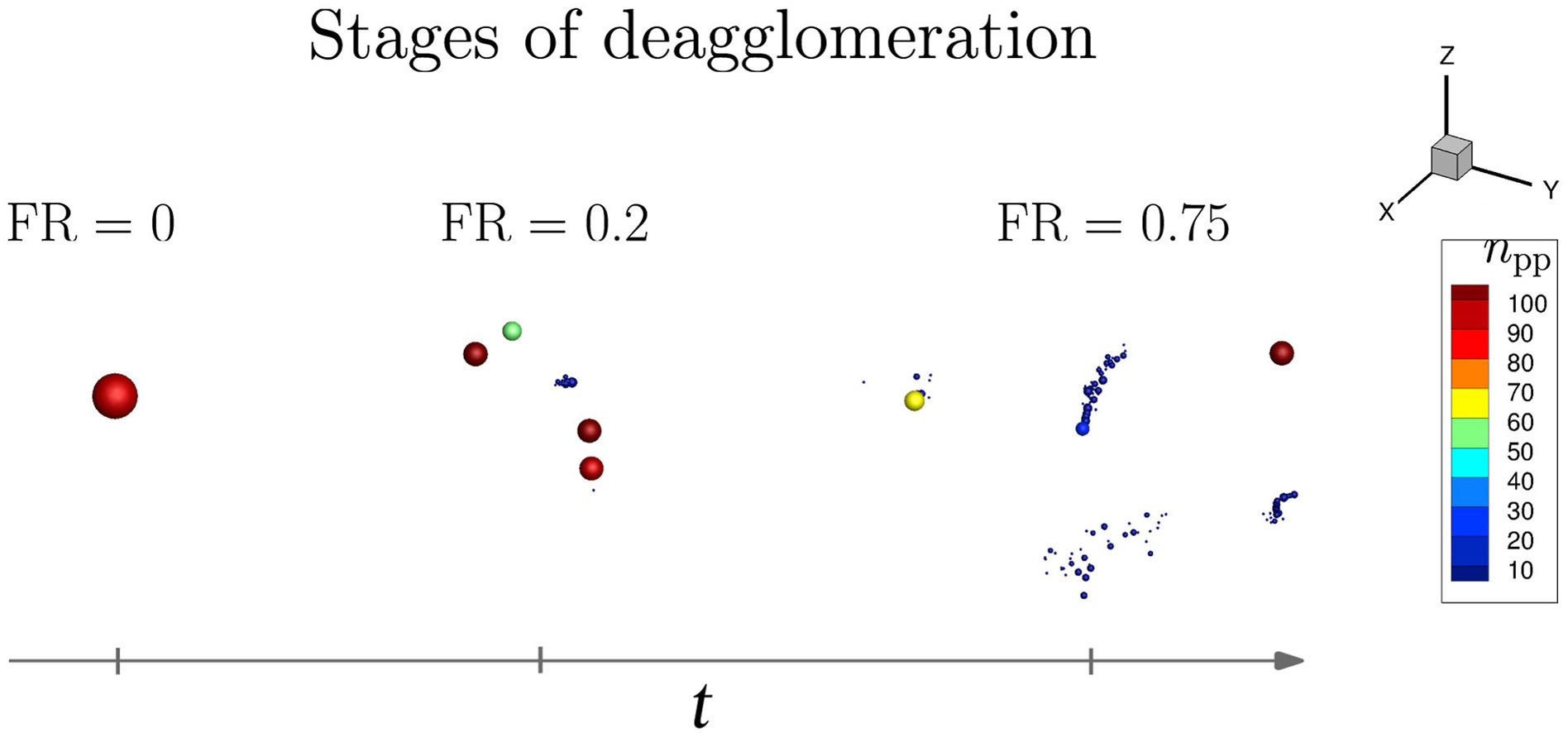
Accurate modeling of agglomerate breakup is essential for predictive simulations of particle-laden turbulent flows. Breakup models applied in the context of agglomerates represented by single spheres often rely on simplifying assumptions about the agglomerate structure and relevant stress mechanisms, raising questions about their fidelity. In this work, the fluid-induced breakup model by Breuer and Khalifa [Powder Technology 348, 105–125 (2019); Computers & Fluids 194, 104315 (2019)] developed for compact, nearly spherical agglomerates is systematically assessed within the Euler–Lagrange framework using high-fidelity reference data from particle-resolved direct numerical simulations coupled with the discrete element method. A single agglomerate composed of 500 primary particles is released into homogeneous isotropic turbulence, with Reynolds number, Hamaker constant, and particle size systematically varied to generate 18 different application cases. Comparisons between the two approaches demonstrate that fragmentation ratios and breakup rates reasonably agree in many cases, both confirming that breakup is augmented by increasing turbulence intensity and is hindered by stronger cohesion. A stress analysis further reveals that the turbulent stress dominates the breakup of large agglomerates, the drag stress acts on intermediate sizes, and the rotary stress mainly disrupts the smallest particle clusters. While the breakup model in the Euler–Lagrange method exhibits characteristic deviations from the resolved data, sudden size drops due to symmetric binary breakup and reduced reagglomeration compared to the gradual erosion in PR-DNS, the overall breakup rates collapse onto a common scaling based on the adhesion number and Reynolds number across both methods. These results highlight that, despite structural simplifications, the Euler–Lagrange breakup model reproduces the essential breakup dynamics observed in PR-DNS at a fraction of the computational costs, making it a practical framework for large-scale simulations of cohesive particle-laden flows.
Graphical abstract
Keywords
Particle-laden flows; Particle-resolved DNS; Euler-Lagrange; Effective sphere; Homogeneous isotropic turbulence; Deagglomeration
文章导读