
期刊文章
过刊浏览
- Volumes 108-119 (2025)
-
Volumes 96-107 (2025)
-
Volume 107
Pages 1-376 (December 2025)
-
Volume 106
Pages 1-336 (November 2025)
-
Volume 105
Pages 1-356 (October 2025)
-
Volume 104
Pages 1-332 (September 2025)
-
Volume 103
Pages 1-314 (August 2025)
-
Volume 102
Pages 1-276 (July 2025)
-
Volume 101
Pages 1-166 (June 2025)
-
Volume 100
Pages 1-256 (May 2025)
-
Volume 99
Pages 1-242 (April 2025)
-
Volume 98
Pages 1-288 (March 2025)
-
Volume 97
Pages 1-256 (February 2025)
-
Volume 96
Pages 1-340 (January 2025)
-
Volume 107
-
Volumes 84-95 (2024)
-
Volume 95
Pages 1-392 (December 2024)
-
Volume 94
Pages 1-400 (November 2024)
-
Volume 93
Pages 1-376 (October 2024)
-
Volume 92
Pages 1-316 (September 2024)
-
Volume 91
Pages 1-378 (August 2024)
-
Volume 90
Pages 1-580 (July 2024)
-
Volume 89
Pages 1-278 (June 2024)
-
Volume 88
Pages 1-350 (May 2024)
-
Volume 87
Pages 1-338 (April 2024)
-
Volume 86
Pages 1-312 (March 2024)
-
Volume 85
Pages 1-334 (February 2024)
-
Volume 84
Pages 1-308 (January 2024)
-
Volume 95
-
Volumes 72-83 (2023)
-
Volume 83
Pages 1-258 (December 2023)
-
Volume 82
Pages 1-204 (November 2023)
-
Volume 81
Pages 1-188 (October 2023)
-
Volume 80
Pages 1-202 (September 2023)
-
Volume 79
Pages 1-172 (August 2023)
-
Volume 78
Pages 1-146 (July 2023)
-
Volume 77
Pages 1-152 (June 2023)
-
Volume 76
Pages 1-176 (May 2023)
-
Volume 75
Pages 1-228 (April 2023)
-
Volume 74
Pages 1-200 (March 2023)
-
Volume 73
Pages 1-138 (February 2023)
-
Volume 72
Pages 1-144 (January 2023)
-
Volume 83
-
Volumes 60-71 (2022)
-
Volume 71
Pages 1-108 (December 2022)
-
Volume 70
Pages 1-106 (November 2022)
-
Volume 69
Pages 1-122 (October 2022)
-
Volume 68
Pages 1-124 (September 2022)
-
Volume 67
Pages 1-102 (August 2022)
-
Volume 66
Pages 1-112 (July 2022)
-
Volume 65
Pages 1-138 (June 2022)
-
Volume 64
Pages 1-186 (May 2022)
-
Volume 63
Pages 1-124 (April 2022)
-
Volume 62
Pages 1-104 (March 2022)
-
Volume 61
Pages 1-120 (February 2022)
-
Volume 60
Pages 1-124 (January 2022)
-
Volume 71
- Volumes 54-59 (2021)
- Volumes 48-53 (2020)
- Volumes 42-47 (2019)
- Volumes 36-41 (2018)
- Volumes 30-35 (2017)
- Volumes 24-29 (2016)
- Volumes 18-23 (2015)
- Volumes 12-17 (2014)
- Volume 11 (2013)
- Volume 10 (2012)
- Volume 9 (2011)
- Volume 8 (2010)
- Volume 7 (2009)
- Volume 6 (2008)
- Volume 5 (2007)
- Volume 4 (2006)
- Volume 3 (2005)
- Volume 2 (2004)
- Volume 1 (2003)
Volume 114
Yuan, M., Wang, J., Chen, M., Wang, T., Wang, N., Huang, X., . . . Hao, H. (2026). Ultrasound-enhanced slug-flow continuous crystallization of ibuprofen investigated by multiphysics CFD-PBE modeling and experiments. Particuology, 114, 431-445. https://doi.org/10.1016/j.partic.2026.04.024
Ultrasound-enhanced slug-flow continuous crystallization of ibuprofen investigated by multiphysics CFD-PBE modeling and experiments
Mingpu Yuan a, Jingkang Wang a, Mingyu Chen a, Ting Wang a b, Na Wang a b, Xin Huang a b *, Dongyang Zhu a b, Hongxun Hao a b *
a National Engineering Research Center for Industrial Crystallization Technology, School of Chemical Engineering and Technology, Tianjin University, Tianjin, 300072, China
b Engineering Research Center of Green Refining Process, Ministry of Education, Tianjin University, Tianjin, 300072, China
10.1016/j.partic.2026.04.024
Volume 114,
July 2026,
Pages 431-445
Received 3 February 2026, Revised 20 April 2026, Accepted 27 April 2026, Available online 8 May 2026, Version of Record 19 May 2026.
E-mail:
x_huang@tju.edu.cn; hongxunhao@tju.edu.cn
Highlights
• Unified CFD-PBE model elucidates ultrasound slug-flow crystallization.
• Acoustic streaming and slug vortices create pseudo-perfect mixing.
• Ultrasonic frequency refines pressure field, and amplitude boosts cavitation.
• Optimized cooling flow effectively mitigates ultrasonic heat accumulation.
• Synergistic intensification yields narrow PSD and prevents channel fouling.
Abstract
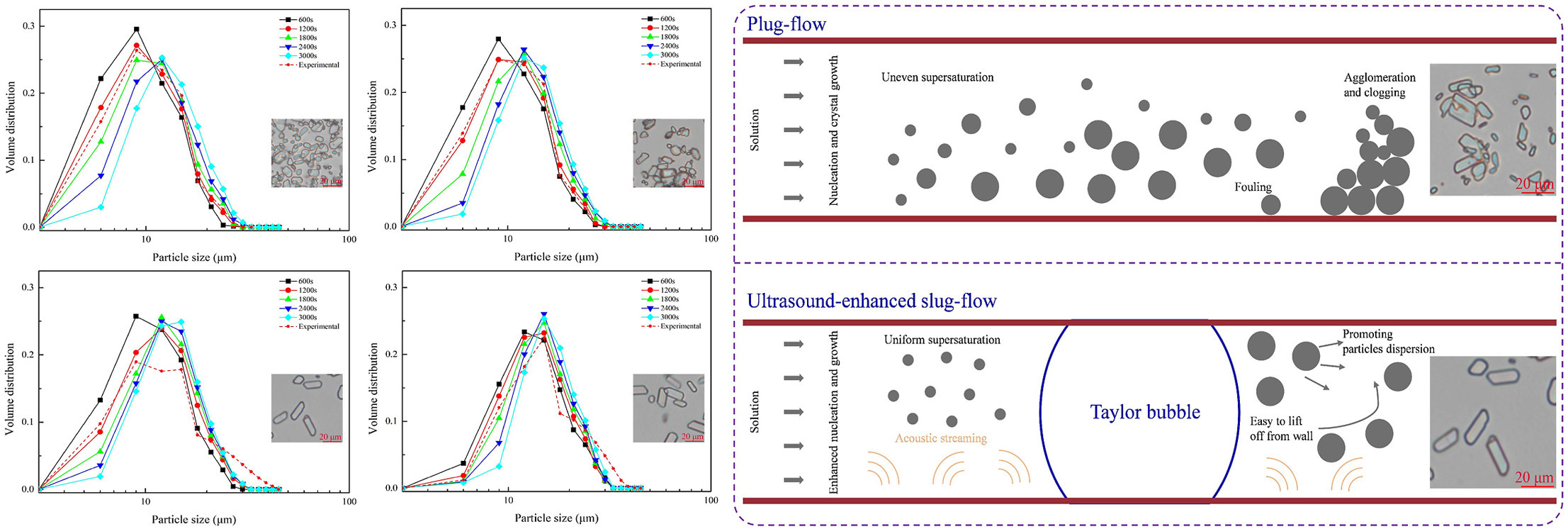
The production of active pharmaceutical ingredients (APIs) crystals with narrow and controllable size distributions presents significant challenges. In this study, an ultrasound-enhanced slug-flow tubular crystallizer was developed and was systematically investigated by experiments and a unified simulation framework which integrates nonlinear acoustic modeling with multiphase CFD, thermal analysis and high-resolution population balance equations (PBE). Acoustic fields were computed using nonlinear Helmholtz equation and coupled to Volume of Fluid (VOF) solver to resolve slug-flow hydrodynamics, while PBE simulations were adopted to capture nucleation and crystal growth under spatially varying supersaturation. Parametric studies demonstrate that ultrasonic frequency can refine pressure-field patterns without altering total energy dissipation, while higher pressure amplitudes can expand high-pressure zones and enhance cavitation-driven microstreaming. Furthermore, simulation results reveal that ultrasound-induced acoustic streaming generates toroidal vortices within liquid slugs, which could enhance micromixing and prevent particle clogging. The calculated results from coupled thermal model which was validated against experimental temperature profiles indicate that localized thermal accumulation can be effectively suppressed by optimizing the cooling medium flow rate. Finally, residence time analyses elucidate that the synergistic effect of segmented flow and acoustic mixing jointly contributed to a narrow particle size distribution (PSD) span even under extended operation. Overall, the intensified tubular crystallizer and the modeling strategy presented in this work could provide practical platform for preparing pharmaceutical crystals with tailored and uniform PSD.
Graphical abstract
Keywords
CFD-PBE modeling; Gas-liquid flow; Ultrasound; Continuous flow tubular crystallization; Ibuprofen
文章导读