
期刊文章
过刊浏览
- Volumes 108-119 (2025)
-
Volumes 96-107 (2025)
-
Volume 107
Pages 1-376 (December 2025)
-
Volume 106
Pages 1-336 (November 2025)
-
Volume 105
Pages 1-356 (October 2025)
-
Volume 104
Pages 1-332 (September 2025)
-
Volume 103
Pages 1-314 (August 2025)
-
Volume 102
Pages 1-276 (July 2025)
-
Volume 101
Pages 1-166 (June 2025)
-
Volume 100
Pages 1-256 (May 2025)
-
Volume 99
Pages 1-242 (April 2025)
-
Volume 98
Pages 1-288 (March 2025)
-
Volume 97
Pages 1-256 (February 2025)
-
Volume 96
Pages 1-340 (January 2025)
-
Volume 107
-
Volumes 84-95 (2024)
-
Volume 95
Pages 1-392 (December 2024)
-
Volume 94
Pages 1-400 (November 2024)
-
Volume 93
Pages 1-376 (October 2024)
-
Volume 92
Pages 1-316 (September 2024)
-
Volume 91
Pages 1-378 (August 2024)
-
Volume 90
Pages 1-580 (July 2024)
-
Volume 89
Pages 1-278 (June 2024)
-
Volume 88
Pages 1-350 (May 2024)
-
Volume 87
Pages 1-338 (April 2024)
-
Volume 86
Pages 1-312 (March 2024)
-
Volume 85
Pages 1-334 (February 2024)
-
Volume 84
Pages 1-308 (January 2024)
-
Volume 95
-
Volumes 72-83 (2023)
-
Volume 83
Pages 1-258 (December 2023)
-
Volume 82
Pages 1-204 (November 2023)
-
Volume 81
Pages 1-188 (October 2023)
-
Volume 80
Pages 1-202 (September 2023)
-
Volume 79
Pages 1-172 (August 2023)
-
Volume 78
Pages 1-146 (July 2023)
-
Volume 77
Pages 1-152 (June 2023)
-
Volume 76
Pages 1-176 (May 2023)
-
Volume 75
Pages 1-228 (April 2023)
-
Volume 74
Pages 1-200 (March 2023)
-
Volume 73
Pages 1-138 (February 2023)
-
Volume 72
Pages 1-144 (January 2023)
-
Volume 83
-
Volumes 60-71 (2022)
-
Volume 71
Pages 1-108 (December 2022)
-
Volume 70
Pages 1-106 (November 2022)
-
Volume 69
Pages 1-122 (October 2022)
-
Volume 68
Pages 1-124 (September 2022)
-
Volume 67
Pages 1-102 (August 2022)
-
Volume 66
Pages 1-112 (July 2022)
-
Volume 65
Pages 1-138 (June 2022)
-
Volume 64
Pages 1-186 (May 2022)
-
Volume 63
Pages 1-124 (April 2022)
-
Volume 62
Pages 1-104 (March 2022)
-
Volume 61
Pages 1-120 (February 2022)
-
Volume 60
Pages 1-124 (January 2022)
-
Volume 71
- Volumes 54-59 (2021)
- Volumes 48-53 (2020)
- Volumes 42-47 (2019)
- Volumes 36-41 (2018)
- Volumes 30-35 (2017)
- Volumes 24-29 (2016)
- Volumes 18-23 (2015)
- Volumes 12-17 (2014)
- Volume 11 (2013)
- Volume 10 (2012)
- Volume 9 (2011)
- Volume 8 (2010)
- Volume 7 (2009)
- Volume 6 (2008)
- Volume 5 (2007)
- Volume 4 (2006)
- Volume 3 (2005)
- Volume 2 (2004)
- Volume 1 (2003)
Volume 114
Wang, T., Zhang, X., Wang, W., Liu, K., Liu, X., & Zhou, J. (2026). Rheology and nonlocal flow behaviors of granular materials under annular shear with normal stress and shear velocity control. Particuology, 114, 446-460. https://doi.org/10.1016/j.partic.2026.05.001
Rheology and nonlocal flow behaviors of granular materials under annular shear with normal stress and shear velocity control
Tao Wang a, Xuejie Zhang b, Wei Wang a, Kun Liu a, Xiaojun Liu a, Jian Zhou a *
a Institute of Tribology, School of Mechanical Engineering, Hefei University of Technology, Hefei, 230009, China
b School of Mechanical and Electrical Engineering, Anhui Jianzhu University, Hefei, 230601, China
10.1016/j.partic.2026.05.001
Volume 114,
July 2026,
Pages 446-460
Received 5 March 2026, Revised 20 April 2026, Accepted 1 May 2026, Available online 13 May 2026, Version of Record 19 May 2026.
E-mail:
jianzhou@hfut.edu.cn
Highlights
• Rheology and nonlocal effect of annular shear were analyzed using PFC3D–FLAC3D.
• Normal stress and shear velocity govern shear localization and stress transmission.
• Nonlocal length of radial velocity is stress-insensitive but decreases with shear velocity.
• Inner dense-flow rings show a μ(I)-type trend and outer low-I rings remain nonlocal.
Abstract
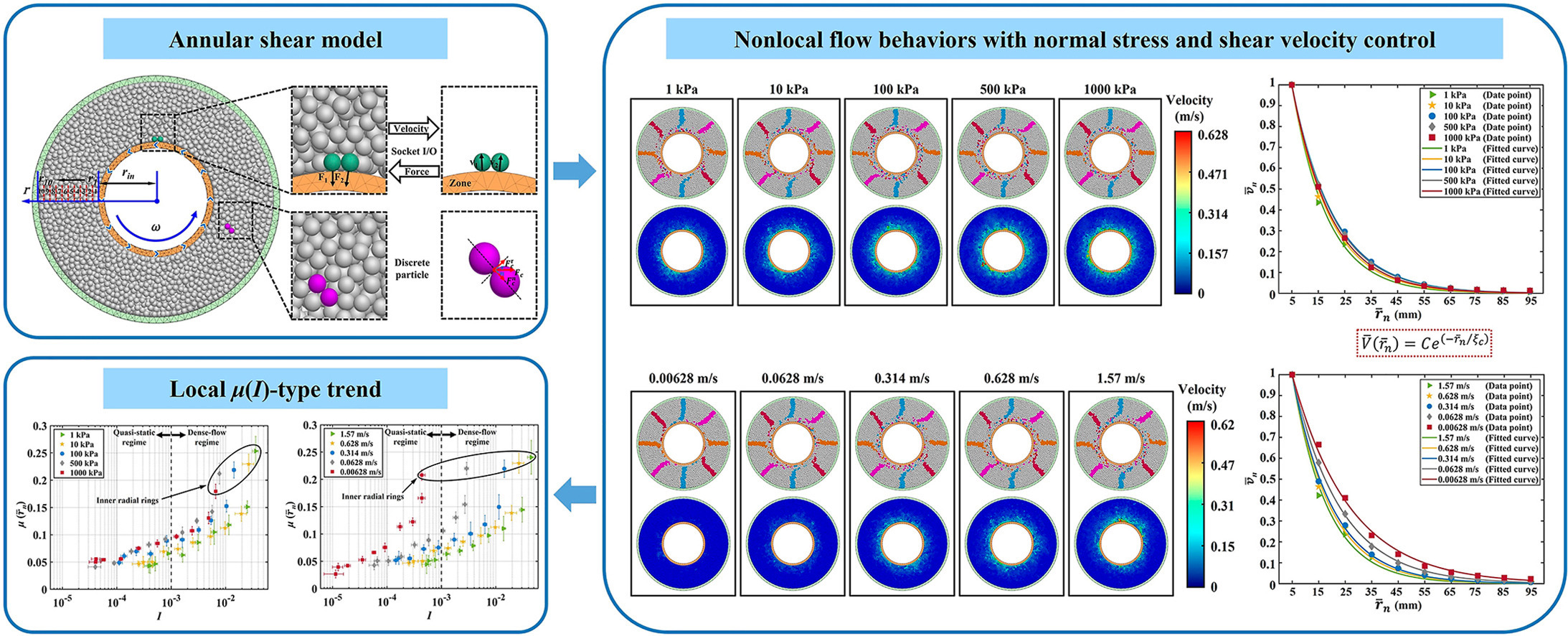
To study the rheological and nonlocal flow behaviors of annular shear granular materials under stress control and shear velocity control conditions, a three-dimensional annular shear numerical model was constructed using the PFC3D–FLAC3D platform, and the flow responses and microstructural evolution were analyzed under different control paths. The results show that increasing normal stress enhances the steady flow while suppressing velocity fluctuations, whereas increasing shear velocity leads to a nonlinear enhancement of flow intensity accompanied by stronger fluctuations. In the outer creep region, the normalized radial velocity profiles obtained under different conditions are well described by the same exponential form, and the characteristic length is insensitive to normal stress, exhibiting only a slight variation within 1.90–2.27 times the mean particle diameter. In contrast, increasing shear velocity decreases this characteristic decay length from 3.08 to 1.91 times the mean particle diameter.This indicates a contracted outer decay scale, reduced radial influence range, and enhanced localization; shear velocity has a stronger impact onthe nonlocal decay length than normal stress. Ring-wise inertial-number analysis indicates that the dense-flow region under both control paths exhibits a comparable frictional rheological trend, whereas the outer low-inertia region is governed by quasi-static creep and nonlocal effects. Together with the calibrated nonlocal characteristic length, these results provide constitutive guidance for continuum modeling of dense-flow and creeping regions in annular shear.
Graphical abstract
Keywords
Granular rheology; Annular shear flow; Inertial number; Contact network; Nonlocal effect
文章导读