
期刊文章
过刊浏览
- Volumes 108-119 (2025)
-
Volumes 96-107 (2025)
-
Volume 107
Pages 1-376 (December 2025)
-
Volume 106
Pages 1-336 (November 2025)
-
Volume 105
Pages 1-356 (October 2025)
-
Volume 104
Pages 1-332 (September 2025)
-
Volume 103
Pages 1-314 (August 2025)
-
Volume 102
Pages 1-276 (July 2025)
-
Volume 101
Pages 1-166 (June 2025)
-
Volume 100
Pages 1-256 (May 2025)
-
Volume 99
Pages 1-242 (April 2025)
-
Volume 98
Pages 1-288 (March 2025)
-
Volume 97
Pages 1-256 (February 2025)
-
Volume 96
Pages 1-340 (January 2025)
-
Volume 107
-
Volumes 84-95 (2024)
-
Volume 95
Pages 1-392 (December 2024)
-
Volume 94
Pages 1-400 (November 2024)
-
Volume 93
Pages 1-376 (October 2024)
-
Volume 92
Pages 1-316 (September 2024)
-
Volume 91
Pages 1-378 (August 2024)
-
Volume 90
Pages 1-580 (July 2024)
-
Volume 89
Pages 1-278 (June 2024)
-
Volume 88
Pages 1-350 (May 2024)
-
Volume 87
Pages 1-338 (April 2024)
-
Volume 86
Pages 1-312 (March 2024)
-
Volume 85
Pages 1-334 (February 2024)
-
Volume 84
Pages 1-308 (January 2024)
-
Volume 95
-
Volumes 72-83 (2023)
-
Volume 83
Pages 1-258 (December 2023)
-
Volume 82
Pages 1-204 (November 2023)
-
Volume 81
Pages 1-188 (October 2023)
-
Volume 80
Pages 1-202 (September 2023)
-
Volume 79
Pages 1-172 (August 2023)
-
Volume 78
Pages 1-146 (July 2023)
-
Volume 77
Pages 1-152 (June 2023)
-
Volume 76
Pages 1-176 (May 2023)
-
Volume 75
Pages 1-228 (April 2023)
-
Volume 74
Pages 1-200 (March 2023)
-
Volume 73
Pages 1-138 (February 2023)
-
Volume 72
Pages 1-144 (January 2023)
-
Volume 83
-
Volumes 60-71 (2022)
-
Volume 71
Pages 1-108 (December 2022)
-
Volume 70
Pages 1-106 (November 2022)
-
Volume 69
Pages 1-122 (October 2022)
-
Volume 68
Pages 1-124 (September 2022)
-
Volume 67
Pages 1-102 (August 2022)
-
Volume 66
Pages 1-112 (July 2022)
-
Volume 65
Pages 1-138 (June 2022)
-
Volume 64
Pages 1-186 (May 2022)
-
Volume 63
Pages 1-124 (April 2022)
-
Volume 62
Pages 1-104 (March 2022)
-
Volume 61
Pages 1-120 (February 2022)
-
Volume 60
Pages 1-124 (January 2022)
-
Volume 71
- Volumes 54-59 (2021)
- Volumes 48-53 (2020)
- Volumes 42-47 (2019)
- Volumes 36-41 (2018)
- Volumes 30-35 (2017)
- Volumes 24-29 (2016)
- Volumes 18-23 (2015)
- Volumes 12-17 (2014)
- Volume 11 (2013)
- Volume 10 (2012)
- Volume 9 (2011)
- Volume 8 (2010)
- Volume 7 (2009)
- Volume 6 (2008)
- Volume 5 (2007)
- Volume 4 (2006)
- Volume 3 (2005)
- Volume 2 (2004)
- Volume 1 (2003)
Volume 115
Liu, S., Yan, J., Jia, S., Yu, K., Yin, H., Chen, S., . . . Gong, J. (2026). Agglomeration-abrasion-oriented strategy for spherical crystallization design: The case of aluminum fluoride. Particuology, 115, 1-14. https://doi.org/10.1016/j.partic.2026.04.025
Agglomeration-abrasion-oriented strategy for spherical crystallization design: The case of aluminum fluoride
Shubo Liu a 1, Jiantao Yan a 1, Shengzhe Jia a, Ke Yu c, Huamin Yin c, Shulin Chen c, Weiwei Tang a b *, Junbo Gong a b *
a School of Chemical Engineering and Technology, State Key Laboratory of Chemical Engineering and Low-Carbon Technology, The Co-Innovation Center of Chemistry and Chemical Engineering of Tianjin, Tianjin University, Tianjin, 300072, China
b Haihe Laboratory of Sustainable Chemical Transformations, Tianjin, 300192, China
c Yunnan Yuntianhua Fluorine Chemical Co., Ltd, Kunming, 650228, China
10.1016/j.partic.2026.04.025
Volume 115,
August 2026,
Pages 1-14
Received 12 February 2026, Revised 16 March 2026, Accepted 20 April 2026, Available online 12 May 2026, Version of Record 20 May 2026.
E-mail:
wwtang@tju.edu.cn; junbo_gong@tju.edu.cn
Highlights
• Microcrystals spontaneously adhere and embed in solution to form dense AFT spheres.
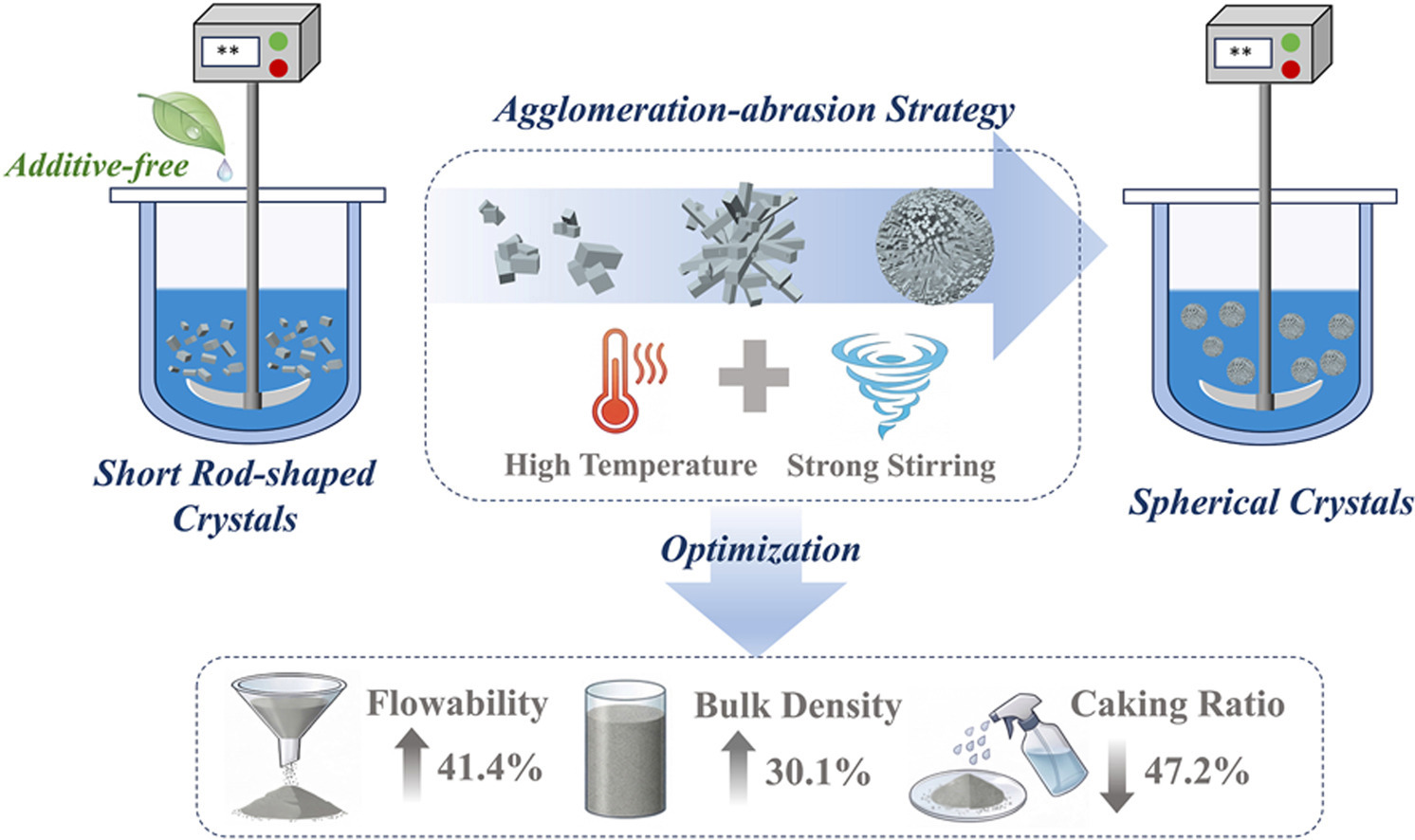
• An additive-free agglomeration-abrasion strategy can be used to prepare AFT spheres.
• RSM quantified multi-factor interactions, yielding AFT spheres of 90.7% circularity.
• Synergy of temperature and stirring drives the AFT spherical crystallization process.
• Optimized spherical AFT exhibits significantly improved powder properties.
Abstract
Aluminum fluoride (AlF3) is an essential industrial material widely used in aluminum electrolysis and ceramics, yet its performance depends critically on the powder properties of its precursor, aluminum fluoride trihydrate (AFT). However, conventional AFT crystals suffer from irregular morphologies, leading to poor flowability, low bulk density, and severe caking. In this study, we successfully prepared highly spherical AFT particles in an additive-free aqueous solution. Through integrated offline and in-situ analyses, we elucidated the AFT spherical agglomeration mechanism dominated by an "agglomeration-abrasion" process. Guided by this mechanism, key process parameters, including temperature, stirring rate, and residence time, were systematically optimized using response surface methodology. Under the optimized conditions, the resulting AFT particles achieved an average circularity of 90.74% and a high yield of 85.7%. Compared to commercial powders, the optimized spherical AFT exhibited maximum improvements of 30.1% in bulk density and 41.4% in flowability, along with significantly enhanced anti-caking properties. The combination of spherical morphology and high yield enhances batch capacity while offering potential for continuous production, providing a green and cost-effective route for the industrial manufacturing of high-quality AFT powders.
Graphical abstract
Keywords
Spherical particles; Aluminum fluoride trihydrate; Response surface methodology; Spherical agglomeration
文章导读